Should City of Alameda voters approve Measure L? (November 3, 2026 ballot)
What's this about?
People disagree about whether Alameda voters should approve Measure L on the November 3, 2026 ballot.
The measure would borrow money for flood safety, roads, public safety, and other city needs.
What supporters say
- Fixing roads before they break may cost less than waiting for bigger repairs.
- Rules for checks and reports could make city leaders more answerable for the borrowed money.
- Long-term loans can pay for useful assets, such as roads, flood walls, and fire stations.
- Alameda faces serious flood risks because it sits low beside the bay.
What critics say
- Property owners would face a long-term tax duty to repay the loan.
- Measure L does not promise which exact projects the city will build.
- Spending more money does not prove that streets will become safer.
- Loan payments could leave less money for other city needs later.
How to read this
The number of points on each side does not show who is right; the strength of each point matters more.
Measure L asks Alameda voters to approve borrowing for projects involving flood protection, public safety, streets, accessibility and environmental infrastructure. The trade-off is clear: the city would gain a dedicated source of capital, but property owners would take on a long-term tax obligation without a firm promise about which projects will be built.
The case for
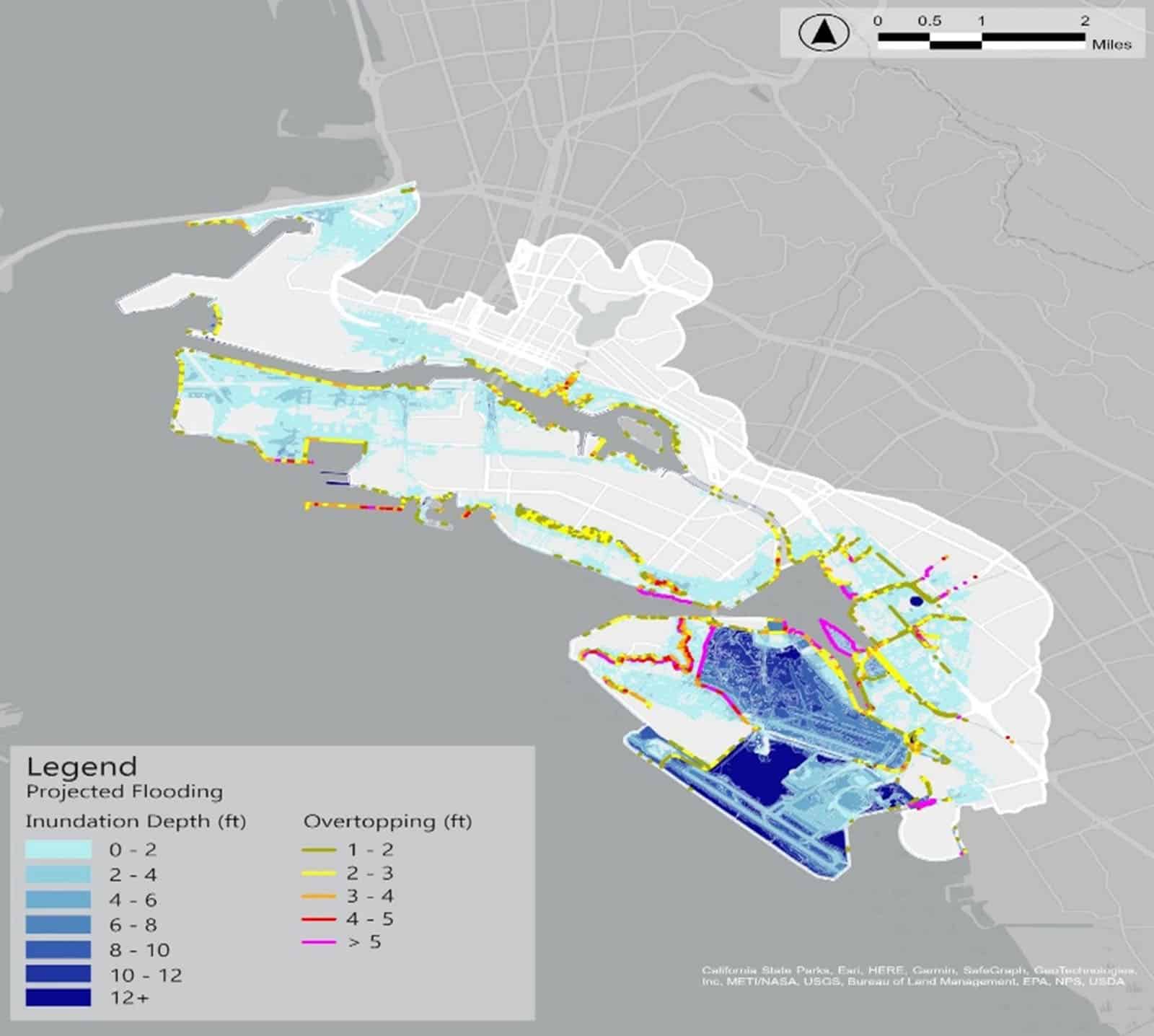
Alameda faces serious infrastructure risks. The city is a low-lying island community exposed to shoreline flooding and sea-level rise. Regional and federal planning documents identify adaptation as a major challenge across the Bay Area, and NOAA maps show how flooding could affect Alameda and other nearby low-lying areas (see Figure 1). A local Oakland-Alameda assessment also places adaptation decisions in the context of identified flood exposure, rather than a purely hypothetical threat (see Figure 2). 1
Measure L’s permitted uses are connected to those risks. They include levees and seawalls, stormwater drainage, fire-station and emergency improvements, streets, sidewalks, traffic signals and pollution controls. That does not show that every possible project would be worthwhile, but it gives the measure a plausible preventive purpose: investing before infrastructure fails could reduce disruption and protect essential services.
Bond financing can fit long-lived public assets. General-obligation bonds spread repayment over many years, allowing residents who benefit from infrastructure to share its cost over time rather than forcing the city to pay the full amount from one year’s operating budget. 2 The argument is strongest for maintenance that becomes more expensive when delayed. Research has found that preventive road treatments can reduce long-term costs, and Alameda says resurfacing can lower future maintenance needs. But those findings do not prove that every project or treatment selected under Measure L would produce savings. 3
The measure also includes an oversight committee and reporting requirements. Audits and other procedures are intended to check whether bond money is spent for authorized purposes. These safeguards could improve transparency and reduce the risk of plainly improper spending, even though they cannot guarantee that projects are well chosen, completed on time or delivered within budget. 4
The case against
Measure L does not make binding project-by-project promises. Its materials describe broad categories and examples, but they do not establish a fixed allocation, completion schedule, quantified benefit target or guarantee that every named example will be built. Oversight can show where money went after decisions are made; it cannot replace a detailed demonstration beforehand that the portfolio will deliver enough resilience, safety or service improvements. 5
The measure would also create a continuing tax obligation for taxable property. The official estimate is an average annual levy of $49 for every $100,000 of assessed value while the bonds remain outstanding. The actual burden would depend on a property’s assessed value and the final borrowing schedule, and the figure does not by itself show the total repayment, including interest. 6 Property owners would pay directly, while renters might receive citywide benefits indirectly and could face some costs if landlords pass the levy through in rents.
More spending also does not automatically mean safer streets. Research on the relationship between road spending and safety outcomes is inconclusive. Streets, signals and intersection projects could help, but the available evidence does not establish Alameda-specific safety gains without defined designs, targets and follow-up evaluations. 7
Borrowing could impose broader trade-offs by limiting future budgets or crowding out other priorities. Evidence from another local-government setting raises that possibility, but the setting differs from California municipal bonds, making it a warning rather than a forecast for Alameda. 8
- City Attorney’s Impartial Analysis of Bond Measure L acvote.alamedacountyca.gov
- Detailed Project List — SAFER Alameda Act alamedaca.gov
- Infrastructure Funding lao.ca.gov
- City Attorney’s Impartial Analysis of Bond Measure L acvote.alamedacountyca.gov
- Bond Accountability and Oversight Activities dof.ca.gov
- Frequently Asked Questions About the Infrastructure Bond alamedaca.gov
- City Attorney’s Impartial Analysis of Bond Measure L acvote.alamedacountyca.gov
- Detailed Project List — SAFER Alameda Act alamedaca.gov
- City Attorney’s Impartial Analysis of Bond Measure L acvote.alamedacountyca.gov
- Infrastructure Funding lao.ca.gov
- Detailed Project List — SAFER Alameda Act alamedaca.gov
- Road safety and road infrastructure expenditure: A bivariate analysis sciencedirect.com
- Infrastructure Funding lao.ca.gov
- The Crowding Out Effect of Local Government Debt: Micro- and Macro-Economic Evidence economics.columbian.gwu.edu
Figures & data