Should Berkeley voters approve Measure Y? (November 3, 2026 ballot)
What's this about?
People disagree about whether Berkeley voters should approve Measure Y on November 3, 2026.
The measure would add a 12-year tax on property to support local arts.
What supporters say
- Community arts may help people feel connected and support their health and well-being.
- A steady arts fund could help local arts groups keep workers, shows, and places open.
- Arts events may bring visitors who spend money at nearby shops, cafes, and other local firms.
What critics say
- Fixed rules for grant money may stop city leaders from changing plans or checking results well.
- Owners may pass the tax to renters and others who use homes, shops, or other property.
- Money guesses may count all arts spending, not the true gain after new tax costs.
- Public money might replace some gifts that arts groups already get from private donors.
How to read this
The number of points on each side does not show which side is right; strong proof matters more.
Measure Y would impose a 12-year property-improvement tax dedicated to Berkeley’s arts sector. Voters must weigh its promise of stable cultural funding against uncertain economic returns, possible costs for renters and property users, and limits on oversight.
The case for
The strongest argument is straightforward: Measure Y would create a predictable source of arts funding. The official analysis estimates $6.3 million in revenue during the first year and $84.8 million over 12 years. The measure would direct 75% to performing-arts organizations, 5% to artists and arts organizations, 10% to capital projects, 5% to festivals and 5% to administration. That stability could help organizations retain staff, maintain programs and keep venues operating.1
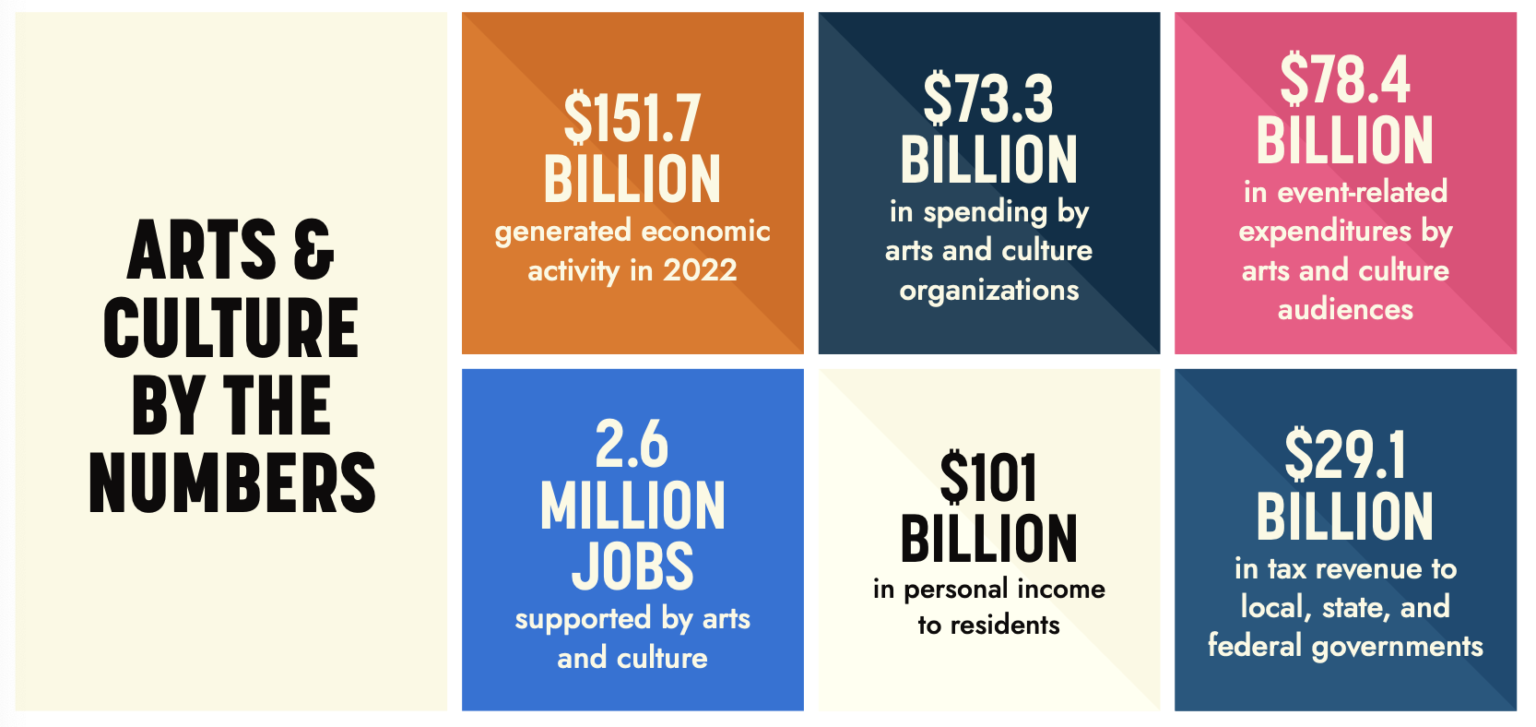
The measure also has a plausible economic rationale. A city-commissioned study of 37 Berkeley arts and cultural nonprofits estimated about $56 million a year in additional local spending by visitors. National research covering 373 regions likewise found that arts organizations are linked to employment and audience spending. These figures suggest that arts activity can support nearby businesses and the broader local economy (see Figure 2). But they show activity associated with the arts, not the net economic effect that Measure Y itself would create.2
Supporters also point to social and health benefits that do not appear in ticket sales. Reviews of community arts programs have linked participation with social connection, health and well-being, while another review found possible long-term benefits from group-based arts and creative activities. Measure Y’s funding for festivals, individual artists and arts organizations could make participation broader than support aimed only at major institutions. Still, the research does not show exactly who would benefit or whether the measure would reach residents equally.3
The case against
The main concerns involve who pays, whether the benefits are genuinely additional, and how well the program could be held accountable. Because the tax is based on property improvements, owners may pass some of the cost to renters or other property users. A California study using a Berkeley setting found that landlords passed through roughly 50 to 89 cents of each dollar of a property-tax increase. That makes renter pass-through a credible concern, although the study involved a different tax and does not directly estimate Measure Y’s effects.4
The economic estimates may also present gross activity rather than true net benefit. Neither the Berkeley study nor the national research shows that Measure Y’s benefits would exceed its tax burden. They do not fully account for spending that would have occurred elsewhere in the local economy, or for arts activity that already exists. Research on nonprofit subsidies has found both “crowding in” and “crowding out”: public money can attract new support, but it can also replace some private giving. The measure’s $84.8 million in projected revenue therefore cannot automatically be treated as an $84.8 million increase in arts resources.5
The measure’s fixed rules create a governance risk. Its allocation percentages could not easily be changed, even if conditions shifted. The Civic Arts Commission would review applications and the City Council would review awards and regulations, but the measure does not require clear targets for attendance, affordability, geographic reach or independent performance audits. Five percent is reserved for administration, yet it is not clear whether that would be enough for strong oversight.7
The measure does include exemptions for certain low-income, affordable-housing, religious, educational and transitional-housing properties. It also requires community benefits from performing-arts applicants seeking more than $100,000. But 75% of the money would go to organizations with at least three consecutive years of live performances in Berkeley. That could protect established institutions while making it harder for newer or less formal groups to qualify.
- City Attorney's impartial analysis of Measure Y acvote.alamedacountyca.gov
- Berkeley arts groups will get $6M a year if voters approve new parcel tax berkeleyside.org
- Berkeley Creative Economy Economic Impact Analysis berkeleyca.gov
- Arts & Economic Prosperity 6 study findings aep6.americansforthearts.org
- The Economic & Social Impact Study of Nonprofit Arts & Culture Industry aep6.americansforthearts.org
- City Attorney's impartial analysis of Measure Y acvote.alamedacountyca.gov
- Relationships between arts participation, social cohesion, and well-being: an integrative review of evidence pmc.ncbi.nlm.nih.gov
- Examining arts and creativity in later life and its impact on older people's health and wellbeing: a systematic review doi.org
- City Attorney's impartial analysis of Measure Y acvote.alamedacountyca.gov
- Property tax pass-through to renters: a quasi-experimental approach philadelphiafed.org
- Berkeley Creative Economy Economic Impact Analysis berkeleyca.gov
- Arts & Economic Prosperity 6 study findings aep6.americansforthearts.org
- The Economic & Social Impact Study of Nonprofit Arts & Culture Industry aep6.americansforthearts.org
- City Attorney's impartial analysis of Measure Y acvote.alamedacountyca.gov
- Resources on program evaluation and performance measurement arts.gov
Figures & data