Rising campaign costs undermine political equality
Bottom line (updated 2026-10-27): The evidence strongly supports the worry that high costs can make politics less fair. Still, money does not decide every election by itself, and we need more proof about online giving.
What's this about?
People disagree about whether rising campaign costs make politics less fair.
The key question: does money decide who can run and who gets heard?
What supporters say
- Money can help decide which candidates seem able to win before voters learn much about them.
- Wealthy candidates can use their own money, giving them an early edge over people with less wealth.
- Challengers need lots of money to overcome famous rivals, strong teams, and old donor ties.
- When a few rich donors give most of the money, they may keep more sway over public choices.
What critics say
- Extra money may help less after a campaign already spends enough.
- Strong candidates may raise more money because people expect them to win.
- Online tools may let more people give small gifts, but we are not sure how much this helps.
How to read this
The number of points on each side does not show who is right; check how strong the proof is behind each point.
The bottom line
The evidence strongly supports the worry that high costs can make politics less fair.
Still, money does not decide every election by itself, and we need more proof about online giving.
Rising campaign costs can weaken political equality when money determines which candidates are able to compete in the first place. The evidence strongly supports that concern, though it does not show that spending mechanically decides every election.
The case for
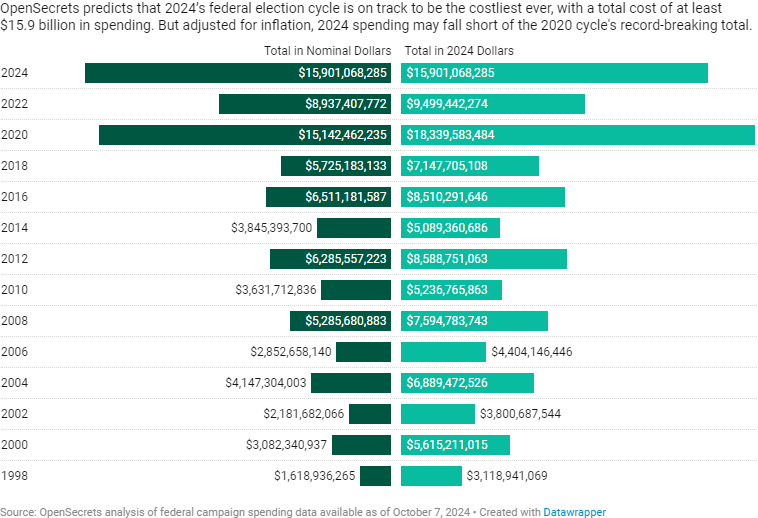
Money helps determine which candidates become viable before voters can fully assess them. Studies of congressional elections link contributions and spending to a greater chance of winning, while research on competition treats fundraising as part of establishing a credible campaign. Early financial support can attract more donors, improve visibility and build an organization, creating a cycle in which candidates with initial access gain further advantages. Federal data show the large and growing scale of election spending (see Figure 1). 1
Personal wealth creates a particularly clear advantage. Candidates who can use their own money do not have to rely as heavily on broad grassroots fundraising. Studies of more than 5,000 nonincumbent U.S. House candidates find that wealth helps people seeking office. Other research links the wealth of candidates and donors to early large contributions, stronger fundraising and better electoral prospects. Rising financial demands can therefore favor affluent candidates even before they have demonstrated broad public support. 2
The burden is often greatest for challengers. They must overcome incumbents’ name recognition, organizations and established donor networks. Research, including field experiments, finds that challenger spending can affect vote totals, while incumbent spending may have little effect on vote margins. This suggests that high costs can protect incumbents and candidates backed by established institutions unless challengers can raise enough money to reach a basic level of competitiveness. 3
There is also evidence of unequal access to financial networks across gender and ethnoracial groups. Research on small-donor matching systems suggests that public financing could reduce some of the disadvantages faced by women and candidates of color who lack access to large donors. The evidence for broad group-based effects is less firm than the evidence on wealth and viability, but it is consistent with conventional fundraising favoring candidates connected to affluent networks. 4
The concern may continue after election day. Researchers disagree about how large or direct the effects are, but studies of contributions and lobbying raise the possibility that affluent constituents and donors receive greater policy responsiveness. If donor access affects government decisions, unequal fundraising would mean unequal political influence, not merely unequal campaign visibility. 5
The case against
The main challenge is cause and effect. Strong candidates, party-backed candidates and contenders in competitive districts may attract money because they are already likely to succeed. A link between spending and winning does not by itself prove that high costs shut out otherwise viable candidates. The available research does not reduce the relationship to candidate strength alone, but it does limit how broadly the claim should be applied. 6
Spending also has diminishing returns. Once voters know an incumbent, additional advertising and outreach may produce little extra benefit. Evidence from House elections finds smaller effects for incumbent spending, and field research reports that incumbent spending can have negligible effects on vote margins. This weakens the strongest version of the argument—that every increase in campaign costs produces a matching increase in electoral inequality. 7
Digital fundraising offers another partial counterweight. National small-donor networks can allow candidates to reach contributors beyond wealthy local donors and traditional political institutions. That route does not erase financial inequality, but it can broaden access to resources. 8
Campaign-finance rules can also change the competitive landscape. Studies of spending limits and public financing have found more candidate entry, greater small-donor participation and improved opportunities for some challengers. But these results depend on the program, its enforcement, voter participation and the electoral system. They do not establish a universal solution, and contribution limits can also reduce the resources available to all candidates.
The bottom line
The evidence favors the claim with high confidence. Its strongest support concerns candidate entry and competitive viability: money affects visibility, early fundraising, personal-wealth advantages and challengers’ ability to overcome incumbents. These are important equality concerns because candidates who cannot raise enough may be screened out before voters can judge them.
The conclusion is narrower than saying spending determines elections. Candidate strength partly drives fundraising, additional spending often has limited value for incumbents, and digital networks can open alternative paths to donors. Evidence is weaker on broad demographic effects and remains contested on whether donor inequality systematically produces unequal policy outcomes. The central uncertainty is how much of the spending advantage is causal—especially whether unequal fundraising leads to unequal representation after elections—not whether financial resources matter at the candidate-viability stage.
Pros — Supporting Arguments
Figures & data
All contributions are reviewed for clarity, balance, and evidence. The strongest insights are elevated into the argument graph — with credit to you.
Help improve this analysis →