Restricting birthright citizenship undermines the principle of equal U.S. citizenship
Bottom line (updated 2026-10-19): The evidence leans toward the claim: limits could weaken equal membership and put some children in legal danger. Critics raise real concerns, but their proof is weaker, and the top court’s view supports birth-based citizenship.
What's this about?
People disagree about whether children born in the United States should get citizenship (full legal membership).
The key question is whether birth place or parent status should decide this right.
What supporters say
- Limits could leave some children without clear papers, rights, or any other country to call home.
- The Fourteenth Amendment aimed to give equal membership, not split people by race, family roots, or rank.
- Secure citizenship may help children join and take part in the country where they grow up.
- The top court has said birth in the United States usually matters more than a parent’s race or country.
What critics say
- Critics say this rule may draw more people who travel here to give birth, or move here to have children.
- They say equal citizenship could still exist if the law checked a child’s parents before giving citizenship.
- Some studies show that citizenship helps children join society, but the gains seem small.
How to read this
The number of points on each side does not show who is right; stronger proof matters more than a longer list.
The bottom line
The evidence leans toward the claim: limits could weaken equal membership and put some children in legal danger.
Critics raise real concerns, but their proof is weaker, and the top court’s view supports birth-based citizenship.
The claim is that limiting citizenship for some children born in the United States would weaken the idea that all U.S. citizens should have equal standing. The debate turns on whether citizenship should depend mainly on where a child is born—or on the immigration status and nationality of the child’s parents.
The case for
The strongest argument rests on the Constitution’s history and its current legal interpretation. The Fourteenth Amendment created a broad citizenship rule that rejected older systems based on race, ancestry and inherited status. Its basic idea was that people born in the United States should generally belong to the national community on equal terms 1.
The Supreme Court reinforced that understanding in *United States v. Wong Kim Ark*. The court held that a person born in the United States to foreign parents who lived and worked there was a citizen under the Fourteenth Amendment. The ruling treated birth on U.S. soil—not race or parental nationality—as the ordinary basis for citizenship, subject to narrow exceptions 4. A policy denying citizenship to children of undocumented or temporarily present parents would therefore introduce a parental-status distinction into a system built around common territorial membership.
The practical concern is greatest when a child has no reliable alternative nationality. Research on childhood statelessness shows that conflicting nationality laws, unknown parentage and difficulties registering births can leave children without secure legal identities. The United Nations refugee agency describes birth registration as a basic safeguard against those gaps. Without a dependable second nationality, restricting U.S. citizenship could make a child’s rights depend on parental paperwork or government administration rather than the child’s own birth 2.
Secure citizenship may also help children take part in the society where they live. Comparative research, including work from Germany, suggests that citizenship can improve participation and developmental outcomes. Those gains appear modest, and there is no direct U.S. estimate, but the findings support a plausible argument: stable legal status can reduce the chance that children born in a country are treated as permanent outsiders 3.
The case against
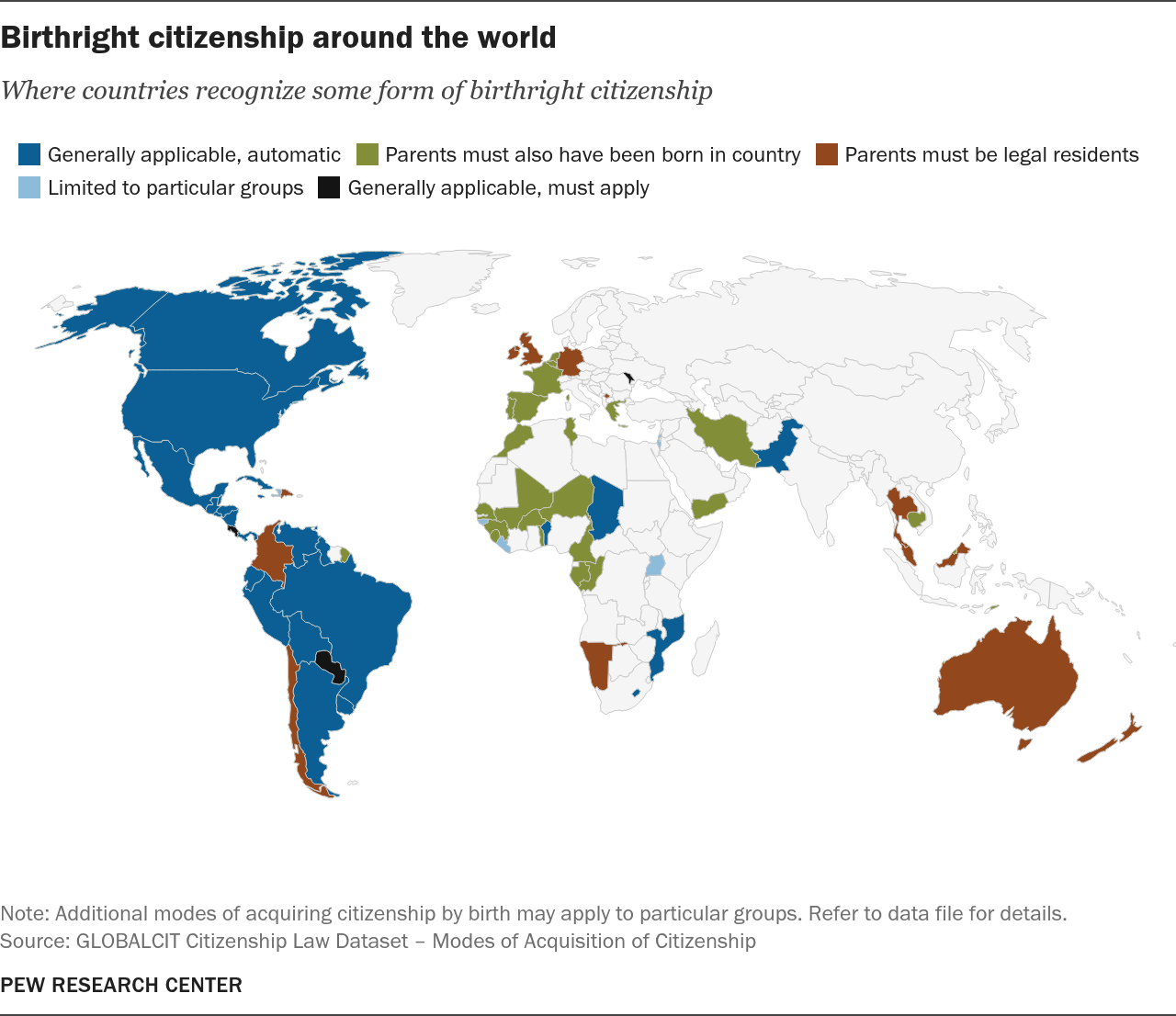
Opponents argue that equal citizenship does not necessarily require unrestricted birthright citizenship. A country could apply the same rule to everyone—such as requiring a parent’s nationality, lawful residence or a citizenship application—without necessarily violating the broader principle of equal treatment 5. Pew’s comparative review found that only a minority of countries use rules substantially like the U.S. system, while many condition citizenship on parental nationality, residence or an application process (see Figure 1).
Critics also point to migration incentives, especially “birth tourism,” in which people travel to the United States so their children can acquire citizenship. A Senate report identifies the practice as a policy concern and examines its legal basis 6. But the available material does not establish how widespread birth tourism is or how much it affects overall migration. The report’s focus on enforcement may also place greater emphasis on those concerns than on possible benefits of the current system.
The evidence on integration limits the expected size of the harm from changing the rules. A Cato review describes the assimilation gains linked to birthright citizenship as slight or modest 7. That finding weakens any claim that restricting citizenship would necessarily cause large integration or economic losses. Still, modest average gains do not resolve the separate risk that a smaller group of children could face severe legal insecurity if they have no other nationality.
The bottom line
The evidence moderately favors the claim that restricting birthright citizenship would undermine equal U.S. citizenship. The legal and historical case is better documented than the evidence about migration, integration or economic effects. The Constitution’s text and history, along with the prevailing Supreme Court interpretation, support territorial birth as the normal basis of citizenship and reject distinctions based on parental status.
The main uncertainty concerns the size of the policy’s practical effects, not whether competing concerns exist. Studies of integration come largely from Germany, international comparisons show what other countries do rather than what the U.S. Constitution permits, and the birth-tourism evidence does not establish the practice’s scale. A narrow policy aimed at particular practices would raise a different equality question from a broad rule denying citizenship to children because a parent is undocumented or temporarily present.
On the current record, however, the stronger evidence indicates that broad restrictions are more likely to weaken equal membership than to preserve it.
Figures & data
All contributions are reviewed for clarity, balance, and evidence. The strongest insights are elevated into the argument graph — with credit to you.
Help improve this analysis →