Qwen3-Coder-30B-A3B-Instruct is coding-focused but broadly usable
What's this about?
People disagree about whether Qwen3-Coder-30B-A3B-Instruct mainly helps with code but also handles many other tasks. Its makers built it for following requests, with a strong focus on programming.
What supporters say
- Its makers call it a code-focused model and show it helping with tools, apps, and large code projects.
- They released it as a special “Coder” model, not as the normal Qwen3 helper model.
- Most public tests and demos show software work, such as fixing real problems from GitHub.
- The wider Qwen Coder group also keeps focusing on tool use, coding agents, and software jobs.
What critics say
- Public facts do not show what part of its learning data came from code.
- Coding tests can show skill at software work, but they cannot prove skill at writing, schoolwork, or daily chat.
- We do not know if it matches the best all-purpose helpers on every kind of task.
- News about newer Coder models gives useful background, but it does not directly test this exact model.
The bottom line
The evidence strongly shows that this model puts coding first. It can likely help with many requests, but we cannot yet say it performs like top general helpers in every area.
Qwen3-Coder-30B-A3B-Instruct is best understood as a general instruction-following model built with a strong emphasis on programming. Public documentation supports that description, though it does not prove the model matches leading general-purpose assistants on every kind of task.
The case for
The evidence that Qwen3-Coder-30B-A3B-Instruct is coding-focused is direct and substantial. Its maker describes it as a code-oriented instruction model, while the official project materials highlight coding agents, understanding large software repositories, using tools, and handling software-development workflows. It was released as a separate “Coder” checkpoint rather than as the standard Qwen3 instruction model, reinforcing the view that programming was a central design priority. 1
Its public demonstrations and comparisons also revolve around software work, not a broad mix of everyday assistant tasks. That does not reveal exactly what share of its training data involved code, but it does show where the product’s developers placed their emphasis. The fairest reading of “more concentrated on programming” is therefore a qualitative description of its documented purpose, not a precise claim about training-data proportions. 3
The evaluation record points in the same direction. Software-engineering tests receive unusual attention, especially SWE-bench, which measures whether a model can resolve real GitHub issues. That is a demanding test of practical coding ability, but it is still specifically about software engineering rather than general knowledge or writing. Public discussion of reproducing results for this exact checkpoint on SWE-bench suggests that performance on such coding tasks was a serious focus. 2
Later reporting on the Qwen3-Coder-Next line is not a direct assessment of this model, but it adds context. It shows the wider Coder family continuing to stress coding trajectories, tools, agent-style programming, and software-engineering work. Taken together, the product positioning and testing make the coding-first label well supported.
The case against
A coding focus does not mean the model is limited to code or unable to follow ordinary instructions. The broader Qwen3 technical report describes instruction tuning, reasoning, and general-language testing across the model family. That is indirect evidence for this particular Coder checkpoint, but it supports the possibility that it retains the capabilities people expect from a general assistant.
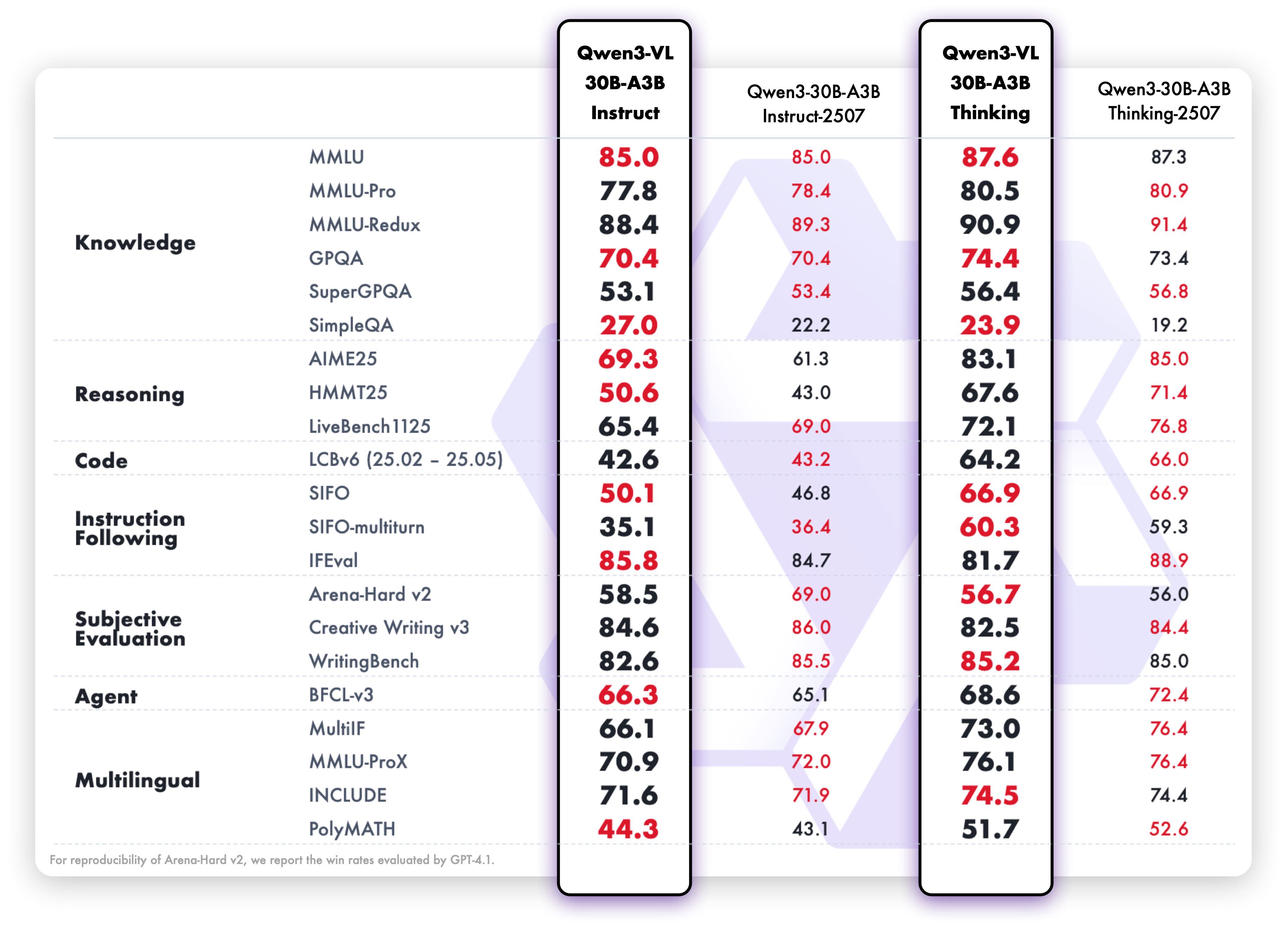
An independent comparative profile also reports both coding and broader capability measures for the exact model. That evidence is consistent with seeing Qwen3-Coder-30B-A3B-Instruct as a general-purpose system with a specialization, rather than a code-only tool (see Figure 2). 4
Cross-benchmark summaries offer further, if limited, support. Benchmark Atlas places coding results next to general-language indicators, suggesting the model has abilities that extend beyond programming (see Figure 1). Provider and leaderboard aggregations likewise may show it being used for both code generation and more general text tasks. 5
But these sources have important limits. Benchmark results can shift depending on the version of a test, the prompts used, the tools available, sampling settings, and the evaluation setup. Strong results on SWE-bench or other coding tests do not establish an overall ranking against broad-assistant models, and general benchmark summaries do not prove reliable performance on every non-code task.
There is also no transparent, independently audited account of the training mix or post-training examples for this exact checkpoint. Nor is there a controlled, checkpoint-specific comparison across the full range of general assistant tasks against leading general-purpose models. Family-level studies and third-party benchmark profiles provide useful context, but cannot settle that question.
The bottom line
The claim is supported with high confidence, provided its terms are read carefully. Qwen3-Coder-30B-A3B-Instruct is clearly coding-focused in its public positioning, intended uses, examples, and evaluation priorities.
At the same time, the available evidence supports a qualified conclusion that it remains broadly usable for general instruction following. What the evidence does not show is that it is universally reliable outside programming, or that it equals a top general-purpose assistant across every task.
Figures & data
All contributions are reviewed for clarity, balance, and evidence. The strongest insights are elevated into the argument graph — with credit to you.
Help improve this analysis →