Professional athletes should use sporting events as venues for political protest
Bottom line (updated 2026-11-08): Athletes should be allowed to protest, but no athlete must protest. Protests can raise awareness, yet we are not sure they often change laws or public rules.
What's this about?
People disagree about whether pro athletes should use games for political protest (public action about laws and power).
The key question is whether they should be free to speak, not forced to speak.
What supporters say
- Athletes are people with rights, and public rules can affect their lives and work.
- Athletes can join their sport with wider groups that fight for fair treatment.
- Games bring huge crowds, so protests can make unfair acts hard to ignore.
What critics say
- Teams must keep games safe and fair, so some protests may break those duties.
- Protests can split fans, and angry fans may stop hearing the main point.
- Protest may cost athletes money, jobs, team support, or future work.
How to read this
The number of points on each side does not show who is right; the proof behind each point matters more.
The bottom line
Athletes should be allowed to protest, but no athlete must protest.
Protests can raise awareness, yet we are not sure they often change laws or public rules.
Professional athletes should be allowed to use sporting events for political protest, but the evidence does not show that they must do so or that protest reliably produces policy change. The strongest case concerns athletes’ right to speak and sport’s ability to bring public attention to social issues; the main limits involve persuasion, safety and institutional responsibilities.
The case for
Sporting events give athletes an unusually large and concentrated audience. Uniforms, gestures, speeches and coordinated performances can bring criticism of racism, discrimination or human-rights abuses into mainstream attention. The 1968 Olympic protests, for example, helped make civil-rights demands visible around the world. Media coverage can carry a message far beyond the stadium, although these effects are uneven rather than automatic. 1
The strongest argument is that athletes are citizens as well as performers. Public policy, discrimination and human-rights conditions affect their lives and working conditions, so treating sport as completely apolitical can prevent them from challenging systems that affect them and their communities. A survey of 407 professional athletes found that 94% supported athletes’ right to engage in activism, suggesting broad support among athletes themselves for recognizing protest as legitimate. 2
Athlete protest can also connect sporting institutions to wider social movements. The 1968 Olympic demonstrations linked sport to the civil-rights movement, while Colin Kaepernick’s protest spread across professional and college sports. In these cases, athletes’ actions were not only individual statements but also acts of solidarity that helped larger campaigns gain attention. 3
The case against
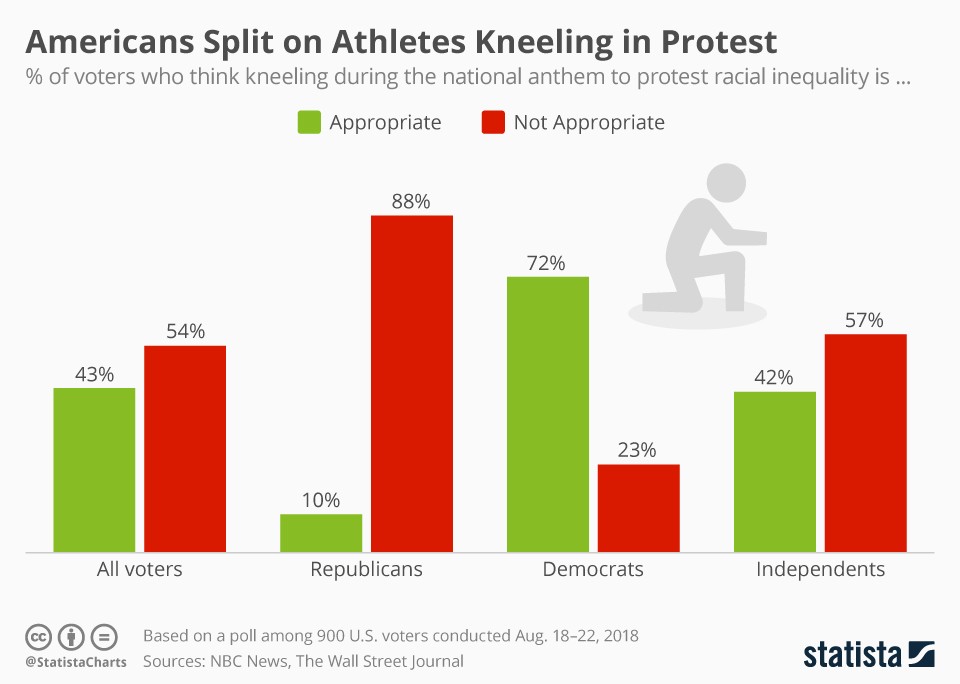
The same visibility that makes protest powerful can also make it divisive. Research shows that reactions depend on political identity, perceptions of the athlete’s motives and fans’ attachment to teams or brands. Some audiences respond positively, while others react negatively. Protest may energize committed supporters without persuading people outside that group (see Figure 1; see Figure 2). 4
There can also be financial and career costs. In some cases, local political divisions have been linked to changes in attendance or consumer interest after an athlete’s protest. But studies of sponsors and fans have found inconsistent results rather than a single, predictable economic penalty. The risks may fall not only on athletes but also on teammates, clubs, sponsors and leagues, especially in politically divided markets. 5
Sporting organizations have their own responsibilities. Competitions are presented as shared spaces governed by common rules, and organizers must consider safety, scheduling, security, diplomacy and equal treatment. Olympic Rule 50, which restricts some forms of athlete activism, reflects those concerns. Political disputes can also alienate athletes and participating nations, while protests may create operational and security problems. These concerns do not automatically justify suppressing political speech, but they support clear, viewpoint-neutral rules dealing with safety, non-discrimination and event administration. 6
The bottom line
The evidence favours protecting athletes’ voluntary right to protest at sporting events, and it does so strongly on the narrower questions of political agency, moral legitimacy and public visibility. Sport can help place neglected issues before large audiences and connect athletes with broader movements.
The case is weaker on whether protest persuades opponents, avoids economic harm or produces lasting changes in law and institutional policy. Reactions vary with the issue, timing, audience, media coverage and the athlete’s connection to sustained organizing. A visible gesture can become a durable campaign, but it can also remain a contested symbolic moment or trigger backlash.
The best-supported position is therefore conditional, not universal. Athletes should not be required to become activists, and protest should not be treated as a complete strategy for policy change. At the same time, institutional neutrality should not be used as a blanket reason to silence athletes. The evidence is substantial that sport offers a meaningful political platform; it is less certain about what that platform ultimately achieves.
Figures & data
All contributions are reviewed for clarity, balance, and evidence. The strongest insights are elevated into the argument graph — with credit to you.
Help improve this analysis →