Reparations for slavery are justified and feasible
What's this about?
People disagree about whether reparations, meaning money or help, should repair harm from slavery and unfair laws.
The main question asks if a plan could work across the whole country.
What supporters say
- Government acts helped cause the harm, so public groups may owe help today.
- Big gaps in family wealth still affect Black families, schools, and chances to build wealth.
- A plan could start small and target people or places hurt most, making it easier to run.
- Past plans show that governments can find groups, check claims, and give payments.
What critics say
- The total cost could change a lot because leaders still lack key facts.
- Leaders might struggle to decide who should get help and how much harm came from slavery.
- Past plans helped smaller groups or shorter harms, so they may not guide a slavery plan well.
How to read this
The number of points on each side does not show who is right; stronger proof matters more than a longer list.
The bottom line
The moral case for reparations looks strong, and some forms could work.
But we are not sure yet whether a nationwide plan could fit the law, cost enough, and last through politics.
Reparations for slavery and related state-enforced discrimination have a strong moral rationale, but their practical delivery remains unsettled. The evidence supports the idea in principle more clearly than it proves that a nationwide program could be affordable, lawful and politically durable.
The case for
The strongest argument is that public institutions can carry responsibility for harms created or maintained by government action, even when the original perpetrators are no longer alive. California’s task force documented government involvement in enslavement, racial terror, segregation, exclusion and discrimination after emancipation. Philosophical research similarly argues that continuing institutions, along with advantages passed down through them, can create obligations to repair past damage. 1 This does not settle who should qualify or what form payment should take, but it provides a coherent basis for treating reparations as a public responsibility rather than a claim against individuals from the past.
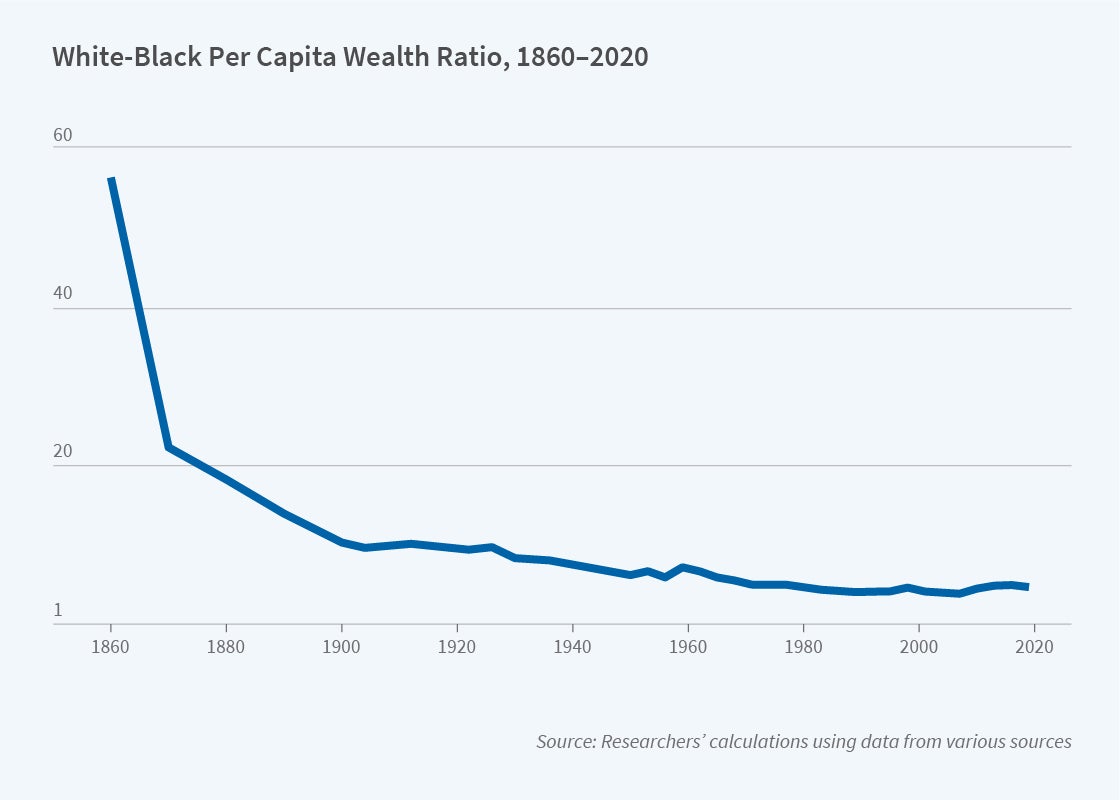
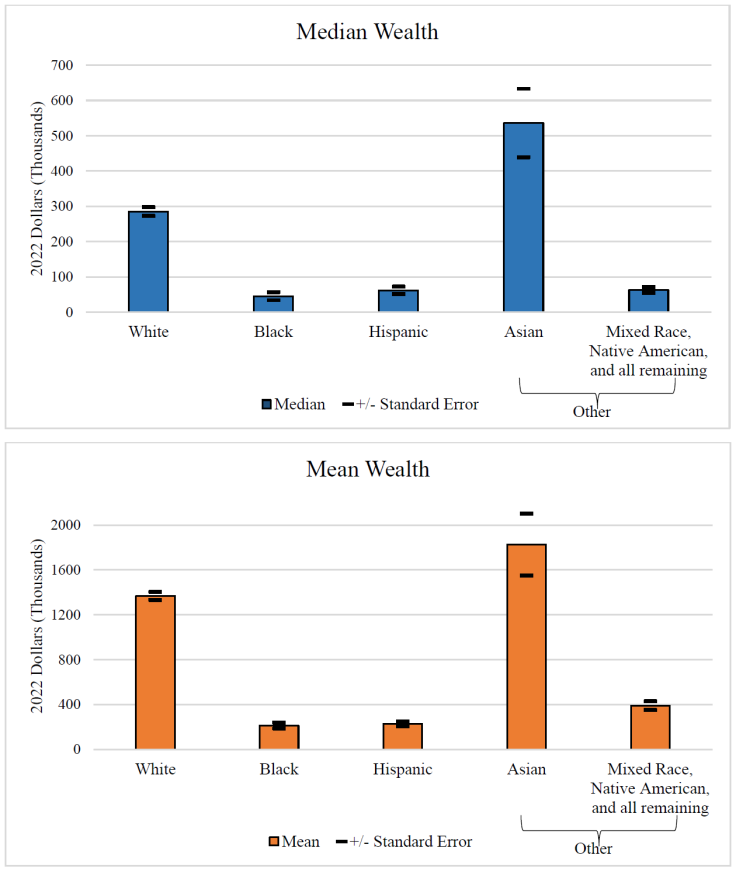
The present-day effects also strengthen the case. Federal Reserve data show lasting racial differences in household wealth, while research links inherited family resources to college access and financial-aid outcomes. Analysts connect these disparities to slavery, segregation, discriminatory policies and unequal opportunities to build assets. The evidence shows continuing disadvantage, even though it cannot identify slavery’s exact share of today’s gap or prove that reparations alone would close it (see Figure 2). 2
There is also evidence that governments can administer some forms of historical redress. The Civil Liberties Act provided apologies and payments to eligible Japanese Americans incarcerated during the Second World War. Germany has delivered compensation through several agreements and programs over decades. These examples show that governments can identify groups, process claims and distribute compensation. 3
A practical program might be more credible if it used targeted or phased measures rather than one universal lump-sum payment. Proposals include housing assistance, debt relief, education support and “baby bonds” to build assets. Targeting could connect benefits to documented forms of disadvantage and reduce the administrative burden of doing everything at once. 4
The case against
The main difficulty is that a national program would require choices that remain unresolved. There is no agreed method for valuing unpaid labor, later discrimination, lost assets and effects that compound across generations. California’s report shows that different definitions and formulas can produce very large costs, but it does not establish a price that could simply be applied nationwide. 5
Eligibility would also be difficult. Policymakers would have to decide what connection to slavery or later state discrimination is sufficient: ancestry, documented injury, residence, or some combination. Legal analysis points to disputes over proof of descent, causation, congressional authority, equal-protection rules and time limits for claims. These are serious obstacles, though they do not prove that every possible design would be unlawful. 6
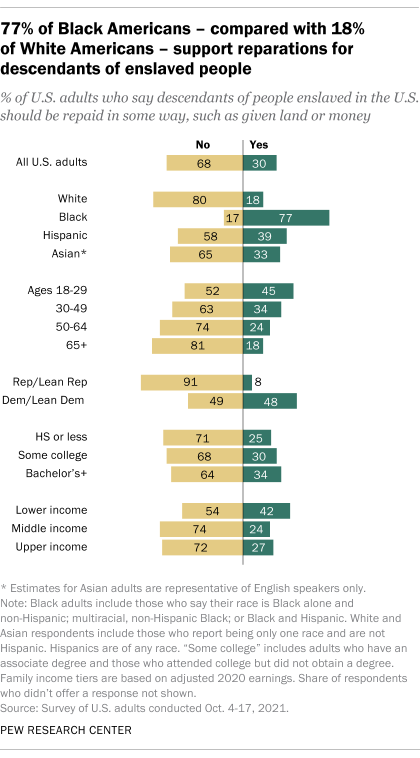
Historical examples offer only limited guidance. The Japanese American program involved a relatively defined group of victims and more recent records. German compensation programs used changing agreements and narrower categories. Reparations for slavery would involve a much larger population, a far longer chain of causes and more disputed boundaries. 7 Public support is similarly sensitive to how reparations are designed and to beliefs about historical responsibility. Research suggests that awareness of Japanese American redress can affect views of Black reparations, but these findings measure attitudes, not whether a national program could be enacted or sustained (see Figure 4).
The bottom line
The evidence favours the claim overall, but only conditionally and with moderate confidence. The moral case is well supported: government responsibility and persistent racial wealth inequality provide substantial reasons to consider reparations. The evidence also shows that some government redress programs are administratively possible.
But the case for full national feasibility is much weaker. Cost, eligibility, legal durability, financing and political support remain unresolved, and existing precedents are not close enough to prove that descendant-based slavery reparations could work at comparable scale. A program tied to clearly documented state discrimination, housing, education or asset-building may be more defensible than an attempt to calculate the total monetary value of centuries of harm.
Reparations would likely address only part of the wealth gap, which also reflects housing discrimination, labor-market inequality, inheritance and contemporary policy. The central uncertainty is therefore not whether repair can be justified in principle, but whether a specific design can turn that justification into a lawful, affordable, administratively credible and politically durable national program.
Figures & data
All contributions are reviewed for clarity, balance, and evidence. The strongest insights are elevated into the argument graph — with credit to you.
Help improve this analysis →