Partisan redistricting reliably gives the party that controls it a meaningful advantage in subsequent elections
Bottom line (updated 2026-11-13): The maps can give a party a real edge in some states, mainly by helping current lawmakers stay safe. But the edge often fades across the country, so the claim does not hold as a sure rule.
What's this about?
People disagree about whether the party that draws voting maps gains a lasting edge in later races.
The key question is whether this edge lasts across a whole country.
What supporters say
- The party in charge can draw maps that keep its lawmakers safe from normal changes in voter choice.
- Recent map changes show real party gains inside some states, with fewer close races.
- Map tricks can turn the same share of votes into more wins for one party.
What critics say
- A party may gain in some states, while the other party gains in other states.
- Voters of one party often live close together, which can look like a map trick.
- Money, top issues, strong or weak leaders, and voter mood also shape race results.
How to read this
The number of points on each side does not show who is right; the strength of each point matters more.
The bottom line
The maps can give a party a real edge in some states, mainly by helping current lawmakers stay safe.
But the edge often fades across the country, so the claim does not hold as a sure rule.
The claim is that the party controlling redistricting can shape electoral boundaries in ways that give it a meaningful advantage in later elections. The evidence supports part of that argument—but mainly at the state level, and more clearly for protecting incumbents than for producing a large nationwide seat gain.
The case for
Partisan maps can turn votes into seats more efficiently. By “packing” opposing voters into a small number of districts and “cracking” them across several others, mapmakers can help their party win more districts than it would under a neutral map. Research using the efficiency gap—a measure of how votes translate into seats—formalizes this effect, although the measure has important limitations. 1
Redistricting control can also make incumbents safer. Comparative studies link legislative control of mapmaking with fewer competitive congressional districts than systems run by independent commissions. That pattern is consistent with governing parties drawing boundaries that protect their sitting lawmakers from ordinary electoral swings. 2
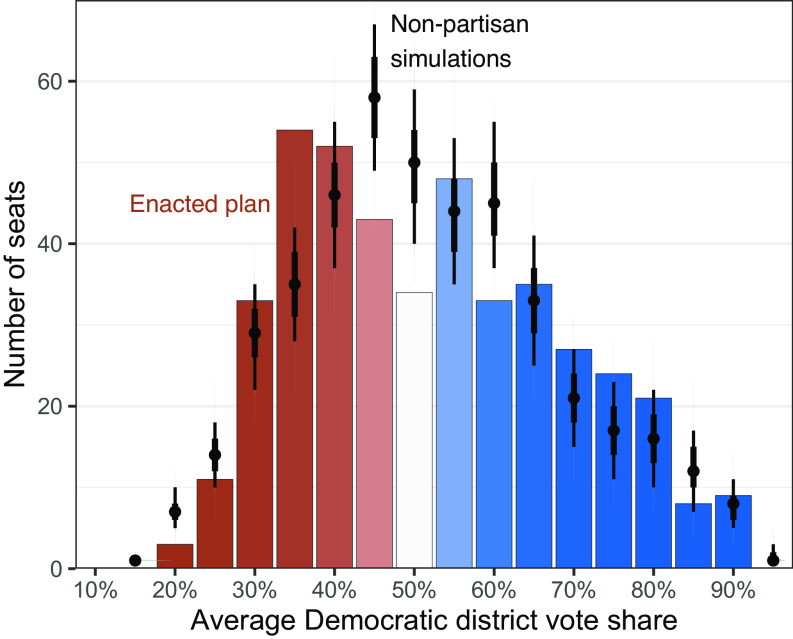
Recent election cycles provide evidence that these effects can matter within individual states. Analyses of the 2020 redistricting cycle found structural advantages for particular parties in some states, along with fewer competitive seats. Those changes may be especially important when control of a state legislature is close, even if they do not produce a large shift in the national balance of seats. A broader study of the same cycle found widespread partisan gerrymandering and reduced competition, supporting the view that control of mapmaking can have real electoral consequences inside states (see Figure 2). 3
The case against
The strongest challenge is that state-level advantages often offset one another nationally. A party may benefit from redistricting in some states while its opponent benefits in others. The leading peer-reviewed study of the 2020 cycle found partisan effects at the state level but little reliable net advantage across the country. It estimated an average national gain of about two additional Republican seats, a result that weighs against treating partisan control as a reliably large nationwide advantage (see Figure 1). 4
It is also difficult to separate deliberate line-drawing from where voters already live. Democratic and Republican voters are not spread evenly across geography. A party may win more districts partly because its opponents are concentrated in a few areas, rather than because mapmakers intentionally created the advantage. Researchers have identified continuing problems in measuring and proving the independent effect of partisan maps. Efficiency-gap estimates can mix boundary effects with geographic clustering and rely on assumptions about how voters behave. 5
Finally, district boundaries are only one influence on an election. National political conditions, candidate quality, campaign competition and existing partisan patterns can all overwhelm a map’s intended effect. A party can control redistricting and still lose seats in the next election. Research also indicates that institutional rules matter: commissions and other reforms can limit partisan mapmaking, while the Supreme Court’s decision in *Rucho v. Common Cause* left many remedies to state governments and Congress rather than federal courts. 6
The bottom line
The evidence favors a qualified version of the claim, not its strongest form. Partisan redistricting appears able to reduce competition, protect incumbents and create meaningful advantages within particular states. Those conclusions are supported more strongly than the idea that the controlling party will reliably gain a large number of seats nationwide in the next election.
The best cycle-level evidence indicates that opposing state-level advantages often cancel out nationally. The expected benefit also depends on geography, political conditions, institutional limits and timing—not simply on which party controls the mapmaking process.
Confidence is therefore high that partisan maps can insulate incumbents and reduce competitiveness, but lower when predicting whether the controlling party will gain seats in a specific election. The main unresolved question is how much of any apparent advantage comes from intentional map design, how much comes from the geographic distribution of voters, and how much comes from the broader political climate.
Figures & data

All contributions are reviewed for clarity, balance, and evidence. The strongest insights are elevated into the argument graph — with credit to you.
Help improve this analysis →