Ocean acidification is threatening marine ecosystems faster than predicted
What's this about?
People disagree about whether ocean acidification (water becoming more acid) harms ocean life faster than experts expected. Carbon dioxide in the air makes seawater more acid.
What supporters say
- Some ocean areas now face sharp acid changes during certain seasons, before yearly averages show the full danger.
- Tiny sea snails near Antarctica have shown shell damage from water that can wear shells away.
- Shellfish farms on the US west coast have lost young shellfish during acid events.
- Heat, low oxygen, and acid water can work together and hurt corals and other sea life more.
What critics say
- Scientists do not yet have proof that ocean life around the whole world worsens faster than predicted.
- Acid levels change a lot by place and season, so one hard-hit area may not show the global trend.
- Coastal water faces other problems besides carbon dioxide, which can add to shellfish losses.
- Different sea animals react in different ways, so scientists cannot give one simple harm rate.
The bottom line
Acid water already causes real harm in some places, especially for shell-building sea life. But we’re not sure yet that all marine life faces harm faster than scientists predicted.
Ocean acidification is changing seawater chemistry as the ocean absorbs carbon dioxide. The evidence shows serious harm is already emerging in some places, but it does not prove that marine ecosystems worldwide are deteriorating faster than scientists predicted.
The case for
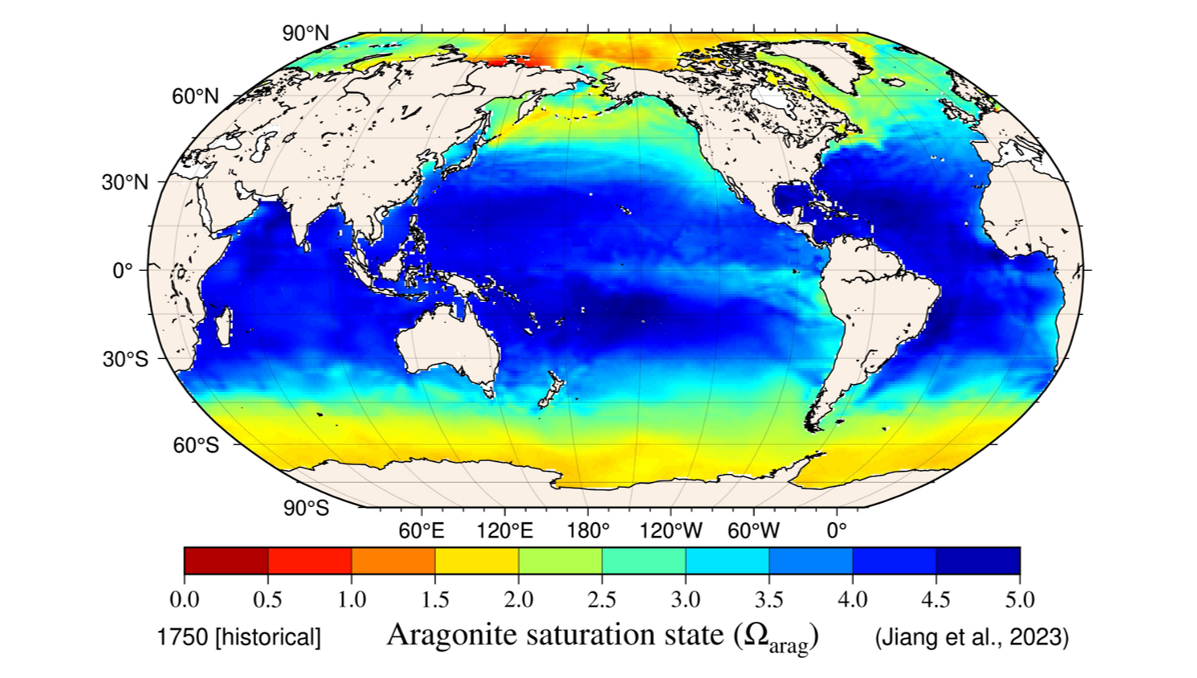
In several regions, the danger may be arriving sooner or more intensely than broad global averages suggest. The California Current and the wider Northeast Pacific, for example, are seeing increasing exposure to acidification extremes that differ sharply by season and location. That means marine life can face damaging episodes before changes in average ocean conditions fully reveal the scale of the threat (see Figure 2). 1
There is also evidence that damage is not merely theoretical. Southern Ocean pteropods—small free-swimming snails that are important in marine food webs—have been found with shell dissolution linked to corrosive seawater. In the Pacific Northwest, acidification episodes have harmed shellfish hatcheries, forcing businesses to invest in monitoring and water treatment. These coastal cases are influenced by more than open-ocean carbon dioxide, but they show that acidification can already bring real ecological and economic costs. 2
Scientists also worry that acidification rarely acts alone. Higher temperatures, low oxygen and other pressures can combine with more acidic water in ways that are harder on organisms than any one stressor by itself. Studies generally find that higher carbon dioxide levels reduce calcification, growth or survival on average in vulnerable marine species, including corals, even though the scale of the effect varies. 3
That is particularly troubling for corals and other organisms that build shells or skeletons. These species do more than survive on their own: they form reefs and other habitats that support many fish and invertebrates. A recent study also found accelerated acidification trends in tropical coral-reef regions between 1985 and 2022, while identifying some local areas that may offer chemical refuge. 4
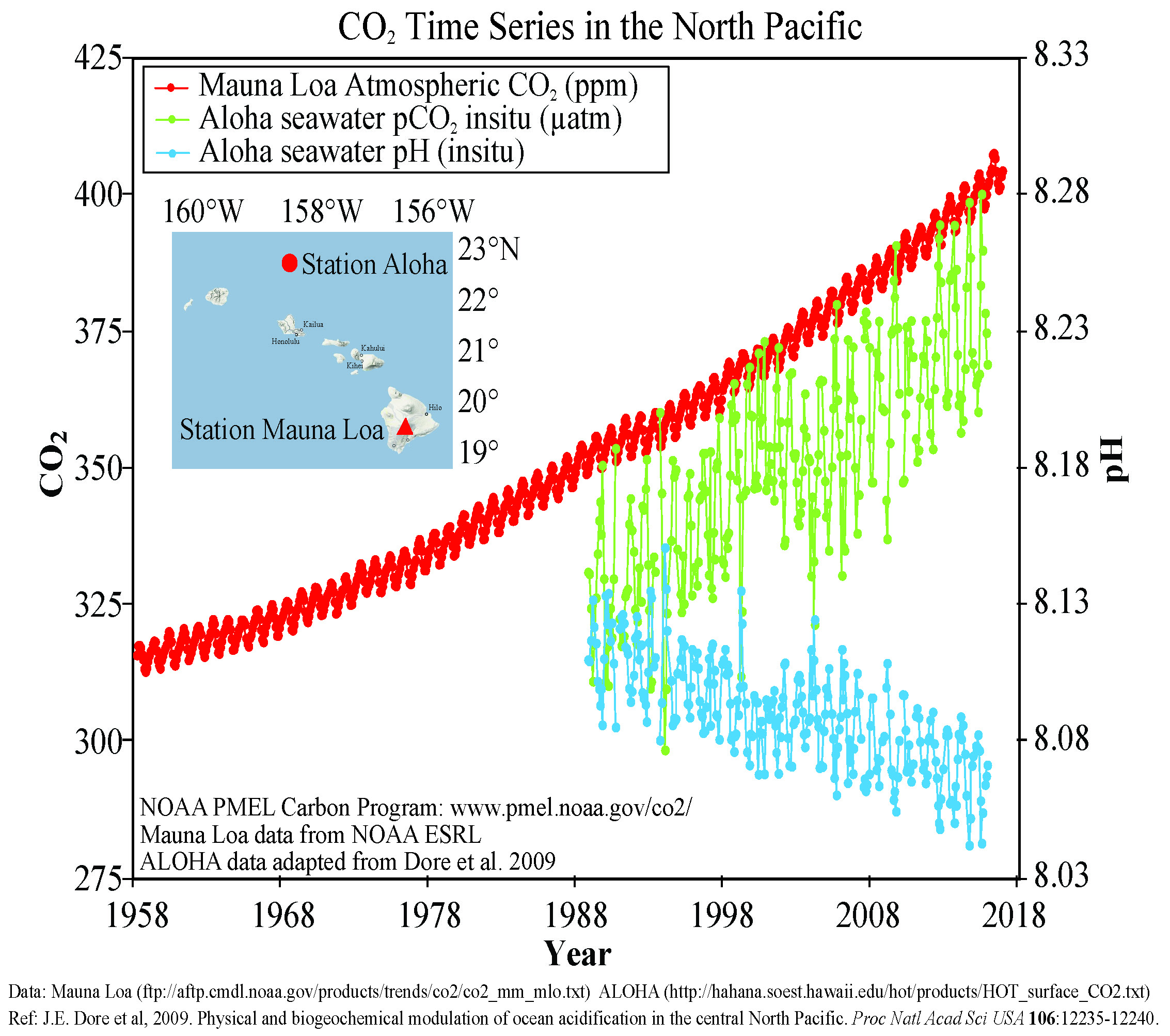
The basic physical evidence is strong. Long-term observations show declining pH and carbonate saturation in surface waters, and scientists attribute those trends mainly to human-produced carbon dioxide (see Figure 1). The uncertainty lies less in whether the chemistry is changing than in predicting exactly when and how entire ecosystems will reorganize.
The case against
The central weakness in the claim is the phrase “faster than predicted.” Existing evidence does not provide a single, consistent global comparison between observed ecosystem damage and clearly defined earlier forecasts. The Intergovernmental Panel on Climate Change has concluded that acidification is increasing and has already affected organisms and ecosystems, but it stresses major regional differences and uncertainty about ecosystem-wide outcomes. 5
A harmful result in a pteropod, coral or shellfish hatchery cannot automatically be extended to every marine species or ecosystem. Large reviews of calcifying organisms find that responses depend heavily on the species, its life stage, local carbonate chemistry and other conditions. Coccolithophores, microscopic algae that produce calcium-carbonate plates, can respond differently even among closely related species or strains. 6
Some populations may also adjust to more acidic conditions. At natural carbon-dioxide seep sites, certain organisms and communities persist under chronically high carbon dioxide, though often with changed species mixes and altered ecological functions. Multigenerational fish studies likewise suggest that acclimation can change sensitivity, but this ability is species-specific and may not protect reproduction, food webs or habitat-forming species when conditions shift quickly. 7
Natural variability further complicates the picture. Local circulation, seasonal upwelling and coastal influences can make it difficult to separate a long-term human-driven trend from short-term swings. And projections of especially severe acidification in Antarctic protected areas depend on high-emissions scenarios, showing grave future risk rather than proving that worldwide impacts have already exceeded expectations.
The bottom line
Ocean acidification is a real and growing threat, and vulnerable regions and species may be experiencing risks that are more rapid or more severe than simple forecasts suggested. Evidence from the Northeast Pacific, Southern Ocean pteropods, Pacific Northwest hatcheries and tropical reef areas points to urgent local danger.
But the broader claim is not established. The evidence does not show that marine ecosystems as a whole, worldwide, are being threatened faster than predicted. Scientists are highly confident that human carbon dioxide emissions are altering ocean chemistry and putting vulnerable organisms at material risk; they are less certain about the timing and scale of ecosystem-wide change because responses vary by region, species, adaptation and interacting stresses.
Figures & data
All contributions are reviewed for clarity, balance, and evidence. The strongest insights are elevated into the argument graph — with credit to you.
Help improve this analysis →