A sustained weakening of the AMOC will significantly change North Atlantic weather and reduce marine carbon uptake by 2050
What's this about?
People disagree about whether a lasting AMOC slowdown will change North Atlantic weather and ocean carbon storage by 2050.
AMOC means a large ocean flow that moves warm water north and cold water south.
What supporters say
- A weaker AMOC may carry less carbon into deep water, so the ocean may store less carbon.
- AMOC weakening can change heat, rain, sea levels, and some storms across nearby lands and seas.
What critics say
- We are not sure the AMOC will weaken enough by 2050 to cause large changes.
- Other climate causes also affect weather, so linking each change to AMOC is hard.
How to read this
The number of points does not show which side is right; stronger proof matters more than a longer list.
The bottom line
The science supports a clear link between AMOC weakening, weather shifts, and less ocean carbon storage.
But the size and timing of these changes by 2050 remain unclear, especially for weather.
The claim is that a long-term weakening of the Atlantic Meridional Overturning Circulation (AMOC) will significantly change North Atlantic weather and reduce the ocean’s carbon uptake by 2050. The evidence supports the physical connection, but is less clear about the size, timing and combined effect of those changes.
The case for
The strongest evidence concerns the link between AMOC strength and regional climate. The AMOC carries warm water northward and interacts with the atmosphere. If it weakens, it can affect temperature patterns, rainfall, sea levels and some weather hazards. Models report changes in tropical Atlantic precipitation, while regional research has found altered storm-surge patterns around the United Kingdom. These findings show that the weather pathway is not merely theoretical 1 (see Figure 2).
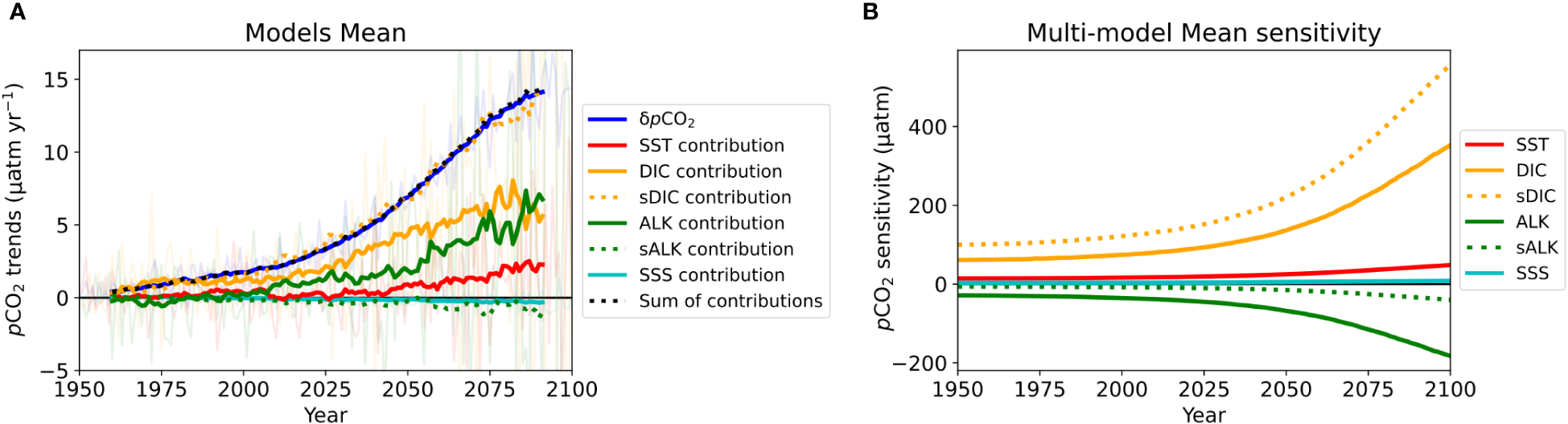
There is also a credible link between circulation and the ocean’s carbon sink. The North Atlantic takes up carbon partly through ventilation and the movement of surface water into the deep ocean. A weaker overturning circulation can reduce that transport and change how much carbon is stored at depth. Models under relevant warming scenarios find reduced uptake particularly in subpolar regions. Research also points to the Gulf Stream and other western-boundary currents as important controls on projections of the future North Atlantic carbon sink 2 (see Figure 3).
Together, this evidence strongly supports a conditional conclusion: if AMOC weakening is sustained, it can materially alter regional weather and carbon cycling. The basic mechanisms are well established, and regional responses have been found in both observations and models.
The case against
The main weakness is the 2050 deadline. Observing systems cover only a limited part of the AMOC’s multidecadal variability, and measured and modeled estimates of its strength differ substantially. Studies that project especially large declines often focus on the end of the century rather than 2050. Estimates of when a possible collapse might occur cannot simply be used to date the less extreme event described here: a sustained weakening 3.
Weather attribution is also difficult. North Atlantic conditions are shaped not only by the AMOC, but by greenhouse-gas warming, aerosols, sea-ice changes, natural variability and other ocean-atmosphere patterns. As a result, a weather change by 2050 would not by itself show that AMOC weakening was the main cause 4.
The carbon effect is not expected to be uniform across the North Atlantic. A weaker AMOC may reduce ventilation and the transfer of carbon into the deep ocean, but warming, changes in seawater chemistry, stronger or weaker layering of the ocean, and biological responses can push in different directions. Regional studies therefore show strong influence from circulation, rather than a simple one-to-one relationship in which a weaker AMOC always produces the same decline in uptake.
The bottom line
The evidence favors the claim’s underlying physical argument, but only moderately supports the full claim as written. It is highly credible that sustained AMOC weakening would produce regional changes in North Atlantic weather and would likely modify marine carbon uptake. However, the evidence does not firmly establish that a sufficiently large and persistent weakening will occur by 2050, or that it will cause a significant net reduction in carbon uptake across the North Atlantic.
The weather response is better supported as a conditional, regional effect than as one uniform outcome for the whole basin. The carbon response depends on location and on competing physical, chemical and biological processes. Overall, the evidence is strong on mechanism and regional effects, but much weaker on the exact timing, magnitude, attribution and direction of the combined changes by 2050.
Pros — Supporting Arguments
Cons — Opposing Arguments
Figures & data

All contributions are reviewed for clarity, balance, and evidence. The strongest insights are elevated into the argument graph — with credit to you.
Help improve this analysis →