Plastic recycling is largely a myth

Updated 2026-07-31 6 supporting · 4 opposing arguments
Aldo's Synthesis high
Based on the strength of the Arguments below
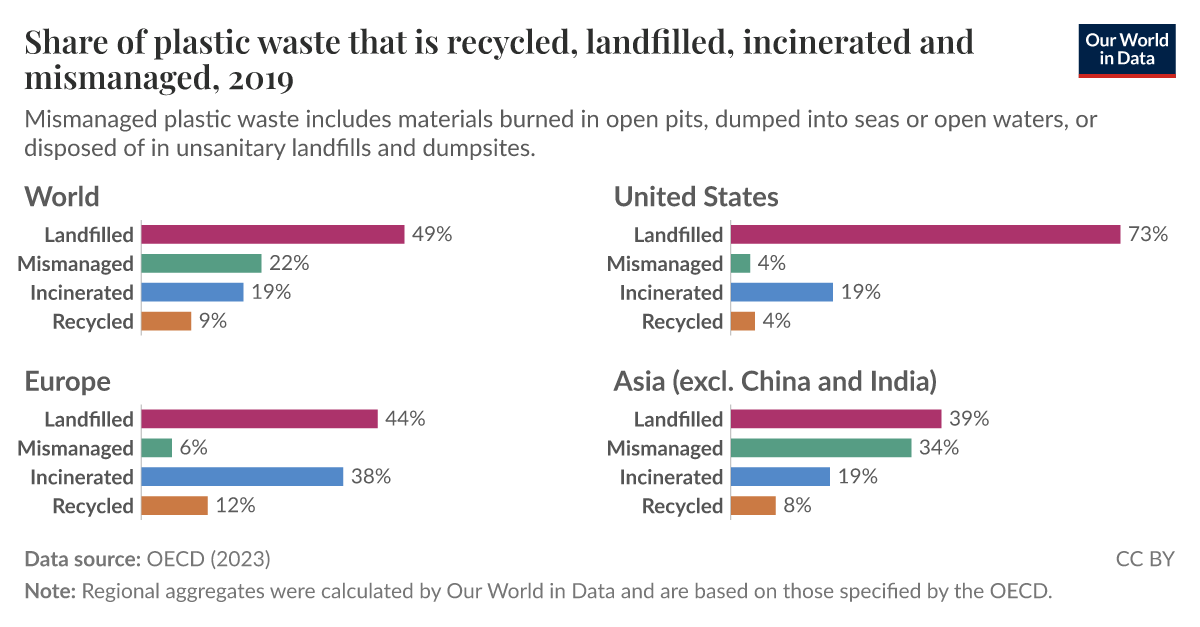
The claim that plastic recycling is “largely a myth” asks whether recycling has been presented as a broadly effective answer to plastic waste despite failing to recover most discarded plastic or sustain a genuinely closed material loop. The wording matters: “largely” permits useful exceptions, whereas “myth” could refer either to an exaggerated public narrative or, more literally, to an assertion that plastic recycling is not real. The assessment therefore must distinguish overall system performance from the performance of particular polymers and programs, and present-day results from what redesigned systems might achieve. The strongest support for the claim is the repeated finding that only a small minority of plastic waste has actually been recycled across global historical accounts and U.S. waste data. A global material-flow analysis estimated that, of approximately 6.3 billion tonnes of plastic waste generated through 2015, about 9% had been recycled, compared with 12% incinerated and 79% accumulated in landfills or the natural environment (see Figure 2). EPA likewise estimated that the United States generated 35.7 million tons of plastic municipal solid waste in 2018 and recycled about 3.1 million tons, or 8.7%, while reporting materially higher rates for some bottle categories (see Figure 1). OECD modeling further projects that, without stronger policies, global plastic use and waste could nearly triple by 2060 while less than one-fifth of plastic waste would be recycled. Collection or a recycling label does not establish that waste became usable secondary resin, because material can be lost during sorting and processing or fail to displace virgin feedstock. The Basel Convention’s plastic-waste rules reflect this distinction by applying prior-informed-consent controls to many mixed, contaminated, or hazardous shipments while reserving narrower treatment for clean, sorted streams destined for environmentally sound recycling. Even successful recovery need not close the loop: processing losses and quality constraints can limit repeated use, while measured recycled output remains only a minority of a much larger plastic market. Historical material-flow research accordingly characterizes recycling as generally delaying disposal unless material remains in repeated closed loops. The heterogeneous composition of the waste stream prevents “plastic” from functioning as a single, universally recyclable material category. A systematic review finds mechanical recycling comparatively mature and often environmentally preferable for clean, homogeneous streams, but constrained by contamination, polymer mixing, additives, degradation, and unstable economics. Product-level EPA data confirm substantial differences by resin and format: PET and natural HDPE bottles have established recovery channels, whereas many films, mixed resins, and other packaging formats perform much worse. Chemical recycling does not presently overcome these constraints as a general solution for mixed plastic waste. Reviews and process assessments find that chemical methods may accept some difficult streams, but their outcomes depend heavily on feedstock, energy source, yields, costs, coproduct credits, and the treatment or production they displace. That sensitivity does not support treating pyrolysis or gasification as automatically circular or environmentally superior. Recycling alone is also unlikely to offset a plastic system in which demand and waste continue to grow. European analysis reports that recycled material supplies only a small share of plastics demand, while OECD scenarios indicate that improved recycling by itself would not eliminate pollution or expanding material use. Institutional assessments consequently place recycling within a broader strategy of reducing production and problematic uses, improving design, expanding reuse, strengthening waste systems, and preventing leakage. The principal objection is that plastic recycling is demonstrably real and useful for selected materials, so describing the entire practice as a myth is too absolute. EPA’s disaggregated data show materially better recovery for PET and natural HDPE bottles than for plastic waste overall, indicating functioning collection and reprocessing channels rather than a wholly fictitious system. For suitable streams, recycling can also produce genuine environmental gains when recovered resin substitutes for virgin production. A comparative life-cycle study found environmental and energy advantages for recycled PET over virgin fossil-based PET under the conditions assessed. Broader reviews and PET-system analysis similarly find that mechanical recycling or recycled PET can reduce energy use, environmental burdens, and virgin-resource demand, although the magnitude depends on collection quality, processing yield, recycled content, and actual displacement. Low aggregate recycling rates are partly contingent on policy and infrastructure rather than solely on immutable material properties. A review of deposit-refund systems finds that they can achieve high beverage-bottle return rates and cleaner streams, improving bottle-to-bottle recycling, with outcomes depending on deposit value, convenient return infrastructure, coverage, and system design. Present performance therefore does not fix the upper bound of future recycling under redesigned products and stronger markets for secondary resin. Institutional assessments identify improved product design, separate collection, recycled-content requirements, and stronger waste systems as measures complementary to waste prevention. The evidence supports the claim under a systemic interpretation of “myth,” but rejects a literal interpretation under which no plastic recycling is technically real or environmentally beneficial. If the claim means that recycling is not the normal fate of plastic waste, the low global historical and U.S. aggregate rates strongly support it. If it means that recycling cannot work or confer benefits for any plastic, evidence concerning PET, natural HDPE, and effective mechanical recovery contradicts it. Reported recycling rates and environmental benefits depend on the system boundary being measured. Collection, entry into a facility, recovered output, and final substitution for virgin plastic represent different stages, with losses possible between them. Life-cycle findings likewise vary with sorting losses, energy sources, transport, allocation rules, substitution assumptions, and other methodological choices, and reviews identify significant data gaps and inconsistency across assessments. The most defensible policy implication is to treat recycling as one component of a hierarchy rather than as either a complete solution or a worthless activity. UNEP’s modeled systems change combines elimination of problematic plastic, reuse, recycling, redesign, and material substitution, treating recycling as necessary for suitable residual streams but insufficient by itself. National Academies and European assessments similarly emphasize source reduction, redesign, reuse, and stronger waste controls because recycling has not made the plastics economy broadly circular. The principal evidentiary gaps concern comparability, future-system performance, and unresolved conflict-of-interest classifications rather than the existence of evidence on either side. The bundle does not provide a harmonized measure that follows the same material from market placement through collection, sorting, reprocessing, repeated use, and verified displacement of virgin resin across jurisdictions. Evidence for established PET and HDPE systems does not by itself quantify how far comparable performance could extend to films, multilayer products, mixed resins, or additive-rich materials under redesigned systems. The source bundle also does not resolve conflict-of-interest classifications, limiting confidence in any inference about the motives or credibility of interested institutions beyond the reported findings themselves. A further structural absence prevents evaluating the strongest deception-oriented meaning of “myth.” Although Figure 3 presents a timeline concerning industry statements, the frozen evidence bundle contains no admissible evidence about that timeline or about deliberate public deception, so the synthesis cannot substantiate claims about intent, knowledge, or misconduct (see Figure 3). On balance, the evidence supports the claim with high confidence if “largely a myth” means that plastic recycling has been treated as a broad solution despite low aggregate recovery, limited closed-loop substitution, and major material constraints; it does not support the literal proposition that plastic recycling is unreal or uniformly futile. PET and natural HDPE recovery, favorable life-cycle findings under suitable conditions, and improved outcomes from well-designed collection systems establish meaningful exceptions. The dominant uncertainty is not whether present aggregate performance is poor, but how broadly better design and policy could extend the successful exceptions, compounded by unresolved conflict-of-interest classifications and the absence of admissible evidence about alleged deceptive intent.

Supporting Arguments

P1Most plastic waste is not recycled
The claim is broadly supported if “largely a myth” means that recycling is routinely perceived as the normal fate of plastic even though it is not. OECD estimated only 9% of global plastic waste was ultimately recycled in 2019, while historical material-flow analysis and EPA data found similarly low global and U.S. shares.
66/100 · Direct Evidence
P2Recycling rarely creates a fully closed material loop
Plastic can degrade during processing, be contaminated or mixed with incompatible polymers, and be converted into lower-grade products that are later discarded. Continued growth in plastic consumption also means recycled resin supplies only a minority of demand, leaving the system dependent on virgin production.
82/100 · Direct Evidence
P3The plastic waste stream is poorly suited to universal recycling
“Plastic” encompasses many polymers, additives, colors, multilayer structures and product formats that cannot simply be processed together. Clean PET and natural HDPE bottles perform better, but mixed packaging, films and contaminated material often lack technically and economically viable recovery routes.
65/100 · Direct Evidence
P4Collection labels do not guarantee actual recycling
Material counted as collected or exported for recycling can be rejected during sorting or processing, so collection statistics can overstate final material recovery. OECD explicitly reports losses before arriving at its 9% global recycling estimate, while Basel rules distinguish clean recyclable shipments from mixed or contaminated plastic waste.
60/100 · Logical Inference
P5Chemical recycling is not yet a general escape route
Pyrolysis and other chemical processes may accept some streams that mechanical plants cannot, but their yields, energy requirements, emissions and economics are highly context-dependent. Reviews therefore do not justify presenting chemical recycling as proof that mixed plastic can already be recycled indefinitely at scale.
60/100 · Direct Evidence
P6Recycling alone cannot keep pace with plastic growth
Even substantial improvements in recycling may be overwhelmed if production and waste continue to expand. OECD scenarios and National Academies analysis support combining recycling with source reduction, redesign and stronger waste controls rather than treating the blue bin as a complete solution.
98/100 · Data Analysis

Opposing Arguments

C1Some plastics are demonstrably recycled at useful scale
Calling recycling itself a myth is too absolute because PET and natural HDPE bottles have functioning collection, sorting and reprocessing markets. EPA's disaggregated figures show substantially better performance for those formats than for plastic waste as a whole.
57/100 · Direct Evidence
C2Recycled resin can reduce environmental impacts
Life-cycle studies commonly find that mechanical recycling and recycled PET can reduce virgin-resource use, energy demand and environmental burdens when recovered resin actually displaces virgin resin. Those benefits are conditional, but they make recycling a real industrial process rather than a literal fiction.
65/100 · Direct Evidence
C3Policy design can greatly improve collection quality
Deposit-refund systems can produce high bottle return rates and cleaner, more valuable feedstock than undifferentiated curbside streams. This indicates that low recycling is partly a policy and infrastructure failure, not an immutable property of every plastic product.
75/100 · Direct Evidence
C4Better design could expand practical recyclability
Standardized polymers, fewer problematic additives, separable components and recycled-content mandates can improve yields and demand for secondary material. Existing low rates therefore do not prove that improved systems cannot recycle a materially larger share in the future.
70/100 · Logical Inference

All contributions are reviewed for clarity, balance, and evidence. The strongest insights are elevated into the argument graph — with credit to you.

Help improve this analysis on ProConWiki →
𝕏 Share Facebook LinkedIn