National protests in France deepen political and social divisions rather than building broad public solidarity
Bottom line (updated 2026-10-29): The picture is mixed: protests can unite people for a cause, while also making old splits sharper. The evidence does not show one simple rule; the result changes from case to case.
What's this about?
People disagree about whether big protests in France bring people together or push groups farther apart.
This question looks at trust, public debate, and daily life during national protests.
Some protests may help people join forces, while others may sharpen old splits.
What supporters say
- Protests can reveal and worsen old gaps between rich and poor places, and between groups with unlike views.
- Blockades and strikes can harm shops, work, travel, and public aid, turning a law fight into a fight between people.
- Online posts may spread anger fast and split protest groups into rival camps, but we're not sure they cause more hate.
What critics say
- Large protests can give more people a way to join public life and speak to leaders.
- People from many groups can join when they share anger about the same unfair rule or hard life.
How to read this
The number of points on each side does not show who is right; the key is how strong the proof is for each point.
The bottom line
The picture is mixed: protests can unite people for a cause, while also making old splits sharper.
The evidence does not show one simple rule; the result changes from case to case.
National protests in France can bring people together around a shared cause, but they can also expose and sharpen divisions that already exist. The evidence points to a mixed, case-by-case picture rather than a simple rule that protest either unites society or tears it apart.
The case for
The strongest evidence for the claim comes from research on the Yellow Vest movement, which showed how protest can make existing territorial, economic and political divisions more visible. Studies linked the movement to areas facing particular socioeconomic difficulties and to patterns of populist voting. Other analysis described the movement as disruptive and polarizing in French political debate. There was also overlap between some Yellow Vest demands and the platforms of populist parties, with many supporters associated with far-right or far-left voting patterns, although that finding rests on less authoritative evidence. 1 (see Figure 2)
Protest tactics can deepen conflict by spreading the costs beyond those taking part. During the Yellow Vest movement, blockades and disruptions affected businesses, public services and people trying to obtain fuel or travel. Pension protests also involved strikes, blockades and, in some cases, injuries. Government data confirm substantial disruption linked to the Yellow Vests, while warning that the movement’s overall economic effects are difficult to calculate. Such tactics can turn a dispute over policy into a wider conflict between demonstrators, the government, employers and members of the public. 2
Online communication may add to this antagonism. Analyses of Yellow Vest networks by Sciences Po researchers describe a digital space vulnerable to the rapid spread of outrage and divided into opposing camps. But this evidence is mainly interpretive, not a direct test showing that online activity caused greater hostility. The role of digital platforms therefore remains plausible but uncertain. 3
The case against
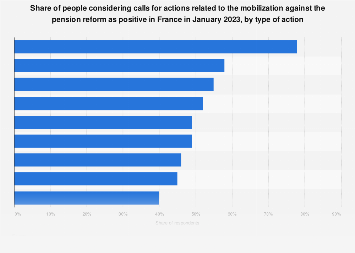
Protest can also create a powerful sense of shared purpose. Research on the Yellow Vests found common identities among participants, even though the movement included people with different backgrounds and political views. The 2023 protests against pension reform brought more than one million people into the streets, while survey-based reporting found substantial public support. These examples suggest that national demonstrations can unite people around a grievance that crosses some social and political boundaries. 4 (see Figure 3)
Mass protest may also increase democratic participation rather than simply intensify conflict. Two peer-reviewed studies of the Grand Débat, launched in response to the Yellow Vest movement, found extensive public involvement. They described the process as a deliberative and institutional channel linking grassroots mobilization with participatory democracy. In that sense, protest can push governments to create new ways for citizens to take part in political debate. 5
Still, solidarity within a movement is not necessarily the same as broad and lasting solidarity across the country. The strongest research finds both shared identities and internal disagreements among protesters. A wider review of social movements likewise identifies connections among participants alongside differences in social background, political beliefs and organization. (see Figure 1)
The bottom line
The evidence moderately favors a conditional version of the claim: some major French protests, especially the Yellow Vest movement, can deepen political and social divisions. But it does not support the broader conclusion that national protest in France generally produces more division than solidarity.
The type of issue and the methods used matter. Opposition to pension reform attracted unusually broad support and mobilization, while the Yellow Vest movement more clearly reflected territorial and populist divisions and involved disruptive conflict. Broad public support does not automatically create a durable national consensus, just as disruption does not prove that divisions will last.
Overall, the evidence shows that movement-level solidarity and wider social conflict can exist at the same time. The studies do not consistently measure whether divisions or unity persist over the long term, or how much protest itself causes them rather than reflecting earlier grievances. The lasting effects of online outrage are especially unclear. France’s protests are therefore best understood as case-sensitive events that can build participation and shared identity while also intensifying conflict beyond the movement itself.
Pros — Supporting Arguments
Cons — Opposing Arguments
Figures & data

All contributions are reviewed for clarity, balance, and evidence. The strongest insights are elevated into the argument graph — with credit to you.
Help improve this analysis →