Midterm losses that weaken a president’s party reduce the administration’s legislative success
Bottom line (updated 2026-11-05): The evidence points to weaker success for a president’s big goals after the other party wins Congress. But we are not sure that midterm losses always lower the total number of laws passed.
What's this about?
People disagree about whether midterm losses make it harder for a president to pass laws.
The answer may change based on whether we count all laws or only big goals.
What supporters say
- When the other party wins Congress, it can replace the president’s goals with its own plan.
- A rival party in charge can start more probes and fights, making deals harder.
- One party in charge of both Congress and the White House links with more big laws.
- After Democrats won in 2006, Congress passed very few laws that made major changes.
What critics say
- Party control does not cause every fight, since other problems can block deals too.
- A split government may not lower the total number of laws that Congress passes.
- A split government does not always stop big changes in public rules.
How to read this
The number of points on each side does not show who is right; strong proof matters more than a long list.
The bottom line
The evidence points to weaker success for a president’s big goals after the other party wins Congress.
But we are not sure that midterm losses always lower the total number of laws passed.
A midterm defeat can make it harder for a president to pass major parts of the administration’s agenda, especially when the loss changes control of Congress. But the effect is less clear if legislative success is measured by the total number of laws passed.
The case for
The strongest evidence comes from historical comparisons of divided and unified government. Congresses controlled by the president’s party tend to produce more landmark legislation, even though the difference is smaller for routine or minor bills. One study estimates that divided government reduces landmark legislative production by about 30%. A longer historical database links unified government to roughly four additional significant acts per Congress during the 20th century. 1
These findings support the claim when success means passing major, distinctive presidential priorities—not simply maximizing the number of enacted bills. A midterm takeover can also replace the president’s program with the opposition’s. After the 1994 election, Republicans won both chambers, pursued their “Contract with America,” and faced presidential vetoes of Republican proposals. The episode showed how a change in control can shift the agenda away from the White House. 2
Opposition control can also increase institutional conflict. President George W. Bush issued 12 vetoes, including during the Democratic-controlled Congress that followed the 2006 midterms. Research also connects divided government with more investigations and oversight, creating additional obstacles to passing legislation in the form the president prefers. 3
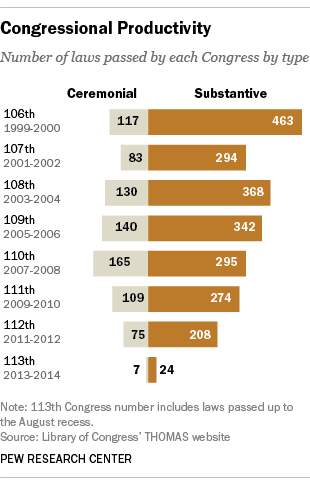
The 2006 election offers a further example. After Democrats won both chambers, the 110th Congress had one of the lowest shares of substantive legislation in Pew Research Center’s comparison period. That is consistent with reduced legislative success after a change in party control, although it is weaker evidence of cause than the broader historical studies. 4
The case against
Divided government does not always prevent important policy change. Presidents may soften their proposals, bargain with opposition leaders or pursue areas of bipartisan agreement. Political scientist David Mayhew found no necessary connection between divided government and less innovative or durable policy. Other research suggests divided government may make uncompromised priorities less likely to pass while encouraging moderate deals that can win broader support. 5
Party control is also only one factor behind gridlock. Supermajority rules, pivotal lawmakers, ideological divisions and the strength of party coalitions can block legislation under either unified or divided government. Kenneth Krehbiel’s work argues that unified government can still produce gridlock, while later research finds no consistent decline in overall legislative productivity caused by divided government. 6
That distinction matters. Studies generally find that the negative effect is concentrated in major legislation, with smaller or inconsistent effects on ordinary bills. The total number of laws passed may not fall substantially; instead, what gets enacted may change more than how much gets enacted. 7
The evidence also leaves causation unresolved. Legislative success can itself hurt a president’s party in the midterms. A recent peer-reviewed study finds that passing more of a president’s agenda can cost the party seats, meaning that later legislative weakness may partly reflect earlier success or broader political conditions. The 2006 Congress illustrates the problem: its low substantive output is descriptive, but cannot by itself show that the party takeover caused the result.
The bottom line
The evidence moderately supports a narrower version of the claim. When a midterm loss changes control of a chamber or removes a pivotal majority, it generally reduces the president’s bargaining power and makes major priorities less likely to pass in their preferred form. Multiple historical studies and institutional examples support that conclusion, so confidence is relatively high that party control affects negotiations and major-policy enactment.
The evidence is weaker on the size of the effect and on whether losses cause lower productivity. A midterm setback does not reliably reduce the total number of laws passed, and polarization, Senate rules, coalition strength, economic conditions and the president’s strategy can all matter. The best-supported conclusion is therefore conditional: midterm losses can weaken a president’s ability to enact major priorities, but they are not a universal explanation for a less productive Congress.
Figures & data
All contributions are reviewed for clarity, balance, and evidence. The strongest insights are elevated into the argument graph — with credit to you.
Help improve this analysis →