Mail-in voting can be regulated to protect election integrity without unfairly disenfranchising eligible voters
What's this about?
People disagree about whether mail-in voting can stay safe while letting all able voters cast a ballot.
The answer depends on how leaders make and use the rules.
What supporters say
- Ballot checks, safe storage, paper records, and later reviews can lower clear risks.
- Fix-it steps can help voters correct small mistakes, such as a missing or wrong sign.
- Mail voting can make voting easier while workers still check ballots and guard the process.
What critics say
- Rules may make voting harder for some groups, such as older people or people with less time.
- Very strict checks may throw out real ballots from voters who made small errors.
How to read this
The number of points on each side does not show which side is right; check the strength of the proof behind each point.
The bottom line
The proof supports a careful “yes,” not a promise that every mail-vote plan will work well.
Mail voting can protect elections without unfairly blocking voters, but only with fair rules, clear checks, and chances to fix mistakes.
Mail-in voting can protect election integrity without unfairly denying eligible voters their rights—but only if the rules are carefully designed and consistently applied. The evidence supports a conditional version of the claim, rather than a blanket assurance that every mail-voting system will strike the right balance.
The case for
Mail elections can use several safeguards without giving up the convenience of voting from home. Ballot tracking, secure storage, chain-of-custody records, bipartisan processing, equipment controls and post-election audits can address specific risks. The National Academies has also emphasized auditable systems and paper records that voters can verify. Research finds little evidence that expanding mail voting systematically increases fraud, supporting rules aimed at identifiable weaknesses rather than treating mail voting as inherently unsafe. 1
Access and oversight can also coexist. Studies have found that universal mail voting can increase turnout modestly, although the effects vary by election and by voter group. Reducing the logistical difficulty of voting may bring more people into the process while administrative checks remain in place. This does not eliminate the importance of deadlines, signatures or other requirements, but it shows that broader access does not necessarily mean weaker controls. 3
Cure procedures offer a practical way to deal with technical mistakes. Missing signatures, signature mismatches and late-arriving ballots are among the common reasons ballots are rejected. Notifying voters, allowing them to correct problems and using better-trained reviewers or multiple levels of review can reduce wrongful rejection. States already differ considerably in how much opportunity they provide to cure a ballot, showing that verification and access do not have to be treated as all-or-nothing choices. 2
The case against
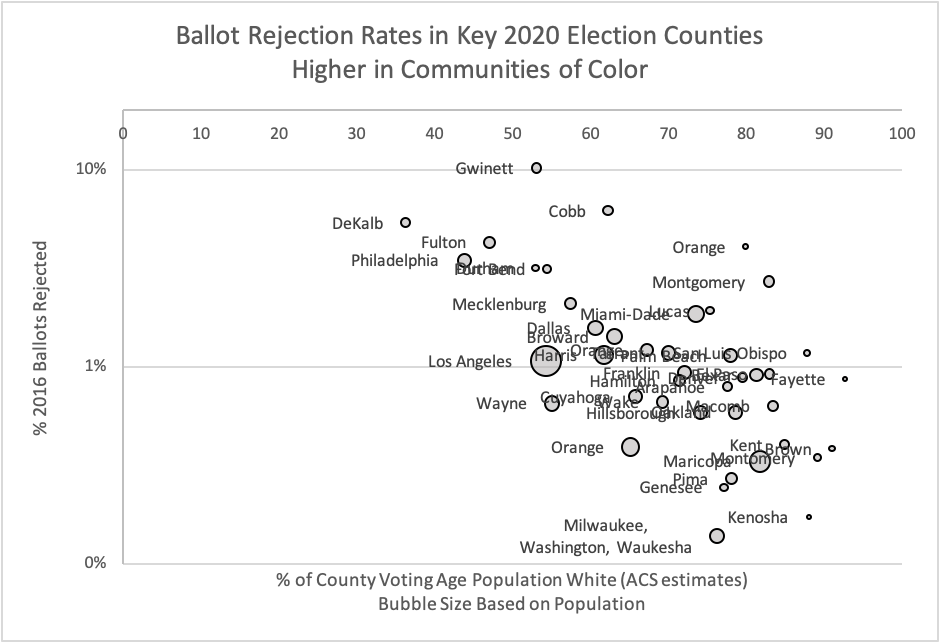
The main concern is that safeguards can become barriers. Signature matching is imperfect: a person’s signature may change with age, disability, language, illness or the conditions in which it is written. Research indicates that strict or inconsistent matching can reject valid ballots, and administrative data show that rejection rates differ across states and groups. (see Figure 1) Most mail voters successfully cast valid ballots, but a minority face problems involving deadlines, ballot completion, mailing or acceptance. 4
The broader problem is unequal practical burdens. Rules may appear neutral while affecting voters differently. Research has identified disparities linked to race, age, language and voting experience in some jurisdictions. States also vary widely in deadlines, witness and notarization requirements, signature standards, drop-box availability, ballot tracking and cure procedures. (see Figure 2) Evidence involving low-income voters suggests that convenience and administrative design can shape access, meaning that a rule applied equally on paper may not give everyone an equal chance in practice. 5
Mail voting does present distinct risks involving custody, coercion, privacy and verification because ballots are cast outside a controlled polling place. Documented voter fraud is rare overall, but the National Academies has recommended stronger absentee-ballot procedures in response to these particular vulnerabilities. The challenge is ensuring that controls aimed at those risks do not create completion or timing burdens that disqualify valid votes without producing comparable security benefits.
The bottom line
The evidence favors the claim, but conditionally and with high confidence. Security safeguards are available, and cure procedures can help prevent technical mistakes from disenfranchising voters. That supporting evidence is strong enough to show that mail voting and election controls can coexist.
The opposing evidence is also substantial, especially on implementation. Strict verification can reject valid ballots, and formally neutral administrative rules can burden some groups more than others. The balance therefore depends less on mail voting itself than on the details: whether safeguards target real risks, whether officials apply them consistently, and whether voters have accessible chances to correct technical errors.
The evidence does not provide one universal formula or a single estimate showing how every possible rule affects both fraud and ballot rejection. Results vary by jurisdiction, voter group and administrative quality. The clearest conclusion is that well-designed, targeted regulation can protect integrity without unfair disenfranchisement—but poorly designed or unevenly administered rules can do the opposite.
Pros — Supporting Arguments
Cons — Opposing Arguments
Figures & data

All contributions are reviewed for clarity, balance, and evidence. The strongest insights are elevated into the argument graph — with credit to you.
Help improve this analysis →