Immigration judges should have the authority to pause deportation proceedings when doing so is necessary to ensure fair and lawful outcomes
Bottom line (updated 2026-10-29): The evidence favors limited pause power with clear rules. We know less about how this power would affect the whole court system.
What's this about?
People disagree about whether judges should pause cases that may send people out of the country.
The question is whether a pause can help judges reach fair, lawful, and sound choices.
What supporters say
- Pauses can give people time to find a lawyer, gather proof, or fix another legal issue.
- Pauses can help judges make better choices when courts face too many cases and too few lawyers.
- Judge choice can stop a case before another legal issue changes what the judge should decide.
What critics say
- Wide use of pauses could make the court pile grow and make cases take much longer.
- Different judges might use pause rules in very different ways, causing unfair results.
- Long case closures could weaken the power of top leaders to set and carry out border rules.
How to read this
The number of points on each side does not show who is right; the strength of the proof matters more.
The bottom line
The evidence favors limited pause power with clear rules.
We know less about how this power would affect the whole court system.
The claim is that immigration judges should be able to pause deportation cases when moving ahead would threaten fairness or produce an unreliable or unlawful result. The evidence favors limited, clearly regulated authority, but offers little certainty about its effects on the immigration court system as a whole.
The case for
A pause can protect a person’s ability to take part meaningfully in the case. Respondents may need time to find a lawyer, prepare evidence or resolve another legal matter that could affect the outcome. The continuance framework in *Matter of L-A-B-R-* asks whether a related issue is likely to make a significant difference and whether the requested delay is reasonable. Legal analysis also concludes that reasonable time between hearings can be necessary to protect representation and other basic procedural rights. 1
There is evidence that these protections can affect the substance of cases, not merely postpone them. A randomized study summarized by the Vera Institute found better outcomes for detained immigrants who received legal representation. That suggests time and safeguards can improve the reliability of decisions, particularly when people otherwise face proceedings without counsel. 1
Judicial discretion can also prevent a decision that is legally premature. A related application for relief, a prosecutorial-discretion question or another collateral issue may change the case. In *Matter of Avetisyan*, administrative closure was treated as a case-management tool, with judges allowed to consider the circumstances as a whole. *Matter of Cruz-Valdez* restored that approach and recognized that it could support prosecutorial discretion and related forms of relief. 2
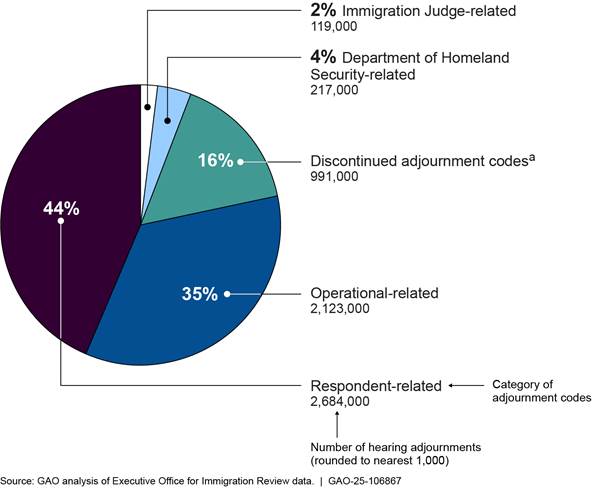
A carefully controlled pause may also improve the quality of adjudication. Reports from the Government Accountability Office, the Administrative Conference of the United States and the Migration Policy Institute describe heavy caseloads, uneven access to representation, management problems and major differences among locations. Those conditions suggest that speed by itself can sometimes undermine accurate decision-making. (see Figure 2) 3
The case against
The strongest concern is delay. Immigration courts already carry a very large and growing caseload, so poorly limited pauses could defer decisions, consume scarce capacity and make timely resolution harder for both respondents and the government. The Congressional Research Service reported about 1.5 million pending defensive asylum applications at the end of fiscal year 2024, while the GAO has documented longstanding operational and caseload problems. (see Figure 3) 4
Indefinite or weakly reviewable closures could also interfere with final decisions and the executive branch’s enforcement choices. *Matter of Castro-Tum* held that immigration judges and the Board generally lacked authority to suspend cases indefinitely without an applicable regulation or delegated authority. Justice Department materials described the concern as leaving cases unresolved for an unknown or unpredictable period. 5
Broader discretion could produce inconsistent results from one court to another. The GAO has reported difficulty tracking continuances and other court activity, while Migration Policy Institute research has found substantial geographic variation and widespread lack of representation. Without clear standards, reporting and review, pause authority could deepen differences based on where a case is heard. 6
The bottom line
The evidence supports a narrow, case-specific power to pause proceedings, not an unrestricted ability to suspend them. A pause should require written reasons, input from both sides, a finding that a due-process problem or legally important related matter exists, a time limit and automatic or readily available recalendaring.
Those safeguards directly address the main objections about delay, executive control and inconsistency. But the evidence does not show how a standardized pause system would affect overall case length, backlog size or geographic differences. It documents the risks and the potential benefits, rather than providing a controlled comparison with other reforms.
The overall case for bounded authority is stronger than the case against it, particularly when an immediate decision would be unfair or legally premature. Confidence in the system-wide effects is low, however. The central uncertainty is whether deadlines, monitoring and recalendaring can keep a useful fairness tool from becoming another source of backlog and uneven treatment.
Figures & data

All contributions are reviewed for clarity, balance, and evidence. The strongest insights are elevated into the argument graph — with credit to you.
Help improve this analysis →