Hosting major sporting events produces uneven economic outcomes
Bottom line (updated 2026-10-24): Big sports events can bring real gains, but those gains often do not reach everyone. The stronger proof shows that public costs, home loss, and uneven gains can limit the wider good.
What's this about?
People disagree about whether big sports events help most local people, or mainly help some groups.
What supporters say
- New sports sites can force people from their homes, especially poor or less powerful groups.
- Huge public costs can cut down or wipe out the gains that local people might receive.
- More tourists can help hotels, shops, food places, and travel firms more than other local families.
- A rise in the whole area’s wealth does not prove that people share it fairly.
What critics say
- Hosting a big event can raise jobs, tourism, building work, and total wealth in the area.
- Good long-term plans can help more local people join in and use new sites.
How to read this
The number of points on each side does not show who is right; strong proof matters more than a long list.
The bottom line
Big sports events can bring real gains, but those gains often do not reach everyone.
The stronger proof shows that public costs, home loss, and uneven gains can limit the wider good.
Major sporting events can boost a host region’s economy, but those gains are not always shared widely. The central question is whether new activity improves life for local residents generally—or mainly benefits certain industries, developers and governments while leaving others with the costs.
The case for
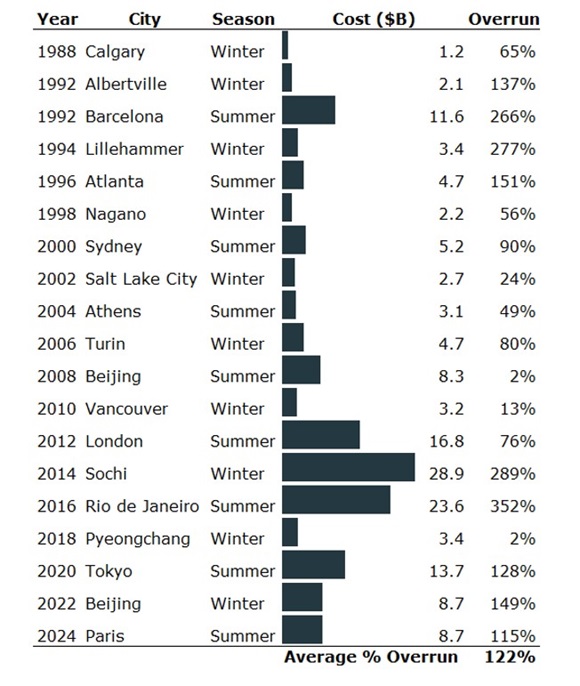
Public costs can shrink or erase local gains. Olympic projects in particular are often unusually expensive and vulnerable to cost overruns. Even when construction, tourism and event spending increase, public financing can leave residents with less of the benefit. Crowding out, displacement and opportunity costs can also make headline figures for spending or regional growth look better than the actual return to local people. 2 (see Figure 1)
Redevelopment can impose a more direct burden. A systematic review found evidence that some major sporting events displace existing residents, especially marginalized groups in host communities. New infrastructure and rising land values may benefit developers and wealthier users while increasing housing costs or forcing lower-income residents to move. 3
Tourism is a genuine source of income, but its clearest short-term benefits often go to event-linked businesses such as hotels, restaurants, transport companies and retailers. Studies find that major events can increase tourist arrivals, although the effect varies according to the event, season, participating countries and other local conditions. More visitors do not necessarily mean equivalent gains for households across the host city. 1
Nor does overall regional growth prove that prosperity is broadly shared. One causal study comparing Olympic hosts with unsuccessful bidders found short-term increases in host-region GDP, but it did not establish who received those gains. Higher output can coexist with concentrated business profits, public debt or worsening housing security. 4 The available research also measures regional GDP, jobs and tourism more often than household income, wealth, housing stability or outcomes by neighborhood, race or class.
The case against
Hosting major events can produce measurable regional benefits, and the claim should not be interpreted as saying that such events are economically irrelevant. Recent causal and empirical studies report positive effects on regional GDP, employment, GDP per person and, in some cases, tourism. The strongest results are often reported for the Summer Olympic Games. 5
The way an event is planned can also affect who benefits. The OECD points to local hiring, skills training, access for small businesses, reuse of infrastructure and inclusive decision-making as ways to connect an event with wider local development. These measures suggest that broad participation is possible rather than impossible. 6
However, this is mainly evidence about conditions that could produce better results, not proof that they consistently do so across host cities. A city with underused facilities, strong local purchasing rules and effective long-term planning may spread gains more widely than one that relies on debt-funded construction and large redevelopment projects. Research has not established a single formula or threshold that reliably produces that outcome.
The bottom line
The evidence strongly favors the qualified version of the claim. Major sporting events can generate real economic activity and regional gains, but those gains are not reliably the same as broadly shared prosperity. The strongest evidence shows that public costs, concentrated tourism benefits and resident displacement can offset or redirect the advantages.
This is not a universal rule. Results depend on the event, season, city, financing, existing infrastructure, governance and legacy planning. But independent studies and reviews generally find that benefits are often overstated unless costs, lost opportunities and displacement are counted. Official forecasts remain relevant, but they deserve less weight because Olympic and sports organizations have an institutional interest in supporting hosting. The main uncertainty is not whether positive economic activity can occur; it is how much of the net benefit reaches different groups of residents under particular local conditions.
Pros — Supporting Arguments
Cons — Opposing Arguments
Figures & data
All contributions are reviewed for clarity, balance, and evidence. The strongest insights are elevated into the argument graph — with credit to you.
Help improve this analysis →