Fear of mass shootings among young voters does not produce consensus in favor of stricter gun-control laws
Bottom line (updated 2026-10-17): Fear of mass shootings does not create one shared view among young voters. The strongest proof shows that fear can split people, though it can raise support for tougher laws.
What's this about?
People disagree about whether fear of mass shootings makes young voters back the same gun laws.
Some want tougher rules, while others want guns for safety.
What supporters say
- Fear links to split views, not one shared view, among young adults.
- After mass shootings, Democrats and Republicans still disagree about gun laws.
- Fear may lead some gun owners to want guns for self-defense instead of new rules.
What critics say
- Seeing or fearing shootings can make some people support tougher gun laws.
- Young adults often favor tougher gun laws more than older adults do.
How to read this
The number of points on each side does not show who is right; strong proof matters more.
The bottom line
Fear of mass shootings does not create one shared view among young voters.
The strongest proof shows that fear can split people, though it can raise support for tougher laws.
Fear of mass shootings does not automatically unite young voters behind stricter gun laws. The evidence points instead to a more complicated pattern: concern may increase support for regulation for some people while pushing others toward armed self-protection or different policy preferences.
The case for
The strongest evidence suggests that fear is linked to division, not uniform agreement. A peer-reviewed study of young adults found a modest overall connection between fear of mass shootings and support for gun control, but that relationship varied across political and demographic groups. A survey of nearly 1,700 adults ages 18 to 29 similarly found some respondents moving toward stricter laws while others moved in the opposite direction. The study’s comparison across groups shows why fear alone cannot be treated as a common political force (see Figure 1). 1
Partisan differences also remain after major shootings. Pew Research Center found that gun policy stayed deeply divided following several mass shootings. In one survey, 58% of Americans supported stricter gun laws, but the overall majority concealed large differences between Democrats and Republicans (see Figure 2). A national majority is not the same as consensus, particularly when substantial groups favor keeping laws unchanged or making them less strict. 2
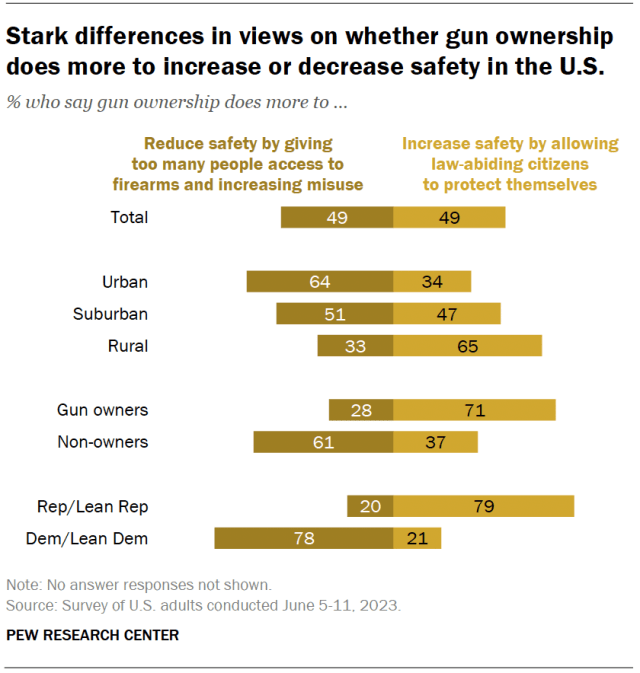
Fear may also lead some people in the opposite direction from regulation. Some gun owners believe firearms make them safer and doubt that stricter laws would prevent mass-shooting deaths. For them, fear can strengthen support for carrying or owning guns rather than for new restrictions. 3
The case against
There is meaningful evidence that fear and exposure to shootings can increase support for gun regulation. Young adults are somewhat more likely than older adults to favor stricter gun laws, and national surveys have repeatedly found majority support—58% in one Pew survey and 56% in a Gallup survey. 4
Research also suggests that proximity to violence matters. People who live nearer to mass shootings have been found more likely to support stricter gun control, while highly publicized shootings can produce sharp increases in public attention to gun-policy information. These findings qualify any simple claim that fear mainly produces division. 5
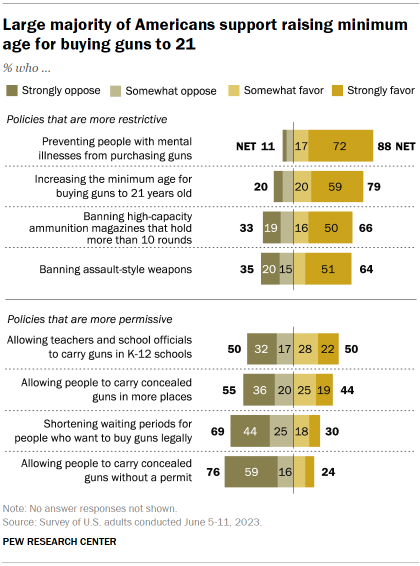
Agreement may also exist on particular policies even when people disagree about gun control in general. Pew has found bipartisan support for raising the minimum purchase age to 21, while showing much wider partisan gaps over assault-weapons restrictions and concealed-carry rules. Johns Hopkins research likewise finds that views vary according to the specific proposal, gun ownership and political identity.
The bottom line
The evidence moderately favors the claim in its literal sense: fear of mass shootings does not produce a unified preference for stricter gun laws among young voters. Some young adults and members of the wider public do move toward regulation, and exposure to shootings can strengthen that support. But the best direct evidence on young adults shows a conditional and divided response rather than a single common reaction.
The conclusion is more secure about the absence of consensus than about why people reach different views. Political identity, gender, gun ownership, perceived safety and proximity to violence may influence both fear and policy preferences. Most of the evidence shows associations rather than proving that fear itself caused a particular opinion, and national surveys do not always translate directly to young voters. Majority support for stricter laws is therefore real, but it should not be confused with unanimity or broad agreement on every policy.
Figures & data
All contributions are reviewed for clarity, balance, and evidence. The strongest insights are elevated into the argument graph — with credit to you.
Help improve this analysis →