Expanding Medicare eligibility beyond older Americans would substantially improve healthcare access without creating unsustainable costs
Bottom line (updated 2026-11-24): More Medicare access would likely help younger adults afford care and get needed help. But we are not sure yet whether the plan could avoid serious money strain; its design and funding would matter greatly.
What's this about?
People disagree about whether more adults should join Medicare before age 65.
The big question is whether this would help care without causing huge costs.
What supporters say
- When people join Medicare at 65, they find care easier to get and pay for.
- A larger public plan could use its size to push for lower prices.
- A larger Medicare plan could lower some costs for jobs and families.
What critics say
- Medicare already faces trouble paying its bills far into the future.
- One plan for people age 60 and older would raise the nation’s debt.
- More people might gain health coverage, but their real access to care might improve less.
- A plan that people choose freely might draw in more people with costly health needs.
How to read this
The number of points on each side does not show who is right; the strength of the proof matters more.
The bottom line
More Medicare access would likely help younger adults afford care and get needed help.
But we are not sure yet whether the plan could avoid serious money strain; its design and funding would matter greatly.
Expanding Medicare to younger adults could make healthcare more affordable and accessible, but the evidence is less clear on whether it could do so without creating serious financial strain. The answer would depend heavily on how the expansion was designed and financed.
The case for
The strongest evidence for expansion comes from what happens when people become eligible for Medicare at 65. Studies comparing people just above and below that age find that Medicare improves access to care, reduces affordability problems, increases prescription use and lowers medical financial stress. It also narrows some racial and ethnic gaps in coverage and access. These findings provide a strong reason to expect benefits for younger adults with unstable, expensive or incomplete private insurance, even though they do not directly measure a lower eligibility age. 1
Expansion could also shift some costs away from employers and households. A KFF analysis of lowering Medicare eligibility to 60 projected higher federal Medicare spending but lower employer health spending. That means an expansion could reduce some premiums or other private insurance costs while still increasing federal outlays. The two effects can happen at the same time. 3
Supporters also argue that public insurance may operate more efficiently by reducing administrative duplication and giving the government greater leverage over prices. Reviews of single-payer proposals have identified possible savings in administration and payments. But those studies cover much broader systems than a limited Medicare expansion, and their estimates range from large savings to significant increases in national health spending. The efficiency argument therefore offers a possible way to control costs, not proof that expansion would lower total spending. 2
The case against
The clearest fiscal warning comes from a federal analysis of one proposal to lower eligibility to 60. The Congressional Budget Office and Joint Committee on Taxation estimated that the plan would increase federal deficits by $155 billion from 2026 through 2031. That does not show that every expansion would be unaffordable, but it directly challenges the idea that better access could come without substantial federal costs. 4
Medicare is already a large and financially pressured program. The Centers for Medicare and Medicaid Services says it covered about 69.3 million people and spent slightly more than $1.2 trillion in 2025. The program’s trustees also warn of long-term financing uncertainty. Any expansion would therefore require decisions about new revenues, premiums, payment cuts, benefits or other offsets rather than simply relying on Medicare’s current financing. 5
More coverage may not translate into equally large improvements in care if doctors and hospitals lack capacity or respond to Medicare payment rates. Lower rates could create access problems in some specialties or regions, although available evidence suggests physician access for current Medicare beneficiaries has remained broadly stable despite slower payment growth. In other words, payment rates matter, but lower rates do not automatically prove that access would worsen. 6
A voluntary buy-in could create another problem. Healthier people might decide not to pay premiums, leaving a pool with unusually high medical costs. An earlier CBO analysis of a Medicare buy-in for adults ages 62 to 64 found that premiums could exceed average costs if the program had to finance itself. That could make coverage unattractive or require subsidies. 7
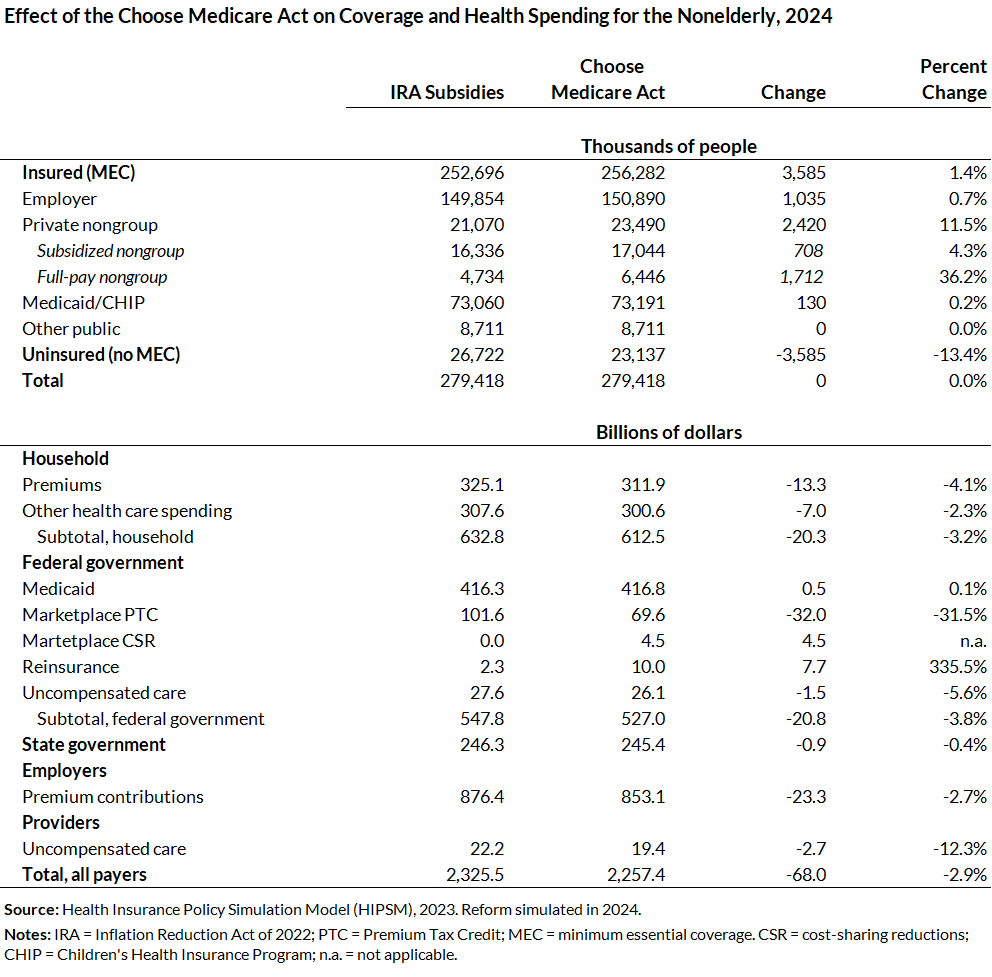
Finally, many newly eligible people would not be uninsured. Urban Institute modeling found that a lower eligibility age would move substantial numbers from employer coverage, Marketplace plans and Medicaid into Medicare. The size of the access gain would therefore depend on enrollment rules, subsidies and how existing coverage programs were treated. (see Figure 2)
The bottom line
The evidence clearly favors the access case more strongly than the cost case. Medicare’s existing age-65 threshold provides strong evidence that public coverage improves affordability and access, so a younger expansion would probably help at least some adults. But the evidence that it could do so without unsustainable costs is only moderate and remains unresolved.
The financial outcome would depend on the details: who enrolls, whether enrollment is automatic or voluntary, how the program is funded, what benefits it provides and how much providers are paid. Broader studies of single-payer systems cannot answer that question by themselves. The most defensible conclusion is that expansion would likely improve coverage-related access, while its effects on federal debt, total spending and provider capacity remain design-dependent.
Figures & data
All contributions are reviewed for clarity, balance, and evidence. The strongest insights are elevated into the argument graph — with credit to you.
Help improve this analysis →