Vaccine hesitancy is impacting global childhood vaccination rates
What's this about?
People disagree about whether doubt or worry about vaccines caused fewer child vaccine shots worldwide.
Some children miss shots because of fear, while others face blocked care or war.
What supporters say
- Studies in many lands link parent doubts about vaccines with children missing some shots.
- In some places, trust in vaccines fell during the pandemic, while child shot rates also stopped rising.
What critics say
- World data show missed shots, but they cannot show that vaccine doubts caused the world’s shortfall.
- Hard travel, closed clinics, war, cost, and weak health care also cause many missed shots.
How to read this
The number of points on each side does not show who is right; strong proof matters more than a long list.
The bottom line
Doubt about vaccines does cause some missed child shots in some places.
But we are not sure how much it caused the drop across the whole world; access problems also matter.
Vaccine hesitancy is contributing to lower childhood vaccination rates in some communities, but the evidence does not show how much it has driven the worldwide decline. Missed vaccinations also reflect access problems, disrupted health services, conflict and other practical barriers.
The case for
Studies from different countries show a clear link between parents’ concerns about vaccines and children receiving incomplete vaccinations. A systematic review found that knowledge, trust, perceived risks, convenience, costs and the quality of health services can all shape whether families keep up with recommended doses. Country-level research has also connected parental hesitancy with vaccination behavior. 2
Research in Türkiye, for example, found that parental concerns and refusal were linked to children missing some vaccinations. A household survey in Brazil likewise connected parents’ attitudes and doubts with how children were vaccinated. These studies do not show hesitancy’s share of the global shortfall, but they establish that it can affect uptake in real populations.
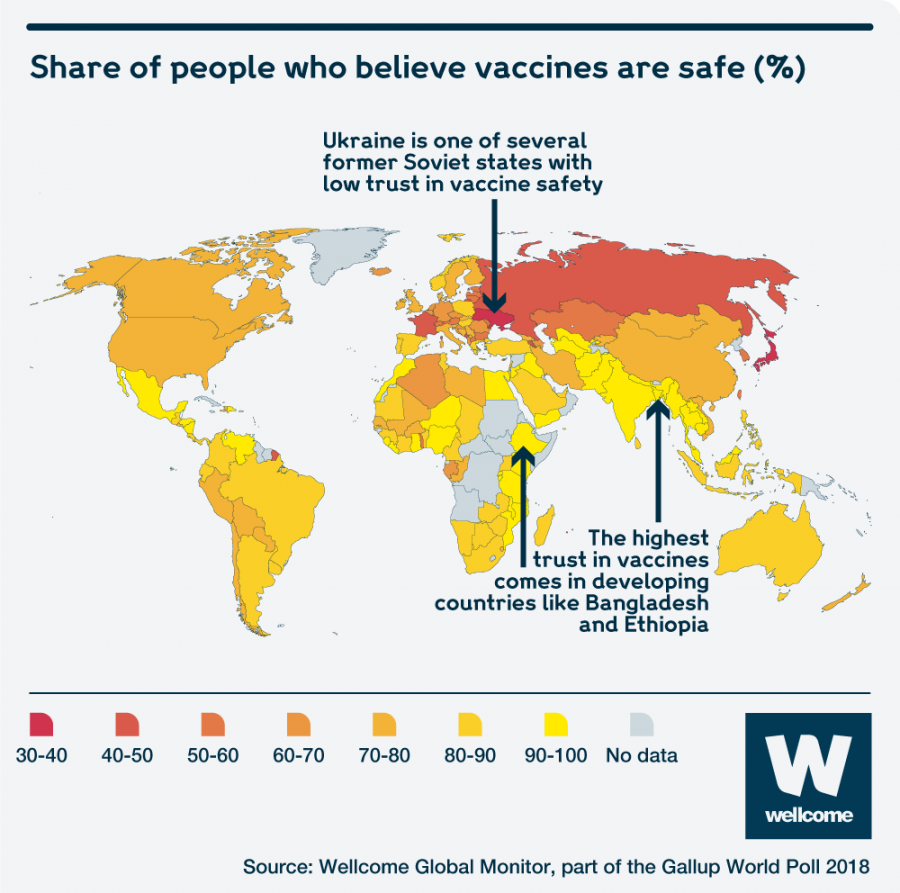
There is also evidence that confidence in vaccines weakened in many countries during the pandemic. UNICEF reporting and an international Vaccine Confidence survey found declines in the perceived importance or safety of vaccines in a number of settings, while routine childhood vaccination coverage stalled or remained below earlier levels. 1 The changes were not universal, however, and confidence moved differently from country to country.
Taken together, the findings support a narrower conclusion: hesitancy is a genuine cause of missed childhood vaccinations in at least some places. The evidence is strongest for an association between attitudes and incomplete vaccination, and for the possibility that falling confidence contributed to stalled uptake. It is much weaker when used to calculate a worldwide effect.
The case against
Global vaccination figures show how many children received vaccines, but usually not why others did not. A missed dose may result from refusal or misinformation, but it may also reflect vaccine shortages, travel distance, cost, conflict, displacement or an interrupted clinic. WHO and UNICEF coverage data show that global coverage of DTP-containing vaccines stayed below pre-pandemic levels for several years before partly recovering, but the figures do not identify what portion was caused by hesitancy. 3
Access and health-system failures provide major alternative explanations. WHO reports that conflict, insecurity, displacement, difficult geography and fragile services repeatedly leave children unvaccinated or only partly vaccinated. During the pandemic, health services were interrupted and many families missed opportunities to receive routine care. Evidence from Ethiopia links full vaccination to household circumstances, caregiver knowledge and access to services. Italian data also suggest that changes in healthcare use during COVID-19 played a role, without showing that hesitancy was responsible.
The WHO’s framework for understanding vaccination behavior separates motivation, including confidence and concerns, from practical issues such as access, social influences and service quality. That distinction matters: it would be misleading to treat every missed dose as a sign that a family rejected vaccination.
The research itself also has limits. Studies use different ways to measure hesitancy, and some rely on cross-sectional surveys or people’s own reports. Such studies can show that hesitancy and incomplete vaccination occur together, but they cannot always prove which caused the other. Global data also do not consistently connect each missed dose to a specific reason.
The bottom line
The evidence favours a qualified version of the claim, not the unqualified global one. There is strong evidence that vaccine hesitancy lowers childhood vaccination rates in some populations, but only limited evidence that it is a principal or measurable cause of the worldwide decline.
The overall picture is mixed. In some communities, concerns about safety, trust or vaccine importance appear influential. In others—especially areas affected by conflict, poverty, displacement or weak health services—practical barriers may matter more. The main unanswered question is not whether hesitancy can reduce vaccination, but how much it contributed globally compared with failures in access and delivery. Current evidence does not resolve that question with confidence.
Pros — Supporting Arguments
Figures & data
All contributions are reviewed for clarity, balance, and evidence. The strongest insights are elevated into the argument graph — with credit to you.
Help improve this analysis →