Executive officials should not be allowed to impose nationwide restrictions on mail-ballot procedures without clear statutory authority
Bottom line (updated 2026-09-01): The evidence leans toward requiring clear power from Congress before leaders set national mail-voting limits. Supporters have stronger reasons, while the critics’ claims rely on weaker proof.
What's this about?
People disagree about whether national leaders may limit mail voting without clear power from Congress.
The question also involves voter confusion, state control, and fast action during crises.
What supporters say
- Clear rules from Congress protect the power that states use to run elections.
- A nationwide limit could confuse voters and cause states to apply the rule in different ways.
- Limits could lower voter turnout, even though strong proof of cheating may not exist.
What critics say
- Broad laws may already give leaders power to change election rules during a crisis.
- Congress may lawfully create the same voting rules for every state.
How to read this
The number of points on each side does not show who is right; stronger proof matters more.
The bottom line
The evidence leans toward requiring clear power from Congress before leaders set national mail-voting limits.
Supporters have stronger reasons, while the critics’ claims rely on weaker proof.
The claim is that executive officials should not be able to impose nationwide limits on mail-ballot procedures unless Congress has clearly authorized them. The issue involves the constitutional division of election powers, the practical risks of changing voting rules nationwide, and the need to respond quickly to emergencies.
The case for
The strongest argument is constitutional. The Elections Clause gives Congress power to change state rules for federal elections, while states retain much of the day-to-day responsibility for running elections. That structure does not clearly give executive officials general power to impose nationwide restrictions on their own. Under the separation-of-powers framework from *Youngstown*, executive authority is strongest when Congress has approved the action and weakest when officials act without, or against, congressional direction. 1
The Supreme Court’s decision in *West Virginia v. EPA* adds another warning. The court rejected an agency’s attempt to claim major powers from unclear statutory language when the issue had broad economic and political importance. A nationwide change to mail-ballot procedures could raise a similar concern: the more significant the restriction, the clearer the legal authority should be.
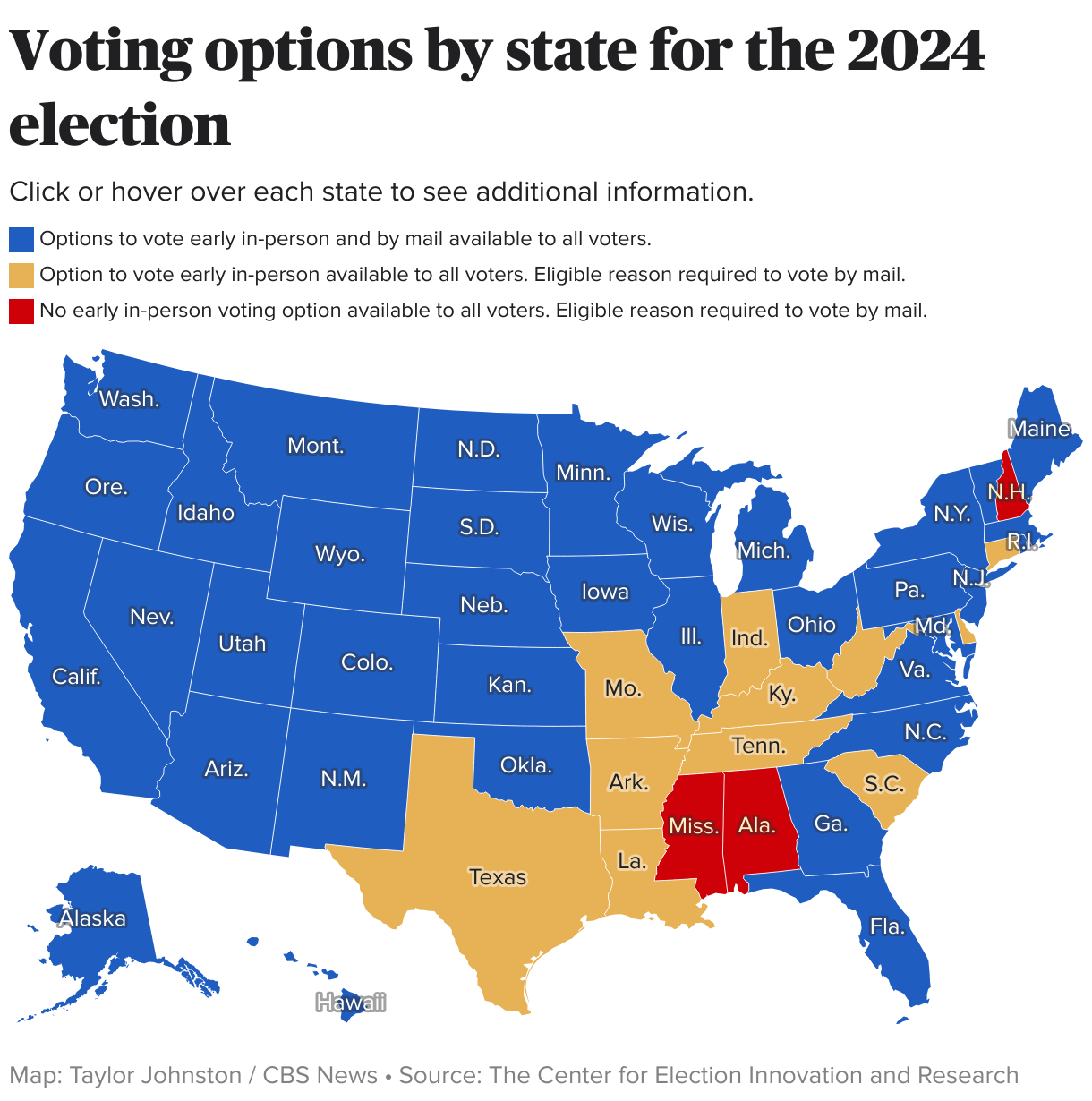
There are also practical reasons for caution. Mail voting depends on a patchwork of state and local systems covering ballot design, deadlines, signature checks, processing and voter education. Federal officials and the Postal Service have separate roles. A sudden nationwide restriction could conflict with those arrangements or be applied unevenly, especially close to an election. The Supreme Court’s *Purcell* principle warns that late changes to election rules can confuse voters and burden administrators. The institutional division behind this concern is summarized in the accompanying materials (see Figure 3). 2
The policy consequences may also be substantial. Peer-reviewed studies generally find that expanding mail voting increases turnout, although the effect varies by policy and population. A study of Washington state found no evidence of widespread fraud from expanded vote-by-mail. The 2020 election evidence shows that participation effects differed across states and voting systems (see Figure 1). These findings do not settle the legal question, but they support leaving major restrictions to Congress through a clear delegation, particularly when there is no strong evidence of fraud requiring immediate limits. 3
The case against
The main objection is that a strict clear-authority rule could slow legitimate emergency action. Congress may enact broad, temporary powers meant to address unforeseen threats to election administration, such as postal disruptions, disasters or security problems. Emergency-power scholarship argues that lawmakers cannot be expected to spell out every operational detail in advance. Requiring highly specific language in every emergency could delay measures that existing statutes were designed to permit. 4
Federal officials may also need discretion to apply uniform election standards. *Arizona v. Inter Tribal Council* confirms that Congress can lawfully establish nationwide rules for federal elections that override conflicting state requirements. That decision shows that uniform federal election standards are constitutionally possible. But it involved federal legislation, not an executive official acting without clear congressional authorization. The supporting evidence for this side is therefore limited: it relies mainly on general legal scholarship and does not identify a specific emergency delegation, evidence that a clear-authority rule caused harmful delays, or a court decision approving an executive restriction on mail ballots.
The bottom line
The evidence moderately to strongly favors a presumption that major nationwide mail-ballot restrictions require clear statutory authority. The constitutional and institutional case is considerably stronger than the counterarguments, especially where officials rely on ambiguous language and make a politically significant change across the country.
This is not an absolute ban on executive action. Congress may create uniform standards and may delegate bounded emergency powers, including authority limited by clear triggers, duration and oversight. Different measures—affecting delivery, deadlines, verification or drop-off locations—may also rest on different legal authorities. The unresolved question is how a court would assess a particular restriction, statute, emergency and timing. Confidence is high that clear authorization matters; it is lower on exactly how clear the law must be in every emergency.
Figures & data
All contributions are reviewed for clarity, balance, and evidence. The strongest insights are elevated into the argument graph — with credit to you.
Help improve this analysis →