Christianity will remain the world’s largest religion through 2070 despite demographic change
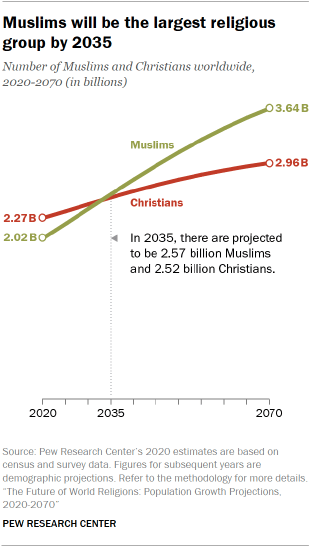
Bottom line (updated 2026-11-22): The best current studies point to Islam becoming the world’s largest faith around 2035. Christianity should still grow, but the claim that it will stay first through 2070 is not well backed.
What's this about?
People disagree about whether Christianity, the Christian faith, will stay the world’s largest faith until 2070.
The answer depends on birth rates, age, moves between lands, and people who leave a faith.
What supporters say
- Christianity stays strong across the world, and its total number should keep growing.
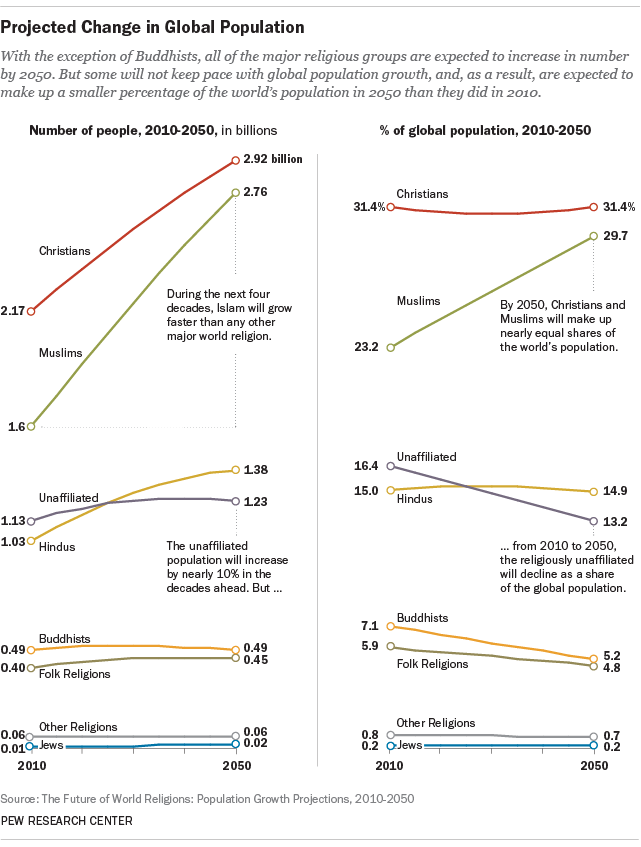
- An older study said about 2.9 billion Christians and 2.8 billion Muslims would live in 2050.
What critics say
- A newer study says Islam may pass Christianity around 2035 and stay ahead until 2070.
- Muslim groups are often younger and have more children, so they may grow faster.
- Some Christians leave the faith, which makes Christian growth weaker than it first seems.
- Much Christian growth happens in parts of Africa, while Muslim growth happens across many fast-growing lands.
How to read this
The number of points on each side does not show who is right; check how strong the proof is behind each point.
The bottom line
The best current studies point to Islam becoming the world’s largest faith around 2035. Christianity should still grow, but the claim that it will stay first through 2070 is not well backed.
The claim that Christianity will remain the world’s largest religion through 2070 is increasingly difficult to support. Current demographic projections put Islam ahead within the next decade, although long-range forecasts remain uncertain.
The case for
An earlier Pew projection supported Christian primacy, at least through 2050. That 2015 forecast estimated about 2.9 billion Christians and 2.8 billion Muslims in 2050, leaving Christianity narrowly in front (see Figure 2) 1. The small gap also showed how changes in assumptions about fertility, migration or religious identity could alter the ranking.
Christianity also remains a large and growing global faith. Pew estimates that Christians were the world’s biggest religious group in 2020 and projects that their total population will continue to rise, especially as growth shifts toward sub-Saharan Africa 2. This makes clear that demographic change does not mean Christianity is disappearing or facing a worldwide numerical collapse.
But this evidence supports Christian resilience more strongly than it supports the specific claim that Christianity will stay in first place. A growing population can still lose its lead if another group grows faster.
The case against
The most direct current evidence points the other way. Pew’s updated projection for 2020 to 2070 places Muslims ahead of Christians from about 2035 onward, with Muslims remaining the larger group through 2070 under the model’s assumptions (see Figure 1) 3. Because this forecast covers the exact period in question and directly compares the two populations, it carries more weight than the older projection ending in 2050.
The projected shift is driven largely by differences in age and fertility. Muslim populations are generally younger and are expected to grow faster, even while the number of Christians also increases 4. The result is a distinction between two claims: Christianity is projected to grow in absolute numbers, but it is not projected to retain global primacy.
Religious switching also works against the claim. In several historically Christian countries, people are moving toward unaffiliated identities. If those patterns continue, they will reduce Christian totals relative to groups with lower projected losses from switching 5.
Population growth is also concentrated in regions where both Christianity and Islam are major traditions, particularly sub-Saharan Africa. United Nations projections show especially rapid growth there, while Pew identifies stronger Muslim demographic momentum as a central reason for the projected change in global ranking 6.
These forecasts are not certainties. They depend on assumptions about fertility, mortality, migration, age structure and religious switching. Future behavior could differ substantially from current trends, and the earlier near-tie shows that relatively modest changes in assumptions can affect the outcome.
The bottom line
The evidence favors rejecting the claim, but only with low confidence. The strongest and most directly relevant projection says Muslims are likely to overtake Christians around 2035 and remain ahead through 2070. That updated forecast outweighs the older projection that kept Christianity narrowly ahead in 2050.
Still, the conclusion is a conditional demographic scenario, not a settled description of 2070. The crossover date is less certain than the broader finding that Muslim growth is likely to narrow or reverse Christianity’s current lead. Christianity is expected to remain a major and growing global religion; the evidence simply suggests it is more likely than not to lose first place.
Pros — Supporting Arguments
Figures & data
All contributions are reviewed for clarity, balance, and evidence. The strongest insights are elevated into the argument graph — with credit to you.
Help improve this analysis →