China will achieve effective naval superiority over the United States in at least part of the western Pacific by 2035
Bottom line (updated 2026-11-04): China could gain short-term control, or keep U.S. forces away, in some areas near Taiwan by 2035. The evidence supports this narrow claim more than the idea of lasting Chinese control across much of the western Pacific.
What's this about?
People disagree about whether China will gain stronger sea power than the United States in part of the western Pacific by 2035.
The answer depends on whether this means short-term control near China or lasting control over a huge area.
What supporters say
- U.S. shipyards face high costs, delays, and limits, which could slowly weaken America’s sea power.
- China could gather ships, planes, subs, and land-based missiles near its coast faster than America could arrive.
- China’s large ship-making power could help it build, fix, and replace warships during a long fight.
What critics say
- A larger fleet does not prove China could control the sea or beat U.S. forces.
- The United States would likely work with nearby friends, adding more ships, planes, bases, and supplies.
- U.S. forces could still stop China from gaining firm control of the area.
How to read this
The number of points on each side does not show who is right; the strength of each point’s proof matters more.
The bottom line
China could gain short-term control, or keep U.S. forces away, in some areas near Taiwan by 2035.
The evidence supports this narrow claim more than the idea of lasting Chinese control across much of the western Pacific.
China could achieve effective naval superiority over the United States in part of the western Pacific by 2035, but the claim depends heavily on what “superiority” means. Temporary control or the ability to keep U.S. forces away is more plausible than lasting command of a broad region.
The case for
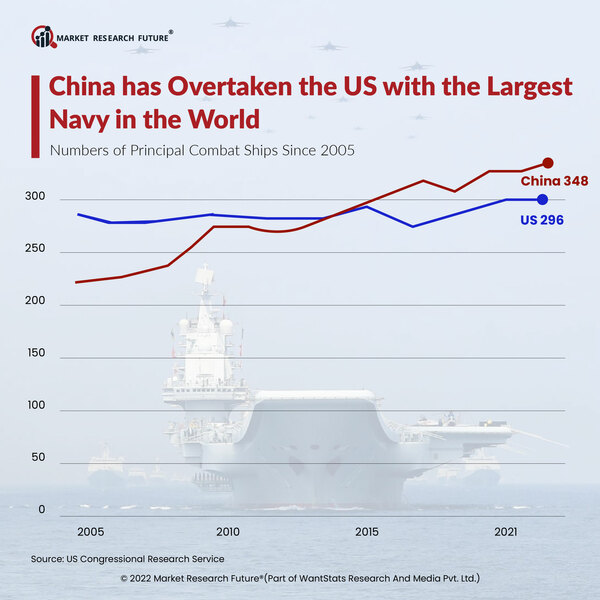
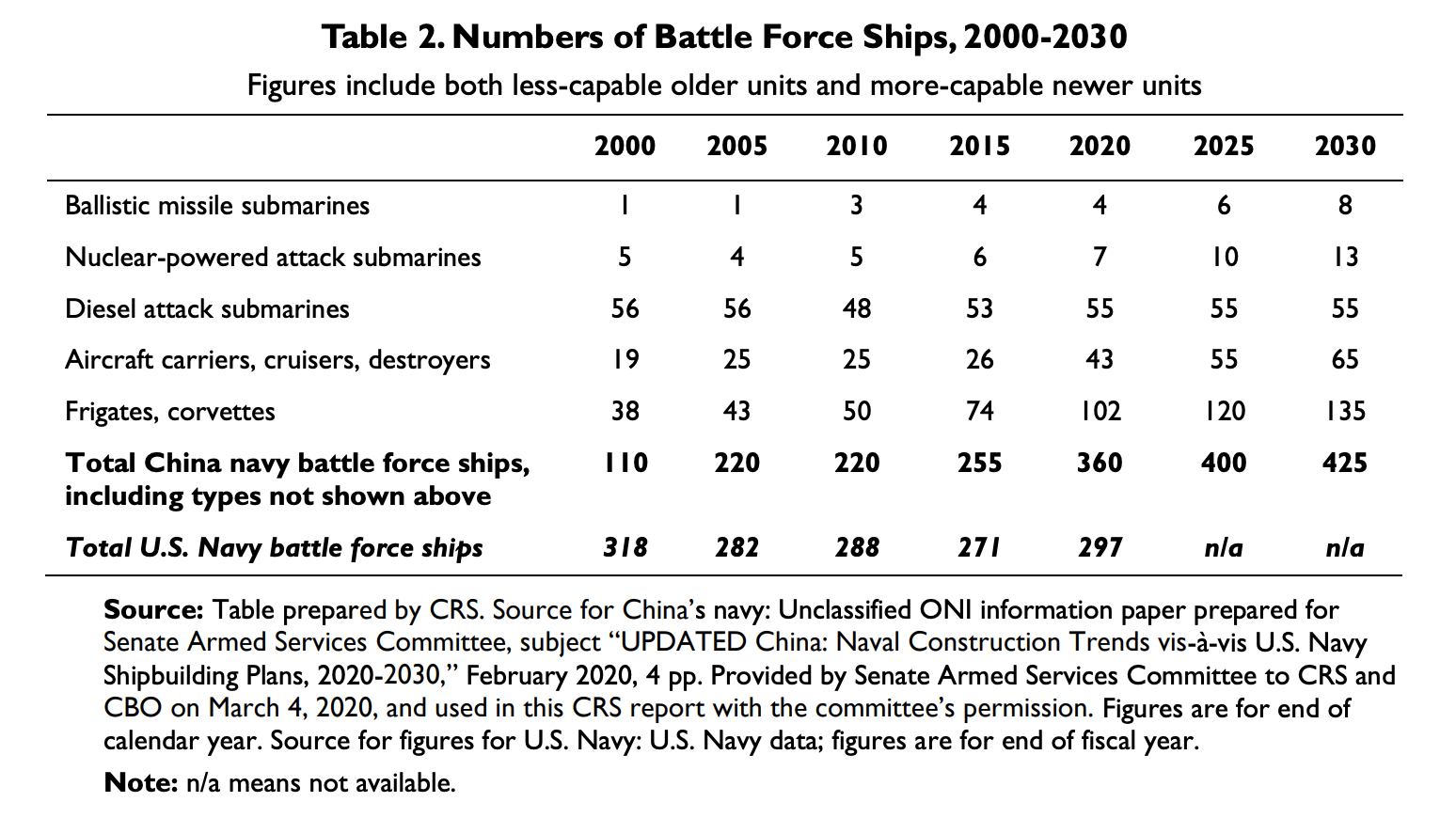
China has a plausible route to localized naval superiority, especially near Taiwan and the first island chain. It could combine a growing navy with land-based missiles, aircraft, submarines and surveillance systems operating close to Chinese bases. The U.S. Department of Defense projects China’s navy will grow from 395 ships in 2025 to 435 by 2030, with further expansion in major surface ships, submarines, carriers and support vessels (see Figure 1). 1
Those numbers do not prove China could win a naval war. But they suggest Beijing may be able to concentrate more forces near its own coastline than the United States could quickly bring from more distant bases. China’s anti-ship ballistic and cruise missiles, submarines, aircraft and sensors are designed to threaten U.S. ships and aircraft before they reach contested waters. Recent analysis suggests that China’s ability to deny access may extend beyond the first island chain. 1
This supports a narrower conclusion: China might temporarily control or deny access to a selected maritime area without defeating the U.S. Navy across the entire western Pacific.
China’s industrial capacity strengthens that possibility. It has a large and growing commercial shipbuilding advantage, and analysts say it is rapidly producing warships, submarines and smaller naval systems. If that capacity can also support maintenance, replacement and wartime production, China could reinforce a regional campaign or absorb losses more quickly than a simple comparison of fleets at one moment would suggest. 2
The United States faces its own constraints. Congressional analyses point to high costs, shipbuilding delays, industrial shortages and readiness problems in carrying out American fleet plans. The Navy’s preferred long-term goal of 381 manned ships is not a forecast for 2035, and the Congressional Budget Office has identified serious challenges to reaching such targets. If American plans fall short while China’s expansion continues, Chinese numbers and missile forces could become more important in a local contest. 3
The case against
Fleet size and proximity do not automatically produce naval superiority. Effective control at sea also requires forces that can find the enemy, communicate, survive attacks, maintain supplies and operate together under combat conditions. U.S. assessments identify continuing Chinese weaknesses in joint operations, anti-submarine warfare, logistics, maintenance, personnel, training and combat experience. Chinese forces are still working to improve even airborne anti-submarine capabilities. 4
The likely contest would also involve allies, not just the American and Chinese navies. Japan and South Korea could help offset U.S. shipbuilding and repair limitations, while other U.S.-aligned powers would present a major obstacle to Chinese operations. One CSIS survey found that 79 percent of security experts expected the United States to prevail in a conflict with China ten years later, although that was an expert poll rather than a battlefield simulation or a specific forecast of naval control. 5
Taiwan also shows why Chinese proximity would not guarantee decisive control. RAND concluded that Taiwan’s ability to withstand a large-scale Chinese attack would require U.S. military intervention. That does not establish American naval superiority, but it argues against assuming that China could reliably secure nearby waters on its own. 6
The bottom line
The evidence slightly favors the view that localized Chinese naval superiority by 2035 is plausible, particularly near Taiwan or the first island chain. China’s expanding forces, missile network and industrial base provide the strongest support for that assessment.
But the evidence does not show that this is the most likely outcome. The strongest opposing evidence is that fleet numbers do not measure readiness, survivability or sustained control, and that U.S. intervention and regional allies could substantially change a local contest. The overall confidence is low. China’s growing capability is clear; whether it can turn that capability into durable, combat-effective control against U.S. forces and partners remains uncertain.
Figures & data
All contributions are reviewed for clarity, balance, and evidence. The strongest insights are elevated into the argument graph — with credit to you.
Help improve this analysis →