Carbon capture technology is a dangerous distraction

Updated 2026-07-29 5 supporting · 4 opposing arguments
Aldo's Synthesis high
Based on the strength of the Arguments below
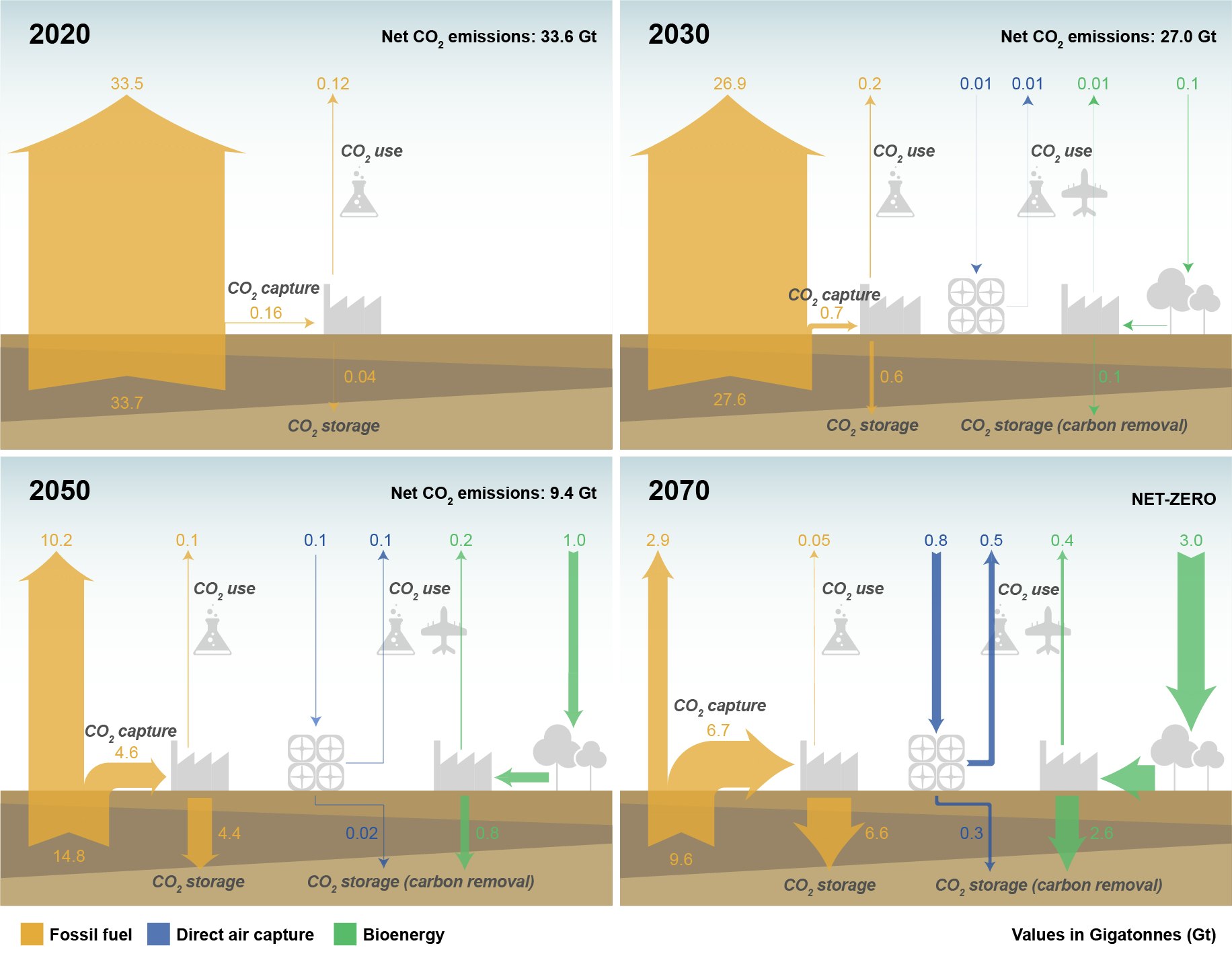
The claim asks whether carbon capture is sufficiently costly, slow, risky, or politically misused that it diverts attention and resources from efficiency, electrification, renewable energy, and direct reductions in fossil-fuel use. The relevant comparison is not whether capture can work in principle, but whether particular applications deliver reliable net mitigation relative to feasible alternatives and without weakening near-term emissions cuts. That inquiry must distinguish point-source capture from carbon removal, industrial process emissions from fossil-power generation, and physical storage performance from the policy consequences of promising future deployment. The strongest support for the claim is the persistent delivery risk: institutional and government assessments report that actual deployment remains below pathway expectations and that large projects face material technical, financial, schedule, permitting, and infrastructure barriers (see Figure 1). In one United States demonstration portfolio, the Department of Energy supplied about $1.1 billion to eleven coal and industrial CCS projects during fiscal years 2010–2017, but only three were built; coal projects were particularly unsuccessful, with outcomes attributed partly to economic conditions and weaknesses in project selection, negotiation, and oversight. More recent assessments still identify uncertain business models, financing constraints, long development periods, coordination needs, and project setbacks, making announced capacity an unreliable proxy for timely emissions reductions. Although the project pipeline is growing, planned capacity is not equivalent to completed facilities, verified annual capture, or permanent storage, and deployment remains off track for the IEA's net-zero pathway (see Figure 2). A second concern is mitigation deterrence: promises of future capture or removal can justify slower action now even though novel removal remains extremely small, its future scale is uncertain, and climate-compatible pathways still require sharp declines in fossil-fuel use. Scenario analysis finds that dependence on future greenhouse-gas removal can produce substantial additional emissions if it delays near-term mitigation and removal later proves constrained or unavailable. Broad assessments likewise warn that removals face constraints involving land, energy, water, cost, permanence, ecology, and feasible deployment speed, and cannot substitute for deep emissions reductions. Accordingly, presenting CCS as a basis for unrestricted continuation or expansion of fossil fuels conflicts with pathways in which capture is only one component and fossil production and consumption still decline sharply. Capture also delivers less than its nameplate rate when its energy demand, incomplete coverage, and upstream emissions are included, so gross captured tonnes do not by themselves establish net climate benefit. A case-based lifecycle analysis found smaller climate and air-pollution benefits for some fossil-plus-capture systems than for replacing fossil energy with low-emission electricity after accounting for capture energy and upstream emissions. That result is not universal, because the study's conclusions depend on selected cases, the energy source, upstream assumptions, and a 20-year climate-accounting horizon. Finally, geological storage creates enduring governance obligations concerning site characterization, well integrity, monitoring, pressure management, leakage, induced seismicity, abandoned wells, liability, and long-term funding. Careful siting, monitoring, adaptive operation, and well management can reduce these hazards, but they do not eliminate geological uncertainty or the need for durable regulatory capacity. The strongest challenge is that a categorical rejection of capture overlooks residual and process-related emissions for which direct alternatives may remain costly, immature, or incomplete, particularly in cement, steel, chemicals, refining, and some hydrogen production. A systematic review reports substantial technical potential for industrial CCS and identifies cement and some high-concentration streams as comparatively favorable opportunities, while also finding wide cost variation and added complexity from retrofits, energy demand, and infrastructure. Institutional and literature assessments also retain roles for capture in industrial decarbonization and for limited removal to counter emissions that remain after direct mitigation. Stringent climate pathways commonly include CCS or carbon removal as parts of a broader portfolio, so excluding them can shift a larger burden onto faster efficiency gains, behavioral change, renewable deployment, electrification, and fossil-fuel retirement. These modeled roles do not show that every capture project is necessary or least-cost, but they do undermine the proposition that capture is inherently incompatible with an effective climate strategy. Nor do they guarantee deployment at the assumed scale, because assessed removal potentials are highly uncertain and CCS deployment rates remain below many modeled trajectories. Storage evidence further rebuts the strongest version of the danger claim: monitored geological sequestration is not inherently unworkable, and well-selected, well-managed reservoirs can retain carbon over long periods. At Norway's Sleipner site, seismic and subsurface monitoring has tracked the injected plume and supported storage management for more than two decades. The IPCC's foundational storage assessment estimated that appropriately selected and managed reservoirs were likely to retain more than 99% of injected carbon dioxide over 1,000 years, while newer risk literature identifies monitoring and site management practices that reduce, but do not remove, risk. A single site cannot establish performance across all geologies, wells, operators, and regulatory systems, and the IPCC's quantitative estimate predates much subsequent deployment. The evidence therefore supports an application-specific judgment: capture is most defensible as a regulated supplement for selected residual industrial emissions and removals, and least defensible when used to defer cheaper direct mitigation or preserve broad fossil-fuel use. Coal-power retrofits, cement process capture, direct air capture, bioenergy with CCS, and capture linked to enhanced oil recovery differ in costs, resource demands, counterfactuals, lifecycle emissions, and storage outcomes; evidence about one category cannot be transferred automatically to another. Failed or expensive coal demonstrations are relevant to delivery risk but do not invalidate capture from favorable industrial streams, just as successful reservoir monitoring does not prove that capture is preferable to renewable substitution where direct replacement is feasible. Project-level accounting is the decisive boundary condition because capture costs and technical performance vary substantially by process, while current novel removal is too small for capacity announcements alone to establish climate value. Credible evaluation should examine verified capture rates and uptime, additional energy, upstream emissions, transport losses, storage permanence, and whether the carbon is permanently stored rather than used in a way that induces additional fossil production. Policy sequencing is equally important: major assessments pair capture with efficiency, renewables, electrification, and reduced fossil demand rather than treating it as their substitute. A bounded capture program can therefore coexist with rapid direct mitigation, whereas making future capture the condition for postponing proven measures would reproduce the deterrence risk at the center of the claim. The main remaining gap is not the absence of pro, con, or conditional evidence, but the lack of a common comparative metric across heterogeneous capture applications and their local alternatives. The bundle does not provide a portfolio-wide comparison of abatement cost, construction time, lifecycle emissions, public subsidy, and opportunity cost against specific efficiency, electrification, renewable, or demand-reduction projects. It also does not resolve how often capture funding actually displaces direct mitigation, rather than supplementing it, so the central allegation of diversion is more strongly established as a risk than as a universal observed effect. Generalization from available cases remains constrained by differences among geologies, industries, energy inputs, policy regimes, and project maturity. Some evidence concerns modeled pathways or prospective capacity rather than realized operating performance, while prominent storage evidence includes a mature site whose record cannot represent every reservoir or governance system. The unresolved conflict-of-interest classifications also counsel caution when interpreting deployment projections from organizations institutionally committed to CCS expansion. On balance, the evidence supports the claim in its conditional form—carbon capture is a dangerous distraction when it delays direct mitigation, relies on speculative future scale, or sustains broadly avoidable fossil use—but does not support treating all capture as inherently distracting or dangerous. A limited role for well-accounted industrial capture, residual-emissions management, and monitored geological storage is consistent with the evidence, provided it supplements rather than substitutes for rapid efficiency, renewable deployment, electrification, and fossil-fuel reduction. Confidence in this balanced conclusion is high; the dominant uncertainty is whether project-specific opportunity costs and institutional conflicts of interest can be resolved well enough to distinguish useful supplementation from mitigation deterrence in practice.

Supporting Arguments

P1CCS can divert scarce money from cheaper near-term emissions cuts
Coal demonstration experience shows a high risk of spending public funds without obtaining operating capture facilities, while both the IEA and GAO document continuing financial and delivery barriers. Where efficiency, renewable power, grids, or electrification can eliminate emissions sooner and more cheaply, prioritizing capture may delay larger near-term reductions.
80/100 · Data Analysis
P2Promises of future removal can weaken present mitigation
Research on mitigation deterrence finds that expected future removals can rationalize slower emissions cuts, with harmful consequences if those removals later fail to scale. Current novel removal is tiny and constrained, so using prospective capture as permission for continuing emissions presents a genuine moral-hazard risk.
76/100 · Logical Inference
P3Capture does not erase upstream emissions or its own energy demand
Capture equipment consumes energy and usually does not capture every emission across fuel extraction, transport, combustion, and the facility supply chain. Case-based lifecycle analysis therefore finds that some fossil-plus-capture systems perform materially worse than replacing fossil energy with low-emission power, although results depend strongly on assumptions and project design.
73/100 · Direct Evidence
P4Capture rhetoric can prolong fossil-fuel infrastructure
Climate-compatible pathways still require steep reductions in unabated fossil-fuel use, and fossil consumption declines even in scenarios where CCS is available. Policies that market CCS as a license for broad continuation or expansion of fossil fuels therefore conflict with the modeled role of CCS as a limited complement for residual emissions.
49/100 · Logical Inference
P5Storage creates long-term environmental and governance obligations
Geological storage requires careful siting, well integrity, monitoring, liability allocation, and management of pressure, leakage, and induced-seismicity risks. These risks can be reduced but not assumed away, making rapid deployment without strong regulation and long-term funding potentially dangerous.
70/100 · Direct Evidence

Opposing Arguments

C1Some industrial emissions are difficult to eliminate without capture
Cement, steel, refining, and chemical production include concentrated or process-related emissions that cannot always be removed merely by switching the electricity supply. Systematic and institutional assessments therefore identify targeted industrial CCS as a potentially important tool, particularly where direct zero-carbon process alternatives remain expensive or immature.
78/100 · Direct Evidence
C2Rejecting CCS could make stringent climate targets harder to reach
The IPCC assesses CCS and carbon removal as components of many least-cost pathways, especially for residual emissions and net-negative phases. Pathways using less CCS are possible, but generally demand faster progress in efficiency, behavioral change, electrification, renewables, and fossil-fuel retirement; calling all capture a distraction overlooks this trade-off.
68/100 · Expert Opinion
C3Geological storage can be monitored and managed successfully
Sleipner's multi-decade monitoring record demonstrates that injected CO2 can be imaged and managed in a real reservoir, countering claims that geological storage is inherently unworkable. Broader assessments also conclude that well-selected, well-managed sites can achieve high long-term retention, though this does not guarantee every proposed project.
88/100 · Direct Evidence
C4Deployment is growing despite an uneven project record
The global project pipeline and shared transport-and-storage proposals indicate increasing commercial and policy interest. However, announced capacity should not be confused with operational performance, and evidence from failed demonstrations means growth forecasts alone do not refute the distraction claim.
64/100 · Data Analysis

All contributions are reviewed for clarity, balance, and evidence. The strongest insights are elevated into the argument graph — with credit to you.

Help improve this analysis on ProConWiki →
𝕏 Share Facebook LinkedIn