Candidates for elected office should accept legitimate election results even when they lose
Bottom line (updated 2026-10-18): The evidence clearly favors accepting a checked result when no strong proof could change it. The duty has limits: candidates may still bring serious, legal claims that could change the winner.
What's this about?
People disagree about whether losing candidates should accept the official result.
They should accept it after fair checks find no serious proof that could change the winner.
What supporters say
- Unproven claims about cheating can make people trust elections less, even when checks support the result.
- Accepting a checked loss can help power move to the next leader without unrest or fights.
- A clear concession, or public admission of defeat, shows that the race has ended and work can begin.
- Candidates can accept the winner while still pointing out mistakes in how the election ran.
What critics say
- Acceptance should not stop a candidate from using the courts when strong proof could change the result.
How to read this
The number of points on each side does not show who is right; the strength of each point matters more.
The bottom line
The evidence clearly favors accepting a checked result when no strong proof could change it.
The duty has limits: candidates may still bring serious, legal claims that could change the winner.
The claim is that losing candidates should recognize a certified election result when independent checks and lawful reviews find no credible reason to change it. But that duty is conditional: accepting the outcome must not prevent legitimate legal challenges based on serious, outcome-changing evidence.
The case for
Conceding a verified defeat helps keep the transfer of power peaceful. When no credible evidence remains that could change the result, continued refusal can turn an ordinary electoral loss into a prolonged political crisis. Comparative research places nonconcession among documented post-election disputes linked with risks including unrest, violence and instability, although it does not provide one definitive estimate of how much refusal itself causes those outcomes. 1
The clearest evidence concerns public trust. Peer-reviewed experimental research found that unsupported claims of voter fraud reduce confidence in elections, including among people most exposed to those claims. That does not mean all criticism is harmful. But when a candidate continues to deny a result after credible verification, without substantiating the allegations, the message can weaken belief that elections are legitimate and that power can change hands lawfully. (see Figure 3) 2
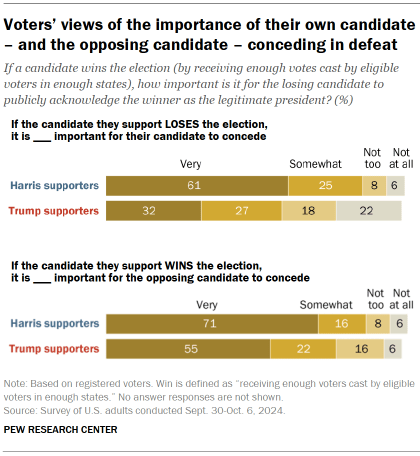
Concession also signals that the campaign is over and governing can begin under the certified result. That matters when voters already fear election-related violence. A Pew survey examined whether people think a losing presidential candidate should concede alongside their concerns about political violence, treating concession as a visible way to reduce tensions after an election. (see Figure 1) 3
The principle is therefore strongest in elections that are genuinely free, fairly administered and independently checked. A candidate’s acceptance of the result can acknowledge the legally determined winner without endorsing every part of the election process or abandoning criticism of administrative failures.
The case against
Acceptance should not mean an immediate or unconditional surrender of legal rights. Election systems provide formal ways for candidates to challenge results when credible irregularities may have affected the outcome. Those procedures set rules about who can bring a case, where it can be heard and how quickly it must be filed. 4
Certification alone is not always enough. The obligation to accept a result depends on the quality and independence of the institutions that verified it. A formal certification by bodies that are biased, compromised or unable to investigate credible allegations would not necessarily settle the matter.
The evidence also does not show that concession by itself guarantees democratic stability. Elections can still involve fraud, disenfranchisement, poor administration and deep institutional distrust. Nor does an earlier concession ensure that democratic conduct will continue in the future. The available research also does not establish exactly how much concession independently reduces violence or how long its effect on public confidence lasts.
The difficult questions are practical ones: What counts as credible evidence? How independent must the review be? And when is an irregularity serious enough to have changed the winner? The supplied evidence does not provide universal answers. Those judgments must be made case by case.
The bottom line
The evidence favours a conditional duty to accept election results, with moderate confidence. Candidates should recognize a certified outcome when independent verification and completed legal review find no credible, outcome-changing basis for reversal. Unsupported denial is associated with lower public confidence, and refusal to concede is part of a broader pattern of post-election disputes.
But the evidence does not support an unconditional rule that certification alone ends all disagreement. The opposing case is decisive where serious, unresolved evidence could have changed the result, or where the reviewing institutions lack independence. The strongest conclusion is therefore simple: accept a credibly verified loss, while continuing to use lawful remedies when a genuine basis for challenge remains.
Pros — Supporting Arguments
Cons — Opposing Arguments
Figures & data

All contributions are reviewed for clarity, balance, and evidence. The strongest insights are elevated into the argument graph — with credit to you.
Help improve this analysis →