Billionaires should not exist
What's this about?
People disagree about whether anyone should be allowed to own one billion dollars or more. The key worry is whether huge wealth harms fair chances and fair government.
What supporters say
- Huge wealth can pass through families, making it harder for other children to get the same chances.
- Rich people often gain from family money, helpful contacts, and rules that favor people who already own things.
- Skill and hard work matter, but they do not fully explain wealth this large.
- Billionaires can spend a lot on votes, law makers, and news groups, which gives them extra power.
What critics say
- The facts more clearly support limits on harm than a total ban on billionaire wealth.
- Making money or building useful firms does not always hurt other people.
- A legal ban could treat all very rich people as harmful, even when their actions do not cause harm.
- Governments can reduce unfair power without saying that no one may become a billionaire.
The bottom line
Big piles of wealth can harm fair chances and give a few people too much say. Stronger taxes, taxes on money passed down, and rules against hidden wealth may help more than a full ban.
The claim that billionaires should not exist rests on a real concern: whether extreme private wealth damages democracy and locks in advantage. But the available evidence supports curbing the harms of concentrated wealth more clearly than it supports a universal legal ban on billionaire fortunes.
The case for
The strongest argument for limiting billionaire wealth is that it can make opportunity less equal from one generation to the next. Research on wealth inequality points to inheritance, ownership of capital, institutional advantages and the cumulative benefits of already being wealthy. Studies also suggest that when wealth is highly concentrated, children’s prospects depend more heavily on their family background than on their own efforts. 2
That evidence challenges the idea that billionaire fortunes are always the simple result of exceptional talent and hard work. Research on the stories behind extreme wealth finds that family resources, professional networks, gender barriers, institutions and unequal access to opportunity often play major roles. Merit matters, but it is not the whole explanation for fortunes at this scale (see Figure 2). 4
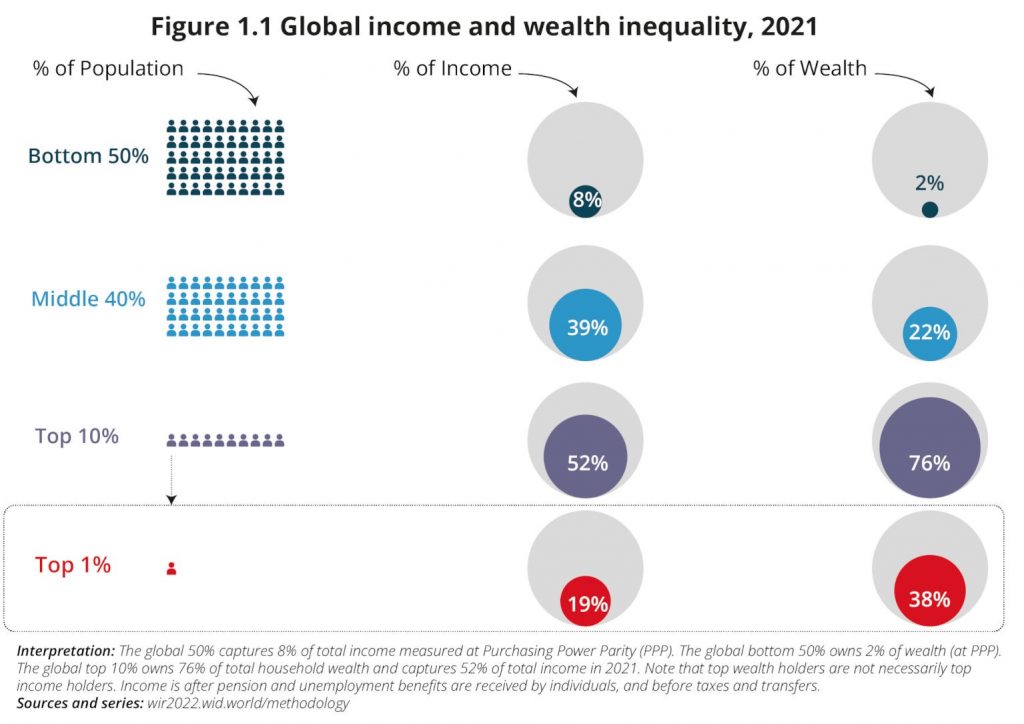
There is also a democratic concern. Billionaires can spend on elections, lobbying and media ownership, and can influence public debate and the issues that governments choose to address. Even when that influence is legal, it gives a small number of people far greater ability than ordinary citizens to shape campaigns, information and policy priorities (see Figure 1). 1
The evidence suggests that governments have tools to address these risks without treating wealth creation itself as wrong. The OECD, IMF and World Inequality Report support measures including progressive taxation, stronger taxes on capital income and inheritances, better enforcement, and international cooperation against offshore wealth and tax competition. These policies can reduce durable concentrations of wealth and their wider social effects. 3
The case against
The main objection to a blanket ban is that not all billionaire fortunes have the same source or effect. Some are linked to high-growth businesses, entrepreneurship and innovation, which can contribute to economic growth. Research distinguishes wealth built through productive enterprise from wealth tied to political connections or extracting special favors. 5
That does not mean billionaires must be allowed to keep unlimited fortunes. But it does mean that a rule treating every billionaire identically could overlook important differences. Existing research also cannot establish, on its own, whether billionaire wealth causes growth or whether a hard wealth ceiling would reduce investment, innovation or job creation.
A legal cap would also be difficult to put into practice. Billionaire wealth is often held in businesses, shares and other assets whose value changes sharply and may not be easy to sell. Governments would have to decide how to value these assets, prevent avoidance, enforce rules across borders and deal with capital moving to lower-tax countries. The IMF’s work favors improving taxes on income from capital, inheritances and property before relying on a standalone annual wealth tax, reflecting these practical obstacles. 6
Private philanthropy is another possible benefit of large fortunes. Billionaires may fund charitable projects, and evidence suggests that incentives can encourage giving. Yet the available research does not show that billionaire-led philanthropy is more effective than collecting public revenue and spending it through democratically accountable institutions. Charity can help, but it is not proven to be a substitute for taxation or public services. 7
The bottom line
The evidence strongly supports the view that extreme wealth concentration can create political and intergenerational harms. It also supports policies to reduce those harms: progressive taxes, inheritance taxes, action against avoidance, stronger enforcement and international coordination.
But there is not enough direct evidence to conclude that every billionaire fortune should be categorically prohibited. The research largely examines inequality, political influence, entrepreneurship and tax policy—not the real-world effects of imposing a hard ceiling at the billionaire threshold.
The clearest conclusion is that governments should target the mechanisms that cause harm: tax avoidance, inherited advantage, corruption, anti-competitive conduct and outsized political influence. Whether those measures should ultimately lead to a legal ban on billionaire-level wealth remains a moral and political choice, not a conclusion the current evidence can settle.
Figures & data


All contributions are reviewed for clarity, balance, and evidence. The strongest insights are elevated into the argument graph — with credit to you.
Help improve this analysis →