Automation taxes are necessary to fund the transition
What's this about?
People disagree about whether governments should tax automation (machines doing jobs) to help workers through job changes.
What supporters say
- Robots can cut jobs and pay in some towns, mainly for workers with fewer skills.
- Workers may need money, new job skills, or help finding work after these changes.
- A robot tax could make firms that gain from machines help pay for that support.
- More machines may shift money from paychecks to company profits, reducing payroll tax money.
What critics say
- Automation can also help firms make more goods and create some new jobs.
- Its effects differ by job, town, and how bosses bring in new tools.
- Global trade and strong big firms also affect pay and job losses.
- A robot tax could slow useful new tools if leaders design it badly.
The bottom line
Automation can hurt some workers and towns, so a tax may help in some cases. But the evidence does not show that robot taxes always must fund job changes.
Automation could bring serious disruption for some workers and communities, raising a clear question: should governments tax robots and artificial intelligence to pay for the transition? The evidence suggests such taxes may be useful in some circumstances, but it does not show they are universally necessary.
The case for
The strongest argument for an automation tax is that the costs of technological change can fall heavily on particular workers and places, while the financial gains flow elsewhere. Studies comparing U.S. local labor markets with different levels of industrial-robot exposure found that areas more exposed to robots saw lower employment and wages, especially among lower- and middle-skilled workers. European research has also found losses for some workers, even as automation raises productivity and benefits others. 1
Those losses can create substantial public costs. Workers may need income support, retraining, help moving to new jobs, or stronger employment services. A tax linked to automation offers a straightforward principle: businesses that benefit from labor-saving technology could help finance assistance for people harmed by the change. The OECD has highlighted worker anxiety, training needs and uncertainty that vary widely by occupation and how technology is introduced. Employer surveys also point to major skill changes, with both jobs created and jobs displaced. 4
There is also a broader concern about the tax base. If automation shifts income from wages toward profits and capital owners, governments may collect less from payroll taxes while inequality grows. An IMF working paper links part of the decline in labor’s share of income to technological change and automation, alongside other forces such as globalization and market power. U.S. tax rules can also favor capital investment and automation over hiring workers, reinforcing the appeal of correcting that imbalance. 2
Economic models offer qualified support for such action. They suggest that a carefully calibrated automation tax can improve overall welfare when automation creates costs that firms do not bear, worsens inequality, or receives unusually favorable tax treatment. But those results depend heavily on the existing tax system, the effect on production, and how easily firms can substitute machines for workers. 3
The case against
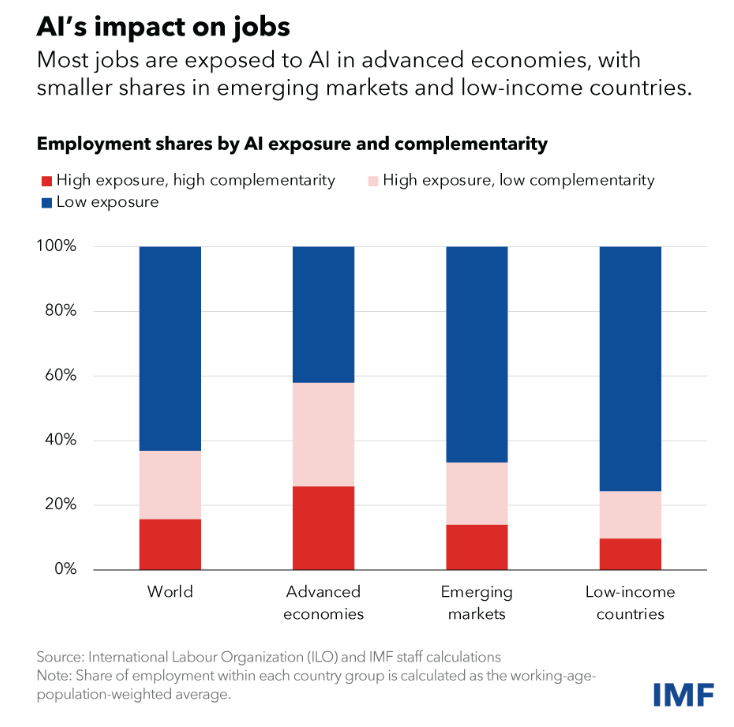
The main weakness in the claim is the word “necessary.” Evidence that workers need support does not prove that a special tax on robots or AI is the only, or best, way to pay for it. The IMF emphasizes stronger social protection, education and retraining, as well as better taxation of high incomes, capital gains and capital income. It treats automation-specific taxes as one possible tool, not the central proven answer to AI disruption (see Figure 3). 7
A robot tax would also be hard to design. Policymakers would have to decide what counts as a robot or automated system, distinguish technology that replaces workers from technology that helps them, and prevent companies from reorganizing investments to avoid the tax. Software, algorithms, machinery and worker-supporting tools often overlap. These boundary problems could make a technology-specific levy arbitrary, costly to administer and easy to evade. 5
There is a further economic risk. Automation does not simply eliminate jobs; it can remove particular tasks while creating complementary work, lowering prices and generating new demand. The OECD stresses that effects differ by industry, occupation and the way technology is introduced. Employer projections anticipate both job losses and job creation, so projected displacement alone cannot show that automation will cause a lasting fall in total employment or public revenue. 8
Taxing automation too broadly could also discourage useful investment, reduce productivity and slow job creation in related sectors. Rather than taxing a machine or algorithm directly, governments might more effectively reform depreciation rules, payroll taxes and capital taxation that already favor automation. A tax on excess profits, economic rents or capital-income gains could capture concentrated benefits without forcing officials to draw uncertain lines around what technology is taxable. 6
The bottom line
The evidence supports targeted action where automation causes significant disruption, inequality or tax distortions. In those situations, an automation-related levy may be worth considering, particularly if ordinary revenues and worker-support systems are clearly inadequate.
But the available research does not establish that governments must impose a technology-specific robot or AI tax to fund the transition. Broader reforms to capital and income taxation, combined with social protection and training, could achieve the same goals more efficiently. There is still no strong real-world comparative evidence showing that automation taxes raise sufficient revenue, can be enforced cleanly, and outperform those alternatives.
Figures & data
All contributions are reviewed for clarity, balance, and evidence. The strongest insights are elevated into the argument graph — with credit to you.
Help improve this analysis →