Artificial intelligence is more likely to deepen geopolitical divisions than foster international cooperation
Bottom line (updated 2026-11-01): AI could deepen splits, especially through war tools, unequal access, and rival goals. Still, we are not sure yet whether AI will split countries more than it helps them work together.
What's this about?
People disagree about whether AI will split countries apart or help them work together.
AI means computer tools that can learn, solve tasks, and make choices.
What supporters say
- Unequal access to AI may leave some countries weak and more dependent on a few strong ones.
- AI used for war, spying, or cyber attacks may raise fear and make fights more likely.
- Rival countries may compete for AI tools, workers, money, and computer power.
- Countries share worries about AI, but their rules often differ and lack force.
What critics say
- AI experts can share research and safety work across country borders.
- AI may help countries talk, spot danger, and manage tense events.
- New world deals show that many countries can agree on basic AI rules.
How to read this
The number of points on each side does not show who is right; strong proof matters more than a long list.
The bottom line
AI could deepen splits, especially through war tools, unequal access, and rival goals.
Still, we are not sure yet whether AI will split countries more than it helps them work together.
The claim is that artificial intelligence is more likely to widen geopolitical divisions than to bring countries together. The evidence points to real risks on both sides, but it does not yet provide a reliable probability ranking.
The case for
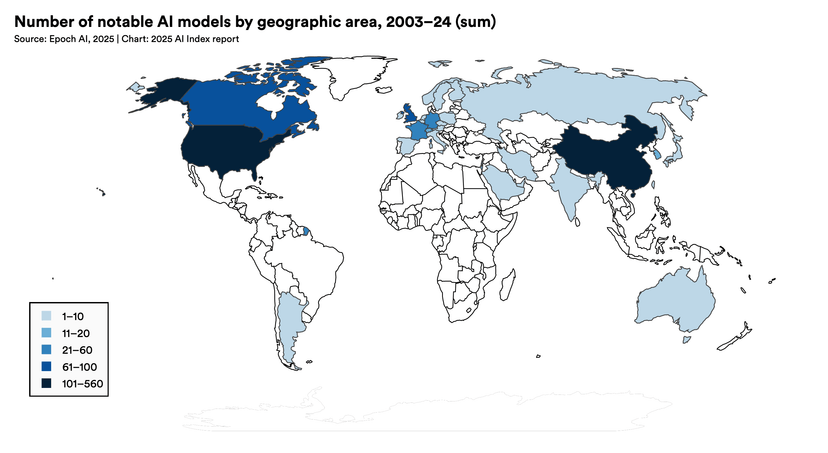
The strongest argument is structural: AI power is becoming concentrated. Frontier models, computing capacity, investment and specialist talent are clustered in a small number of countries and companies. The AI Index also shows major differences between countries in research strength and technical capability, patterns consistent with growing strategic competition, though they do not by themselves prove that division will prevail. 1 (see Figure 1)
Unequal access could also widen political divides. Countries with less computing power, data, expertise and investment may become dependent on a few technology leaders and have less influence over the rules governing AI. The existence of these gaps is well supported. Their eventual political effect is less certain: dependence could create leverage and exclusion, but it could also encourage technology-sharing agreements or joint development.
Military uses provide a more direct route to rivalry. AI can affect deterrence, intelligence, cyber operations and autonomous weapons, prompting governments to fear that rivals are gaining an advantage. SIPRI links AI to military competition, instability, escalation and arms-control problems. The International AI Safety Report likewise identifies cyber, biological and loss-of-control risks, while warning that strategic competition can restrict information-sharing. 2
This creates a classic security dilemma: even when countries share an interest in reducing harm, they may hesitate to reveal capabilities or cooperate closely if doing so could weaken their position. Shared principles have not fully solved the problem. International AI governance remains fragmented and often voluntary, leaving room for different national rules, competing technology blocs and persistent mistrust. 4
The case against
Cooperation is not merely theoretical. UNESCO’s 193 member states unanimously adopted a global recommendation on AI ethics, while OECD members updated principles calling for cooperation, compatible systems and shared responses to cross-border risks. These agreements show broad normative coordination, although their voluntary or nonbinding nature makes it unclear how consistently they will be implemented. 5
Cross-border research offers stronger evidence of practical cooperation. International AI collaboration remains common, including across geopolitical rivalries, and experts see opportunities for selective cooperation on technical safety. But this cooperation is limited rather than comprehensive. The same safety literature warns that collaboration can create information-security and strategic risks, and that competition limits what countries and companies are willing to share. 6 (see Figure 3)
AI could also help diplomacy by improving consular services, crisis management, public diplomacy and communication between governments. These applications might reduce administrative barriers and help countries respond more quickly during crises. But the evidence mainly identifies possibilities rather than showing that AI has already produced better diplomatic outcomes overall. 7
The bottom line
The evidence leans toward the claim, but only weakly and with low confidence. Concentrated capabilities, military competition and weak governance provide substantial support for the division pathway. Evidence of shared norms, international research and selective safety cooperation prevents a confident conclusion that geopolitical conflict is more likely than cooperation.
The central uncertainty is not whether either pathway exists. It is whether strategic competition will overwhelm, coexist with or be limited by institutions capable of turning shared principles into durable cooperation. Current research is better at showing mechanisms and present conditions than at measuring which outcome will dominate over time. There is no common, long-term measure comparing geopolitical division with cooperation across countries and sectors.
AI therefore appears conditionally divisive rather than inherently so. It is more likely to deepen divisions where advanced capabilities are concentrated, militarized and restricted, and where governance is weak. Shared standards, inclusive institutions and narrowly focused safety partnerships could push its effects in the opposite direction.
Figures & data


All contributions are reviewed for clarity, balance, and evidence. The strongest insights are elevated into the argument graph — with credit to you.
Help improve this analysis →