Among young voters, fear of mass shootings does not consistently translate into support for stricter gun-control laws
Bottom line (updated 2026-10-17): Fear does not lead all young voters to the same view. The claim is mostly right, but fear still links with more support for gun laws in young adults overall.
What's this about?
People disagree about whether fear of mass shootings makes young voters back tougher gun laws. The answer changes by group, law, and trust in the law’s likely results.
What supporters say
- Fear leads young men, right-wing voters, and other groups toward quite different gun views.
- Young adults did not all back more gun laws after the Parkland school shooting.
- Young adults may back one gun law but reject another law.
What critics say
- Fear links with more support for gun laws when we look at young adults as a whole.
- Some tests and real-world studies show that fear can raise support for gun laws.
- Many young adults back laws that aim to cut the number of shootings.
How to read this
The number of points on each side does not show who is right; strong proof matters more than a long list.
The bottom line
Fear does not lead all young voters to the same view. The claim is mostly right, but fear still links with more support for gun laws in young adults overall.
Among young voters, fear of mass shootings does not produce one predictable response. It is linked to stronger support for gun restrictions in some groups, but to greater opposition in others, depending on political identity, demographics, the specific proposal and whether people believe the policy will work.
The case for
The strongest evidence comes from research focused directly on young adults. A peer-reviewed study of nearly 1,700 people ages 18 to 29 found a modest link between fear of mass shootings and support for gun control across the group as a whole. But that relationship reversed among young men, Republicans and conservatives: greater fear was associated with greater opposition to gun-control measures. 1 The finding suggests that fear can be interpreted in opposite ways—either as a reason to restrict guns or as a reason to keep them for protection.
National survey comparisons also weaken the idea that highly publicized shootings reliably move young adults toward stricter laws. One analysis found that young adults expressed less support than older adults for 16 of 20 gun policies. Their views were also largely unchanged between 2017 and 2019, a period that included the 2018 Parkland school shooting. 2 That does not mean the event had no effect on any individual, but it challenges the broader claim that fear consistently produces a lasting shift among young voters.
There is also no single attitude called “support for stricter gun control.” Young adults can favor one restriction while rejecting another, and partisan differences remain substantial across individual proposals. 3 That makes a simple fear-to-support pathway difficult to sustain.
The case against
The main challenge is that fear is associated with greater support overall. The same study of emerging adults found a positive relationship in its full sample, even though the pattern differed sharply among subgroups. 4 In other words, the evidence does not show that fear is generally unrelated to gun-control views.
Other research strengthens the case that fear can actively change opinions, rather than merely appearing alongside them. Studies examining attitudes around an actual mass shooting, along with observational research and survey experiments, found that anxiety about mass shootings can increase support for gun control. This work was not limited to young voters, but it provides evidence for a real fear effect. 5
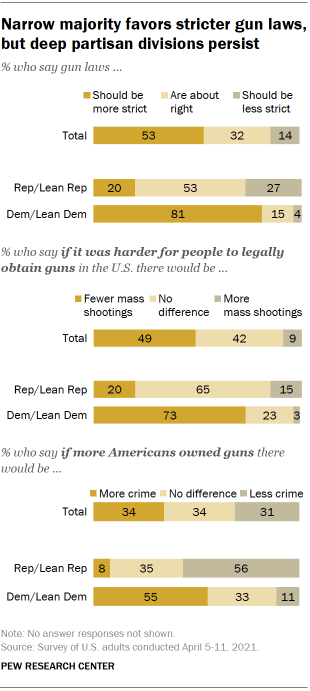
Many young adults also believe that at least some stricter measures could reduce shootings. Pew Research found that 62% of adults ages 18 to 29 said making guns harder to obtain would lead to fewer mass shootings—the highest share among the age groups surveyed (see Figure 2). That finding shows that concern often coincides with support for tighter access, although it does not establish support for every proposal or prove that fear caused the opinion. 6
The connection between fear and policy support may also depend on whether people think a law will be effective. Approval of the 2022 federal gun law was higher than the share who believed it would greatly reduce gun violence, showing that support for a law and confidence in its results can diverge. Research linking permit-to-purchase laws with fewer mass public shootings, and large-capacity-magazine bans with fewer deaths and injuries when shootings occur, may shape those judgments.
The bottom line
The evidence favours the claim in its qualified form, with high confidence: among young adults, fear of mass shootings does not consistently translate into support for stricter gun laws. The strongest age-specific evidence shows opposing responses among important groups, while broader surveys find little general increase in support after Parkland.
But the evidence does not support saying that fear has no effect. Fear is linked to greater support overall and for some policies, and broader research suggests it can cause opinion changes. The key uncertainty is how often fear changes young voters’ views, how lasting those changes are, and how much the outcome is shaped by party identity, beliefs about self-protection, the specific law being considered and confidence that it will work.
Figures & data

All contributions are reviewed for clarity, balance, and evidence. The strongest insights are elevated into the argument graph — with credit to you.
Help improve this analysis →