Abortion bans should include an exception when continuing a pregnancy threatens the woman’s health
Bottom line (updated 2026-11-02): The proof mostly supports allowing abortion when pregnancy seriously threatens a woman’s health. But we are not sure which legal words would protect care best, and data on bans and deaths remain unclear.
What's this about?
People disagree about whether abortion bans should allow abortion when pregnancy threatens a woman’s health.
The main question asks how much danger she must face before the law allows care.
What supporters say
- Pregnancy and birth can cause serious health risks, even before a woman faces death.
- A narrow law may make doctors wait until a woman becomes very sick before giving needed care.
- Denying an abortion can lead to worse health, money, and well-being results for people who sought one.
What critics say
- We are not sure whether abortion bans cause more deaths, because state health results can differ for many reasons.
- A health exception may use unclear words, so doctors may still fear jail or loss of their jobs.
How to read this
The number of points on each side does not show which side is right; strong proof matters more than a longer list.
The bottom line
The proof mostly supports allowing abortion when pregnancy seriously threatens a woman’s health.
But we are not sure which legal words would protect care best, and data on bans and deaths remain unclear.
The claim is that abortion bans should allow an abortion when continuing a pregnancy threatens a woman’s health, even if she is not yet facing immediate danger of death. The evidence generally supports that principle, but is less clear about which legal wording would work best.
The case for
Pregnancy and childbirth can themselves create serious health risks, and some conditions make an abortion medically appropriate before a patient reaches a life-threatening crisis. The National Academies describes legal abortion as a safe medical procedure when compared with the risks of continuing pregnancy and childbirth. The World Health Organization also treats comprehensive abortion care as an essential health service aimed at reducing preventable illness and death. 1
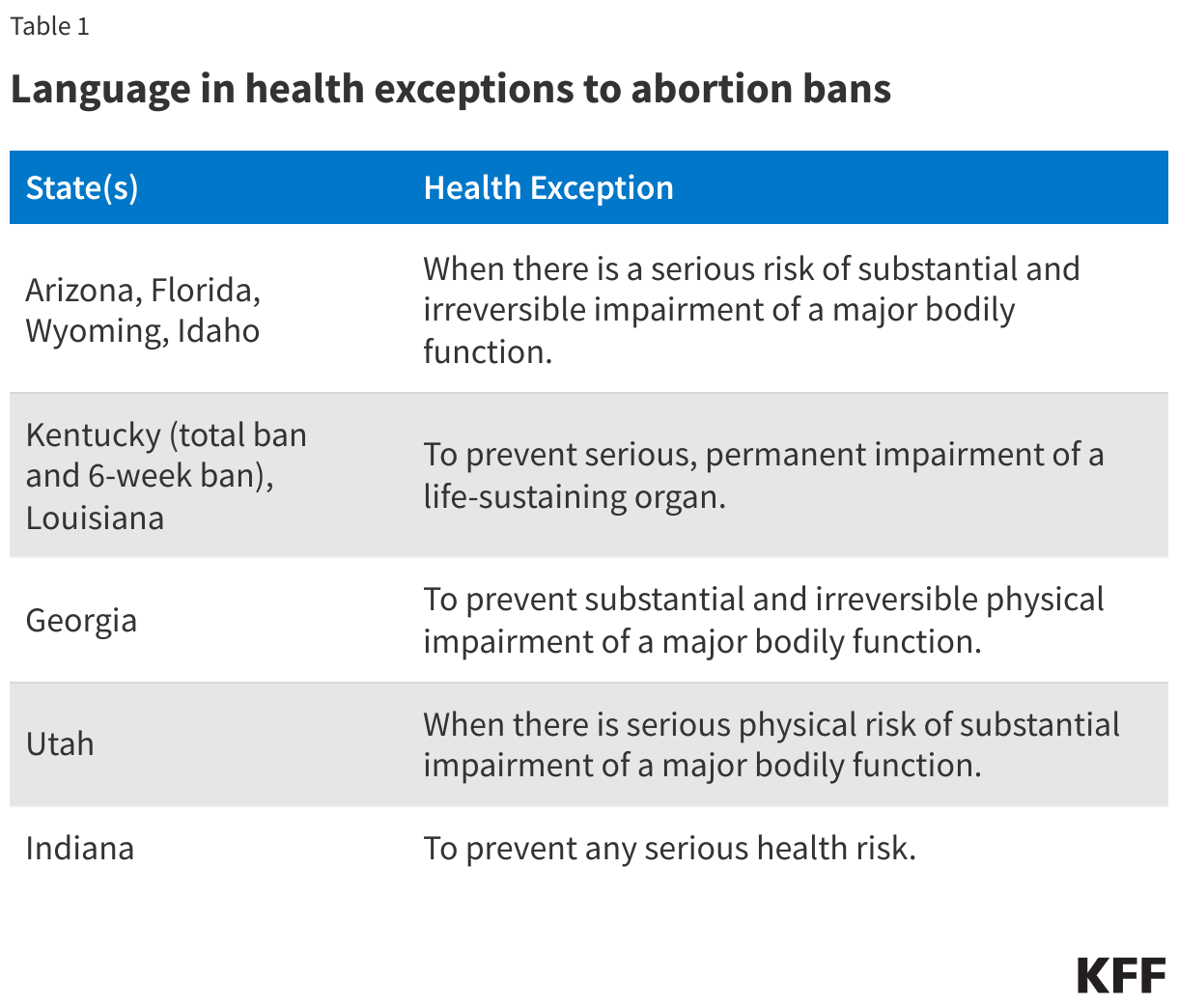
A major concern is that a life-only or “imminent danger” exception may force doctors to wait until a patient is already critically ill. Analyses in the *New England Journal of Medicine* and by the KFF health policy organization describe how vague laws, narrow definitions of health and fear of criminal or professional penalties can make clinicians delay treatment. Medical groups have similarly argued that necessary care should not require a patient to deteriorate first. 2
The evidence also suggests that denying an abortion can carry health and broader personal costs. The Turnaway Study compared people who received abortions with those denied care because they were just beyond a clinic’s gestational limit. Those denied abortions were more likely to continue unwanted pregnancies and experienced later health, economic and well-being consequences. The study found no evidence that receiving an abortion worsened long-term self-reported physical health. 3 Forecasting and observational studies have also linked abortion bans with higher maternal mortality or severe maternal illness, though those findings depend on assumptions and can be affected by other differences between states.
Together, these findings support an exception covering serious threats to physical or psychological health, not only conditions that are already immediately fatal. They also support allowing doctors to act preventively, based on good-faith clinical judgment.
The case against
A health exception may be difficult to apply in practice. The outcome depends on the law’s wording, how prosecutors and licensing authorities enforce it, and whether doctors can predict future deterioration. Existing exceptions vary, and narrow or unclear rules may leave physicians unsure whether treating a patient before an emergency could expose them to criminal or professional penalties. 4 In that situation, an exception may exist on paper while still failing to prevent delays.
Broader evidence about abortion bans and maternal outcomes is also unsettled. Some post-*Dobbs* studies report higher mortality or severe illness in states with bans, while others find mixed results or larger increases in selected measures of illness in states without bans. Short study periods, changes in medical coding, the Covid-19 pandemic, differences in health systems and other state-level factors make it difficult to identify the bans’ direct effects. One national study found that fetal and maternal health exceptions did not change the link between abortion restrictions and increased infant deaths. But infant deaths are not the same as maternal outcomes, and the finding does not show that an exception would fail during an individual medical emergency. 5
Most importantly, there is no direct comparison showing how different health-exception wordings affect maternal health under otherwise similar conditions. Existing studies generally examine bans or broader state policies, rather than testing the operation of one particular legal exception. The research also does not establish how often doctors refuse indicated care because of legal risk, which protections would change their behavior, or whether broader safeguards measurably improve outcomes.
The bottom line
The evidence favors including a health exception, but with moderate rather than complete confidence. The strongest evidence supports the underlying principle: pregnancy can seriously threaten health, and requiring doctors to wait for imminent death can delay necessary treatment. Evidence about the harm of being denied an abortion also supports allowing intervention before a crisis.
The uncertainty is mainly about implementation. A workable exception would need to cover serious physical and psychological threats, permit preventive treatment before imminent danger, defer to good-faith medical judgment and protect clinicians from penalties when they act responsibly. The evidence supports that approach more clearly than it proves the effects of any specific statutory language.
Pros — Supporting Arguments
Cons — Opposing Arguments
Figures & data
All contributions are reviewed for clarity, balance, and evidence. The strongest insights are elevated into the argument graph — with credit to you.
Help improve this analysis →