A ceasefire negotiated through U.S. envoy diplomacy in Ukraine can last at least 12 months without binding security guarantees
What's this about?
People disagree about whether U.S. peace talks could help Ukraine keep a ceasefire for 12 months.
The main question is whether this could work without a firm promise to defend Ukraine.
What supporters say
- Careful checks and shared reasons to pause could help both sides follow the ceasefire.
- U.S. talks could bring short-term peace without a treaty promise to fight for Ukraine.
What critics say
- Checks cannot stop rule-breaking when the side that breaks the deal faces no real cost.
- Ukraine had past ceasefires, but fighting began again after each pause.
How to read this
The number of points on each side does not show who is right; strong proof matters more.
The bottom line
A 12-month ceasefire seems possible, but the proof does not make it a safe forecast.
Both sides have points here, but the supporters’ evidence is weaker.
The claim is that U.S. envoy diplomacy could produce a ceasefire in Ukraine that lasts at least 12 months, even without binding security guarantees. The evidence shows this is possible, but not a reliable forecast.
The case for
A ceasefire does not necessarily need a formal treaty guarantee to hold. If both sides temporarily see a pause as better than continued fighting, and if violations can be detected and blamed, they may have reasons to comply. Monitoring, diplomatic pressure and the threat of political or economic costs could help sustain an agreement. 1
Research on ceasefires in other conflicts suggests that clear implementation measures and incentives to comply can significantly reduce violence. Monitoring can also reduce uncertainty by showing who violated an agreement and documenting what happened. The experience of Colombia’s FARC ceasefire illustrates that a negotiated pause can endure under the right conditions, although the comparison is limited: Colombia was not a high-intensity interstate war, and the arrangement did not present exactly the same security problems.
U.S. diplomacy could also create temporary compliance without turning its support into a formal promise to defend Ukraine. Washington might combine political pressure, economic incentives, monitoring and continued military assistance. Current reporting indicates that diplomatic proposals, battlefield conditions and outside pressure continue to shape the war’s direction. That means sustained U.S. involvement could change the immediate costs of breaking a ceasefire. 2
But this is a conditional possibility, not direct evidence that a ceasefire would last a year. A pause would be more credible if both sides benefited from restraint and if the agreement included strong verification, penalties, limits on arms movements and force deployments, and workable territorial and political arrangements.
The case against
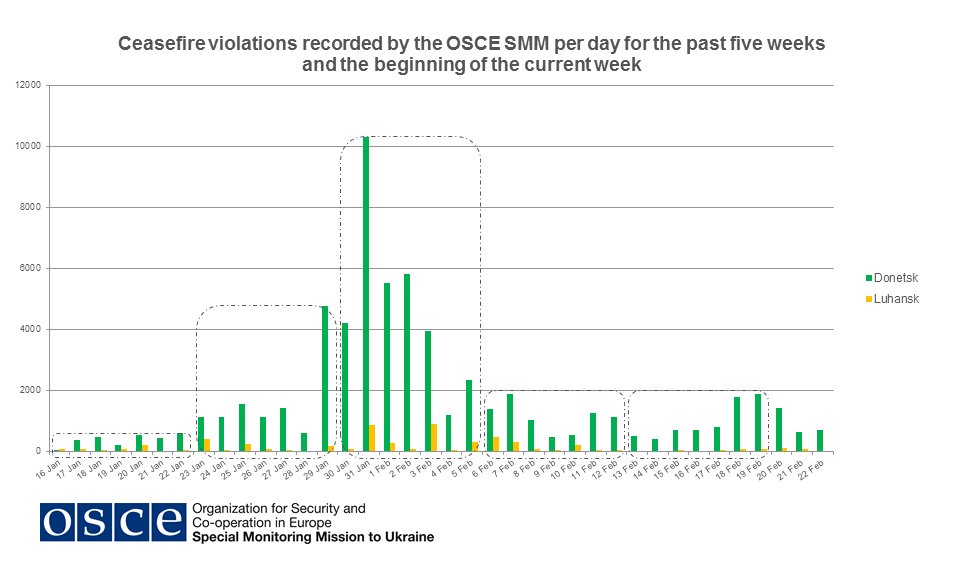
Ukraine’s own experience presents the strongest warning. The Minsk agreements and their associated ceasefires did not prevent repeated violations or, eventually, a return to large-scale war. OSCE monitors recorded frequent breaches and faced restrictions on their access. That history directly challenges the idea that international observation and diplomatic mediation are enough to preserve a ceasefire. 3 (see Figure 1)
Monitoring can establish what happened, but it cannot by itself force a government or military to comply. This is especially serious when a party believes renewed fighting could bring a military advantage. If violations carry no credible consequences, documenting them may do little more than confirm that the agreement is weakening. 4
The OSCE experience also shows how restricted access can undermine verification. More broadly, studies of peace settlements find that credible security arrangements matter because each side worries that the other could use a pause to rearm, improve its position or prepare for another offensive. Without binding guarantees, there is less confidence that violations would bring protection or enforcement rather than more observation. (see Figure 2)
The historical comparison is not conclusive. A new agreement could offer stronger verification, better incentives and more credible penalties than Minsk did. But the past record makes it difficult to infer that U.S. mediation alone would produce a durable ceasefire.
The bottom line
The evidence slightly favours caution, but not a firm rejection of the claim. A 12-month ceasefire without binding security guarantees is plausible if the parties’ immediate interests favour restraint and the agreement has effective monitoring and meaningful consequences for violations.
However, the evidence for those mechanisms is weaker than the evidence of Ukraine’s previous ceasefire failures. No available study directly estimates the chance that a future U.S.-brokered ceasefire, without binding guarantees, would survive for 12 months. The materials identify important risks and possible routes to success, but they do not establish a dependable probability.
The result is moderate confidence that such a ceasefire could happen under favourable conditions, but low confidence that it can be predicted in advance. The main uncertainties are the design of the agreement, the parties’ incentives and whether violations would bring real costs.
Figures & data
All contributions are reviewed for clarity, balance, and evidence. The strongest insights are elevated into the argument graph — with credit to you.
Help improve this analysis →