Young adults’ economic pessimism is driven more by housing and cost-of-living pressures than by stagnant wages alone
Bottom line (updated 2026-11-19): Housing and daily costs seem to matter more than weak pay growth alone. Still, we are not sure how much each problem adds, so this answer has limits.
What's this about?
People disagree about whether young adults feel gloomy about money mainly because of housing and rising daily costs.
The question is whether these pressures matter more than pay that has barely grown.
What supporters say
- Housing takes a large share of income and can delay young adults from supporting themselves.
- Rising prices for food and other needs can make people feel less safe about their money.
- Home prices have risen faster than young adults’ pay in many places.
- Debt and unsafe housing can add extra stress when pay already feels too low.
What critics say
- Most studies do not clearly show how much each problem causes young adults’ money worries.
- Pay that barely grows may sit at the root of high housing costs and other money troubles.
How to read this
The number of points on each side does not show who is right; the stronger proof matters more.
The bottom line
Housing and daily costs seem to matter more than weak pay growth alone.
Still, we are not sure how much each problem adds, so this answer has limits.
Young adults’ economic pessimism appears to be driven more by the rising cost of housing and everyday essentials than by weak wage growth alone. But the evidence cannot cleanly separate the effects, so the conclusion remains qualified.
The case for
Housing is a direct and unusually heavy financial burden. The Federal Reserve identifies housing as the largest expense for most families and reports greater housing pressure among renters and lower-income households. Pew’s analysis also links housing costs and limited wealth accumulation to young adults’ broader economic disadvantage. High rents, mortgage payments and the cost of entering the housing market can delay homeownership and financial independence, even when people’s nominal pay is not falling 1. (see Figure 3)
Housing has also become less affordable relative to young adults’ earnings. Pew’s analysis of government data found that home prices rose faster than young adults’ incomes from 2019 onward in the United States and in most metropolitan areas. That gap represents a distinct pressure beyond the simple question of how much people earn 3. (see Figure 1)
The wider cost of living adds to the strain. The Federal Reserve found that inflation—particularly food and grocery prices—remained a leading financial concern. Its 2025 survey also found a decline in financial well-being among young adults, although the inflation findings cover adults more broadly and are not limited to that age group 2.
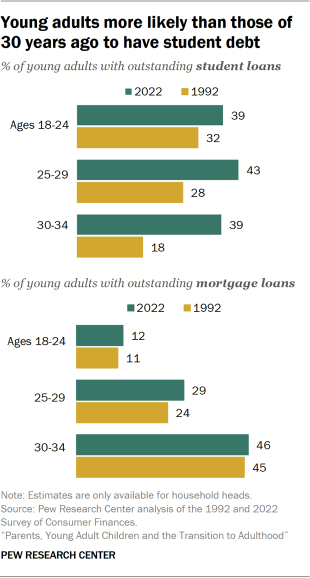
Other evidence points to the same pattern. The Office for National Statistics identified reducing living costs as one reason young adults live with their parents. Pew found that debt is associated with weaker economic well-being among young adults. Together, these findings suggest that pessimism reflects not only wages but also the money left after rent, food, debt payments and other basic obligations 4. The debt evidence, however, predates the most recent surge in housing prices and inflation.
The case against
The main challenge is not that housing and prices are unimportant. It is that the available research does not firmly show they matter more than stagnant wages.
Historical evidence from the Economic Policy Institute indicates that typical workers’ wages have fallen behind productivity growth. Another analysis connects wage stagnation with rising living costs in young Americans’ financial distress. From this perspective, unaffordable housing may partly result from inadequate earnings: if wages had kept pace with productivity or living costs, some housing pressures might have been less severe 5. The wage evidence deserves caution, however, because one cited analysis is not clearly peer-reviewed and the EPI is an advocacy-oriented source.
The larger problem is comparison. Surveys and affordability studies can show that people worry about inflation, housing or their financial situation, but they rarely measure the separate contribution of each factor. Housing prices, rents, wages, interest rates, student debt and job prospects are closely connected. Showing that one pressure is noticeable does not prove it has a greater independent effect on pessimism 6.
The evidence also covers different groups, countries, years and outcomes. Housing behavior is not identical to economic pessimism, and adult-wide responses to inflation cannot automatically be assumed to represent young adults. Housing and financial pressures also vary by income, tenure, borrowing conditions and household circumstances.
The bottom line
The evidence leans toward the claim, but only weakly. It more firmly documents rising housing and cost-of-living burdens than it proves those pressures independently outweigh stagnant wages in causing young adults’ pessimism.
The most defensible reading is that housing and living costs are the more immediate and visible sources of insecurity, while stagnant wages remain an important underlying condition—and may help create those affordability problems. The explanations are therefore interactive rather than mutually exclusive. Better research would need to measure young adults’ pessimism while examining wages, housing costs, inflation, debt, employment prospects, tenure and location together.
Figures & data

All contributions are reviewed for clarity, balance, and evidence. The strongest insights are elevated into the argument graph — with credit to you.
Help improve this analysis →