The global frequency of earthquakes has increased in recent decades
What's this about?
People disagree about whether big earthquakes now happen more often around the world. Recent disasters can make the world seem more shaky than before.
What supporters say
- Several big quakes can happen close together, making a short time seem unusually busy.
- Aftershocks can keep one quake area in the news for weeks or months.
- Modern tools find many more small quakes than older tools could find.
- Mining, water pumping, dams, and heat projects can cause more local quakes.
What critics say
- Big earthquakes do not happen on a neat schedule, so busy years can occur by chance.
- The best world records track large quakes more well than small quakes.
- Those records do not show a clear, long-term rise in major natural earthquakes.
- More news reports and online quake lists can make recent activity seem larger than it is.
The bottom line
Recent years can look very active, and some places have more human-caused quakes. But the evidence does not show a lasting world rise in major natural earthquakes.
The claim is that significant earthquakes have become more frequent around the world in recent decades. The evidence suggests that recent activity can look unusually intense, but there is no convincing evidence of a sustained global rise in major natural earthquakes.
The case for
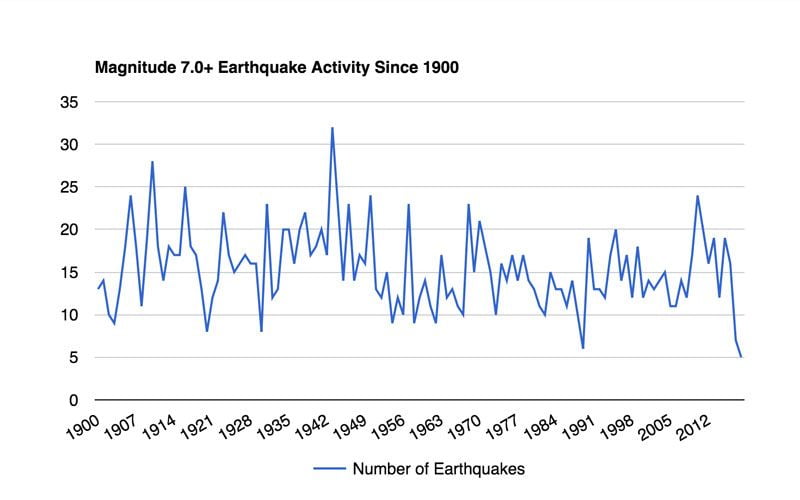
Recent years have included highly visible periods of earthquake activity, with damaging disasters and clusters of events occurring close together. That can understandably leave the impression that earthquakes are becoming more common worldwide. Official long-term statistics also show that the number of recorded quakes varies substantially from year to year, depending on the size of the events counted. 1
This impression is especially strong when several major earthquakes strike within a short period, or when a sequence of aftershocks keeps a region in the news. Earthquakes do not occur at perfectly regular intervals. They can cluster in time, meaning a busy few years can be real without showing that the long-term global average has changed.
There are also more earthquakes in modern databases than in older records, particularly smaller ones. Today’s dense monitoring networks, rapid data sharing and constant media coverage make earthquakes far more visible than they once were. For people looking at recent online catalogs, that can create a persuasive picture of rising activity.
The meaning of “significant” matters greatly. If it includes smaller reported events, the observed total may indeed be higher because modern instruments detect far more of them. And in some places, human activity has caused genuine increases in local seismicity. Fluid injection, mining, reservoirs and geothermal projects can trigger earthquakes in particular areas. But these local, induced events do not establish a worldwide increase in natural tectonic earthquakes.
The case against
The strongest evidence on the question—studies of large earthquakes with the most reliable global records—does not find a recent increase in their long-term rate. A study published in *Proceedings of the National Academy of Sciences* concluded that what looked like an elevated recent rate could be explained by random clustering. The US Geological Survey likewise says there is no evidence that the global rate of major earthquakes has risen (see Figure 2). 2
This matters because large earthquakes are more consistently recorded over long periods than small ones. They are therefore the best test of whether the Earth’s overall seismic activity has changed. On that test, the evidence does not show a statistically convincing upward trend in recent decades.
A major problem with simple historical comparisons is that earthquake records have changed dramatically. Earlier monitoring systems missed many small events, especially in remote regions. Modern seismometers, better communications and faster reporting now detect and publish earthquakes with much greater speed and precision. The USGS attributes much of the apparent increase in earthquake counts to these improvements in instruments and communications (see Figure 1). 3
That means a rise in the number of events listed in a modern catalog does not necessarily mean the Earth is producing more earthquakes. It may instead mean that scientists are finding more of those that were always occurring. Changes in network coverage, estimated magnitudes, location accuracy and reporting practices all make raw comparisons between old and new records unreliable. 4
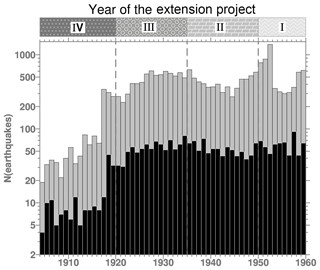
Scientists have built more uniform catalogs of large earthquakes, including the ISC-GEM record, precisely to reduce these historical biases (see Figure 3). Such work underscores why unadjusted counts can be misleading.
The bottom line
The broad claim is not supported. Evidence strongly weighs against the idea that the global frequency of major natural earthquakes has increased in recent decades.
Recent periods can be genuinely busy, and clusters of damaging earthquakes can make activity appear to be rising. Modern monitoring also records many more smaller events than older systems did. Local human activity can increase earthquakes in certain places. But none of those facts demonstrates a sustained worldwide increase in the natural rate of major earthquakes.
The main uncertainty lies in the undefined word “significant.” Without a clear magnitude threshold, the claim can blur together better detection of small earthquakes, local human-induced seismicity and temporary clusters. For major natural earthquakes, however, the available evidence and USGS assessment point clearly in one direction: there has been no demonstrated recent global increase.
Pros — Supporting Arguments
Figures & data

All contributions are reviewed for clarity, balance, and evidence. The strongest insights are elevated into the argument graph — with credit to you.
Help improve this analysis →