Supreme Court rulings that limit or change mail‑in voting procedures increase voter confusion in elections
Bottom line (updated 2026-08-28): The claim could be true, especially when courts change rules very late. But current studies do not show that these rulings usually cause voter confusion.
What's this about?
People disagree about whether court rulings that change mail voting rules confuse voters.
We need to ask if these rulings cause more voting mistakes.
What supporters say
- Mail voting has many steps, so rule changes may cause more mistakes.
- Rulings close to Election Day can change voter advice before people send ballots.
What critics say
- Rejected ballots show that a ballot had a problem, not that a court ruling confused someone.
- Ballot rejection rates did not always rise after court rulings changed mail voting rules.
How to read this
The number of points on each side does not show who is right; stronger proof matters more.
The bottom line
The claim could be true, especially when courts change rules very late.
But current studies do not show that these rulings usually cause voter confusion.
The claim is that Supreme Court decisions changing mail-in voting rules can leave voters confused and increase mistakes. The evidence supports that possibility, especially when rulings come close to an election, but it does not show that such confusion generally occurs.
The case for
Last-minute court rulings can disrupt voting instructions. In 2020, the Supreme Court declined to extend Wisconsin’s deadline for receiving absentee ballots shortly before the state’s primary. That decision reversed the practical effect of a lower-court order and forced election officials and others to communicate the controlling rule quickly. 1
Similar disputes in Pennsylvania involved ballot-receipt deadlines and problems with ballot envelopes. Competing interpretations made the rules harder to explain not only to voters, but also to campaigns and election workers. When a deadline or ballot requirement changes near Election Day, voters may have little time to adjust.
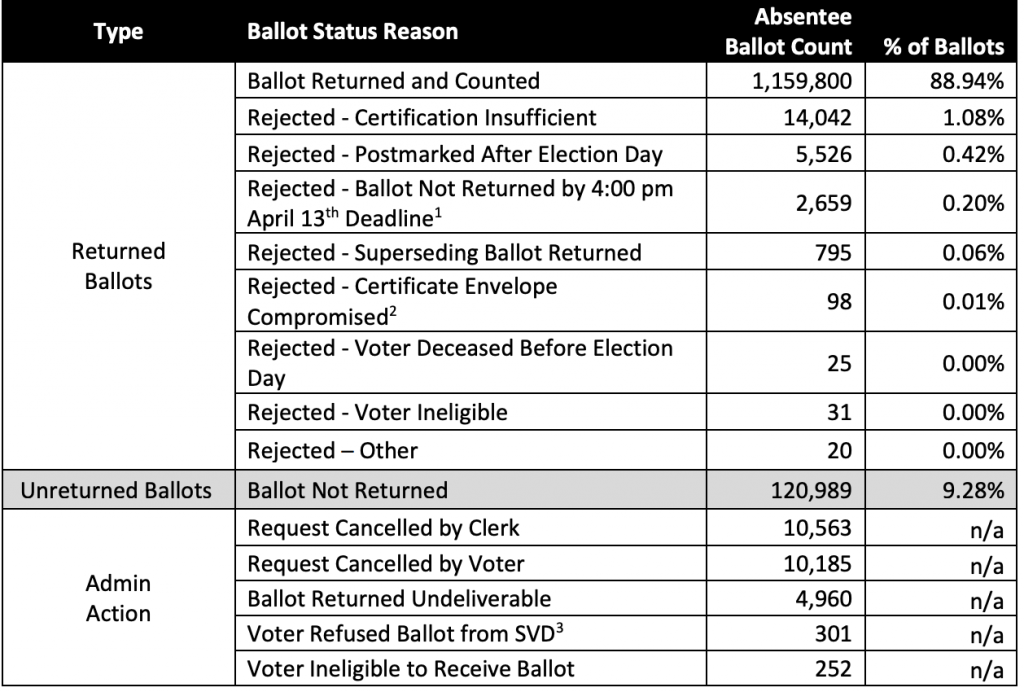
Mail voting is also vulnerable to procedural mistakes. Common reasons for rejecting ballots include late arrival, missing signatures and signature problems. Rules on deadlines, identity checks, witnesses, notarization and fixing—or “curing”—mistakes vary widely between states. Changing one of these requirements can create more opportunities for voters to submit ballots incorrectly, particularly when the change is made at the last minute. 2 (see Figure 1)
The Wisconsin ruling itself recognized the institutional risks of changing election procedures late. But that concern was about the danger of disrupted administration, not a direct measurement of how many voters became confused. Clear instructions, voter education, notification and opportunities to cure mistakes can also reduce the risks.
The case against
The main problem with the claim is that existing evidence does not directly connect Supreme Court rulings to voter confusion. Studies and administrative records show how many ballots were returned or rejected, but generally do not reveal whether a particular ruling caused voters to misunderstand the rules.
Ballot rejection rates also do not show a consistent increase. Research summarized by the Harvard Ash Center found that rejection rates generally fell in many states in 2020, even as mail-voting litigation intensified. An analysis by MIT found large differences between states, rather than a uniform rise. 3 (see Figure 1)
More importantly, a rejected ballot is not the same thing as a confused voter. Election officials may reject a ballot because of a signature review, administrative judgment or other processing decision, even when the voter understood the rules. Peer-reviewed research has found uncertainty, error and subjectivity in signature verification. As a result, a rise or fall in signature-related rejections cannot by itself prove that voters were confused by a court decision. 4
The nationwide Election Administration and Voting Survey provides useful information on ballots sent, returned, rejected and the reasons for rejection. But it does not identify which outcomes were caused by Supreme Court rulings. Researchers also cannot cleanly separate the effects of a Court decision from state-law differences, campaign messages, voters’ previous experience, election timing or local administrative practices.
The bottom line
The evidence supports only a qualified version of the claim. Supreme Court rulings—especially late decisions affecting deadlines or ballot standards—can plausibly increase the chance of confusion and procedural mistakes. But the available research does not show that they generally do so.
The evidence against a broad version of the claim is stronger on the central question of measurement: rejection rates did not uniformly rise, and rejected ballots are an imperfect measure of confusion. Overall confidence is moderate, because there is strong evidence that mail voting involves complex procedures and that late changes can disrupt administration. The key gap is direct, voter-level evidence showing that a specific Supreme Court ruling caused measured confusion or increased errors.
Pros — Supporting Arguments
Cons — Opposing Arguments
Figures & data
All contributions are reviewed for clarity, balance, and evidence. The strongest insights are elevated into the argument graph — with credit to you.
Help improve this analysis →