Streaming platforms will accelerate broadcasters’ declining dominance of live sports
Bottom line (updated 2026-10-15): The proof shows a real shift toward online sports, but not a clear, broad loss of TV control yet. Both sides have points, but the case for TV firms losing their full power has weaker proof.
What's this about?
People disagree about whether stream sites will end TV firms’ long control of live sports.
The big question asks if sports fans will leave TV for online shows.
What supporters say
- Stream sites can now bring huge sports crowds, such as the NFL games on Netflix.
- Big sports deals now move from TV firms to stream sites, so TV no longer holds every top game.
- More people watch online, which gives stream sites more power when they seek sports deals.
What critics say
- Major sports still bring many viewers to TV firms, helping those firms keep strong reach.
- Online games may add new viewers without taking the same number from TV.
How to read this
The number of points on each side does not show who is right; check how strong each point’s proof is.
The bottom line
The proof shows a real shift toward online sports, but not a clear, broad loss of TV control yet.
Both sides have points, but the case for TV firms losing their full power has weaker proof.
Streaming platforms are challenging broadcasters’ long-standing control of live sports, but the evidence does not yet show a clear, broad transfer of dominance. The strongest case is that premium rights are becoming more fragmented; the weaker case is that broadcasters are losing their overall audiences and market power at the same pace.
The case for
Exclusive sports rights are no longer controlled mainly by traditional broadcasters. Industry analysis commissioned by Ofcom describes online platforms as increasingly important alongside broadcasters, while academic research says streaming services are reshaping relationships among leagues, platforms and viewers. Deals such as the NFL’s move of Sunday Ticket to YouTube and YouTube TV, and Netflix’s multiyear agreement for Christmas Day NFL games, show that technology companies can now secure valuable packages. These deals do not mean conventional television has disappeared, but they do show that broadcasters no longer have uncontested control of every major opportunity. 1
Streaming services have also demonstrated that they can attract audiences at a national scale. The NFL said Netflix’s Christmas Day games reached 65 million viewers in the United States, while S&P Global reported audience gains for Amazon Prime Video’s Thursday Night Football. Those figures show meaningful reach, although they do not prove that broadcasters lost an equal number of viewers. Some streaming viewers may be new or additional viewers rather than people who switched from television. 2
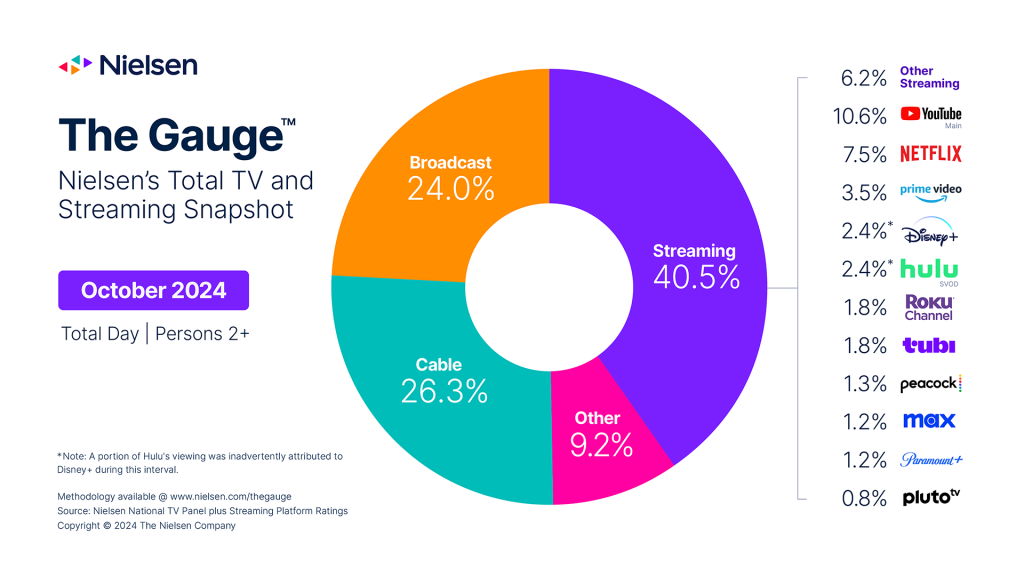
The broader market is moving in the same direction. Nielsen reported that streaming accounted for a larger share of U.S. television viewing than broadcast and cable combined during one monthly measurement period. Deloitte’s industry outlook also points to continued growth in digital distribution, direct-to-consumer services and competition among platforms. This creates a stronger commercial position for streamers, but it is important context rather than direct proof that sports acquisitions caused broadcasters’ decline. 3
The case against
Major sports events still give broadcasters powerful audience boosts. Nielsen found that sports increased broadcast television’s viewing share in October 2024, while football lifted traditional television viewing in January 2025 (see Figure 3). That suggests streaming growth has not yet been shown to reduce broadcasters’ total live-sports reach.
The market may also be expanding across several outlets rather than simply moving from one to another. Nielsen linked exceptionally high total viewing of the Super Bowl to a strategy that combined broadcast and digital platforms. The International Olympic Committee said about five billion people followed the Paris Olympics across television and digital services. These examples show that streaming can add reach while broadcasters remain central to the event. 45
There is no comparable, long-term measure showing that specific streaming rights deals have reduced broadcasters’ total audience, share of rights or economic control. League-reported streaming totals, platform figures and Nielsen television ratings are not always measuring the same thing. Several important numbers also come from leagues or industry participants, while consultancy and trade research provides useful market context but cannot by itself prove cause and effect.
The bottom line
The evidence leans toward the claim, but only weakly and with low confidence. It more clearly supports the idea that streaming is intensifying competition and breaking up broadcasters’ exclusive control of premium sports rights than the stronger claim that it is accelerating a general decline in their overall dominance.
The market remains mixed and event-specific. Streaming platforms are gaining leverage and can deliver very large audiences, but major sports still drive viewers to traditional television, especially when rights are shared across broadcast and digital services. The central unanswered question is whether streaming audiences are replacing broadcaster viewers or simply adding to total consumption. Until there is a consistent, long-term comparison of rights, audiences and economic control, the evidence supports structural disruption more strongly than measured displacement.
Figures & data

All contributions are reviewed for clarity, balance, and evidence. The strongest insights are elevated into the argument graph — with credit to you.
Help improve this analysis →