State governments can expand data centers while retaining their economic benefits without straining infrastructure or harming communities
Bottom line (updated 2026-10-29): States may gain from data centers, but only with site-by-site plans and strong rules. The critics have stronger proof about power and water risks, so growth will not always avoid harm.
What's this about?
People disagree about whether states can grow data centers without hurting power, water, roads, or nearby people.
The answer seems to depend on each site and on strong rules.
What supporters say
- Fair power prices and smart rules could help data centers pay for the stress they add.
- Careful site choices and deals with towns could limit harm to water, roads, and local life.
- Data centers can bring jobs, tax money, and more business to a region.
What critics say
- Many data centers may push power grids too hard and raise bills for other users.
- Their water use may clash with the small water supplies of some towns.
- We still do not fully know how data centers affect health, land, noise, and daily life.
- The gains may not last, and some towns or workers may get less help than others.
How to read this
The number of points on each side does not show who is right; strong proof matters more than a long list.
The bottom line
States may gain from data centers, but only with site-by-site plans and strong rules.
The critics have stronger proof about power and water risks, so growth will not always avoid harm.
State governments may be able to expand data centers and capture their economic benefits, but only under strict, location-specific conditions. The evidence supports a conditional version of the claim—not a promise that growth will always avoid pressure on infrastructure or nearby communities.
The case for
Data centers can generate substantial economic activity, jobs, tax revenue and regional output. A Richmond Federal Reserve study estimated that Virginia’s data centers supported 45,460 jobs and $15.3 billion in economic output in 2021, including indirect and induced effects. A state legislative audit also found significant economic activity and tax revenue linked to the industry, showing that the benefits are measurable rather than merely theoretical. But these figures do not by themselves show whether the gains outweigh public costs. 1
Governments also have tools that could reduce the strain created by large facilities. Lawrence Berkeley National Laboratory describes large-load electricity pricing as an emerging policy area focused on making major customers pay an appropriate share of system costs and managing risks to reliability. Research also suggests that data centers could adjust computing workloads and respond quickly to changes in electricity demand, if companies adopt the technology and market rules allow it. 2
Local governments can attach conditions to project approvals. These may include water-use disclosure, checks on whether supplies are available, low-water cooling systems, contributions to infrastructure, local hiring and community-benefit agreements. Such agreements could require environmental and economic commitments, giving states a practical way to pursue expansion while limiting local harm. The approach is plausible, but it depends heavily on strong enforcement. 3
The case against
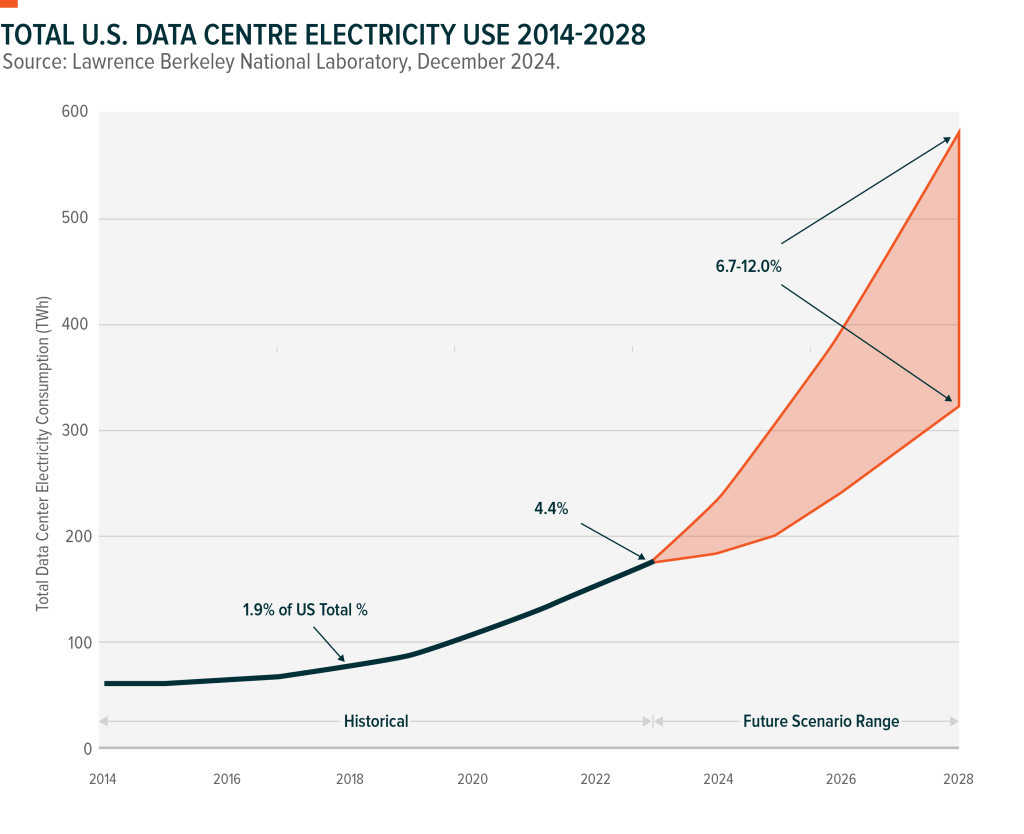
The strongest evidence against the claim concerns electricity. Lawrence Berkeley National Laboratory estimates that data centers could consume 11.8% of U.S. electricity by 2030. The Department of Energy estimated their share at about 4.4% in 2023 and projected it could reach 6.7% to 12% by 2028. The International Energy Agency has said data centers could account for nearly half of U.S. electricity-demand growth through 2030 (see Figure 1). These are national projections, not proof that every state will face a crisis, but they show that generation, transmission, distribution and electricity pricing can become major constraints. Virginia’s legislative review specifically warned that continued growth could raise costs for other electricity customers. 4
Water is another serious concern. Demand varies with a facility’s workload, cooling system, climate, location and operating practices. Because reporting is inconsistent, residents and regulators may not have enough information to judge whether a particular watershed can safely support new facilities. National growth figures therefore cannot show that every local water system will remain within safe or fair limits. 5
The economic benefits may also be less durable or evenly shared than investment headlines suggest. Construction can account for much of the early activity, while permanent operating jobs may be relatively limited. Tax incentives may further reduce the public return. Brookings has concluded that lasting local prosperity generally requires negotiated commitments on workforce development, procurement and community benefits; it does not automatically follow from building a facility. 6
Other community effects remain poorly measured. Backup generators, noise, land use, emissions and water withdrawals can affect nearby residents. A peer-reviewed review found that possible health effects from data-center noise remain largely understudied, while policy research has identified energy and water pressures requiring targeted action. This uncertainty does not prove widespread harm, but it means officials cannot safely assume that impacts are negligible.
The bottom line
The evidence moderately favors a conditional version of the claim. States can sometimes expand data centers while preserving meaningful economic benefits and controlling burdens, but the evidence is stronger at identifying risks and possible policy tools than at showing that safeguards consistently work in practice.
Success depends on local grid capacity, fair electricity cost allocation, cooling technology, water availability, transparent reporting, tax-incentive design and enforceable community protections. Many available sources are projections, policy recommendations or studies of potential tools rather than long-term evaluations of completed projects. States therefore should not rely on a blanket presumption that data-center growth is harmless. Expansion is most defensible when each project faces location-specific capacity reviews, public impact reporting, fair allocation of infrastructure costs and binding environmental and community safeguards.
Figures & data
All contributions are reviewed for clarity, balance, and evidence. The strongest insights are elevated into the argument graph — with credit to you.
Help improve this analysis →