Social media platforms should be regulated as public utilities
What's this about?
People disagree about whether social media sites should follow rules like power and water firms.
The key question asks if these sites act like needed public systems.
What supporters say
- Big social media sites can shape health, sleep, votes, news, and trust between groups.
- Utility-style rules could limit the power of a few firms over data, site rules, and online access.
What critics say
- A public-utility label may cover too much, since social media sites differ from power, water, and phone firms.
- Utility rules could make fights over speech and free talk even harder to solve.
How to read this
The number of points on each side does not show who is right; stronger proof matters more.
The bottom line
The proof supports stronger rules for large social media sites, but it does not prove that utility status fits best.
Critics raise real concerns, yet the speech concern has weaker proof than the main case for oversight.
Social media platforms now shape public health, political debate, privacy and access to information on a scale that resembles essential infrastructure. The question is whether they should be treated as public utilities, or regulated through narrower rules aimed at particular risks.
The case for
The strongest argument for utility-style regulation is the platforms’ wide effects on public life, not proof that a utility label is the only answer. Research has linked social-media use with mental-health and sleep outcomes, although the findings vary and do not always show direct cause and effect. A field experiment in an ethnically divided setting also found effects on political and social outcomes, while research during the COVID-19 pandemic documented widespread concern about health misinformation. Together, these findings suggest that large platforms are more than ordinary businesses: their design and access decisions can affect people who are not simply making a private consumer choice. 1
That could justify public duties involving continuity, equal treatment, transparency and accountability. Such rules might limit arbitrary account decisions, require clearer explanations of platform policies, or ensure that users are not unfairly excluded from important online services.
A second argument is that utility-style oversight could restrain concentrated private power. A small number of companies control vast stores of personal data, the design of online interfaces, recommendation systems and the rules governing access. Privacy research identifies continuing concerns about data collection, profiling, sharing, consent and security. Other scholarship links deceptive design to competition and consumer-protection problems, while transparency research supports giving users and outside researchers more insight into how platforms operate. 2
From this perspective, measures such as interoperability, independent audits, safeguards for account decisions and restrictions on exploitative or discriminatory practices could turn those concerns into enforceable obligations. But the evidence supports the need for oversight more directly than it proves that a public-utility system would be the best way to provide it.
The case against
The main objection is that social media is too varied for one broad utility classification. Platforms combine hosting, messaging, recommendation, advertising, search and entertainment. A single set of utility obligations might fit some functions but not others. Research on content moderation describes a difficult balance among safety, free expression, platform responsibility and the risk of excessive regulation. Studies of mental-health effects likewise find mixed results rather than one uniform impact. 3
That uncertainty points toward rules tailored to a platform’s size, function, users and demonstrated harms, rather than identical duties for every service. It also raises doubts about treating all platforms—or all of their activities—as essential utilities.
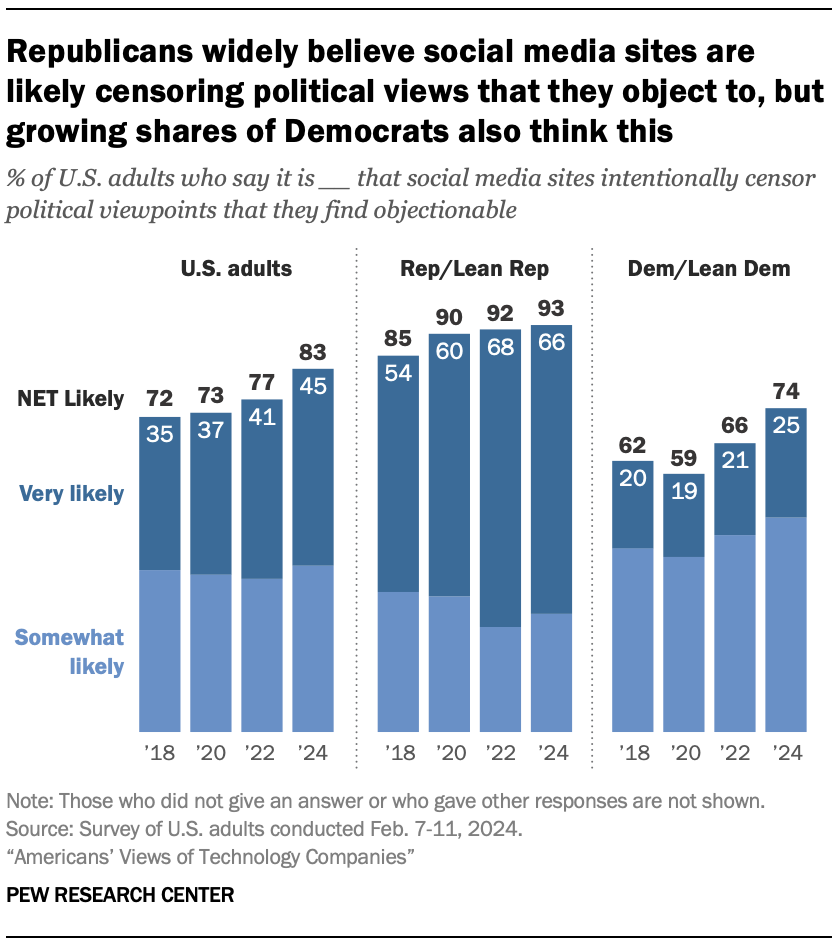
There is a further risk involving speech and editorial judgment. Requirements for equal access, nondiscrimination or uninterrupted service could conflict with decisions to remove content, rank posts or restrict dangerous material. Utility regulation might draw governments more deeply into deciding what content is permissible or which voices receive priority, creating constitutional disputes and political pressure. The available research supports carefully designed moderation rules, but does not show that utility regulation would solve these conflicts. 4
Existing alternatives may address many of the same problems. The European Union’s Digital Services Act, for example, requires large platforms to conduct risk assessments, improve transparency, provide access for researchers and accept stronger accountability. Other proposals focus on privacy limits, recommender-system audits, user choice, child safety, competition enforcement and fair procedures for account suspensions. Evidence on these tools is still developing, and no cited research directly compares them with public-utility regulation.
The bottom line
The evidence strongly supports substantial public oversight of social-media platforms, because their harms, privacy risks, market concentration and influence over public life are well documented. But it does not establish that blanket public-utility classification would produce better results than targeted, risk-based rules.
The case is therefore balanced on the specific claim that social media should be regulated as public utilities. Confidence is high that enforceable regulation is needed, but lower that the utility model is the right structure. The decisive comparison—whether utility status works better than differentiated regulation—remains unresolved, as do questions about speech protections and how obligations should vary across platform functions.
Pros — Supporting Arguments
Cons — Opposing Arguments
Figures & data
All contributions are reviewed for clarity, balance, and evidence. The strongest insights are elevated into the argument graph — with credit to you.
Help improve this analysis →