Nuclear-armed states are modernizing their arsenals even when their total stockpiles decline
Bottom line (updated 2026-11-16): The claim fits the United States and Russia, where old arms decline as newer systems take their place. But it does not fit every state, since China and some others keep or grow their forces.
What's this about?
People disagree about whether nuclear states update their weapons while their total warhead count falls.
What supporters say
- A state can remove old warheads while building newer missiles, subs, planes, and warheads.
- Russia replaces old weapons from the Soviet age instead of only adding more weapons.
- New weapons can fly farther, hit more well, stay safe, or launch faster.
What critics say
- Some states, such as China, are growing their nuclear forces instead of cutting them.
- The claim may focus too much on the United States and Russia, not every nuclear state.
How to read this
The number of points on each side does not show who is right; strong proof matters more.
The bottom line
The claim fits the United States and Russia, where old arms decline as newer systems take their place.
But it does not fit every state, since China and some others keep or grow their forces.
Nuclear powers can modernize their forces even when the total number of warheads falls. But the pattern is not universal: it is clearest in the United States and Russia, while China and some other countries are expanding or maintaining their arsenals.
The case for
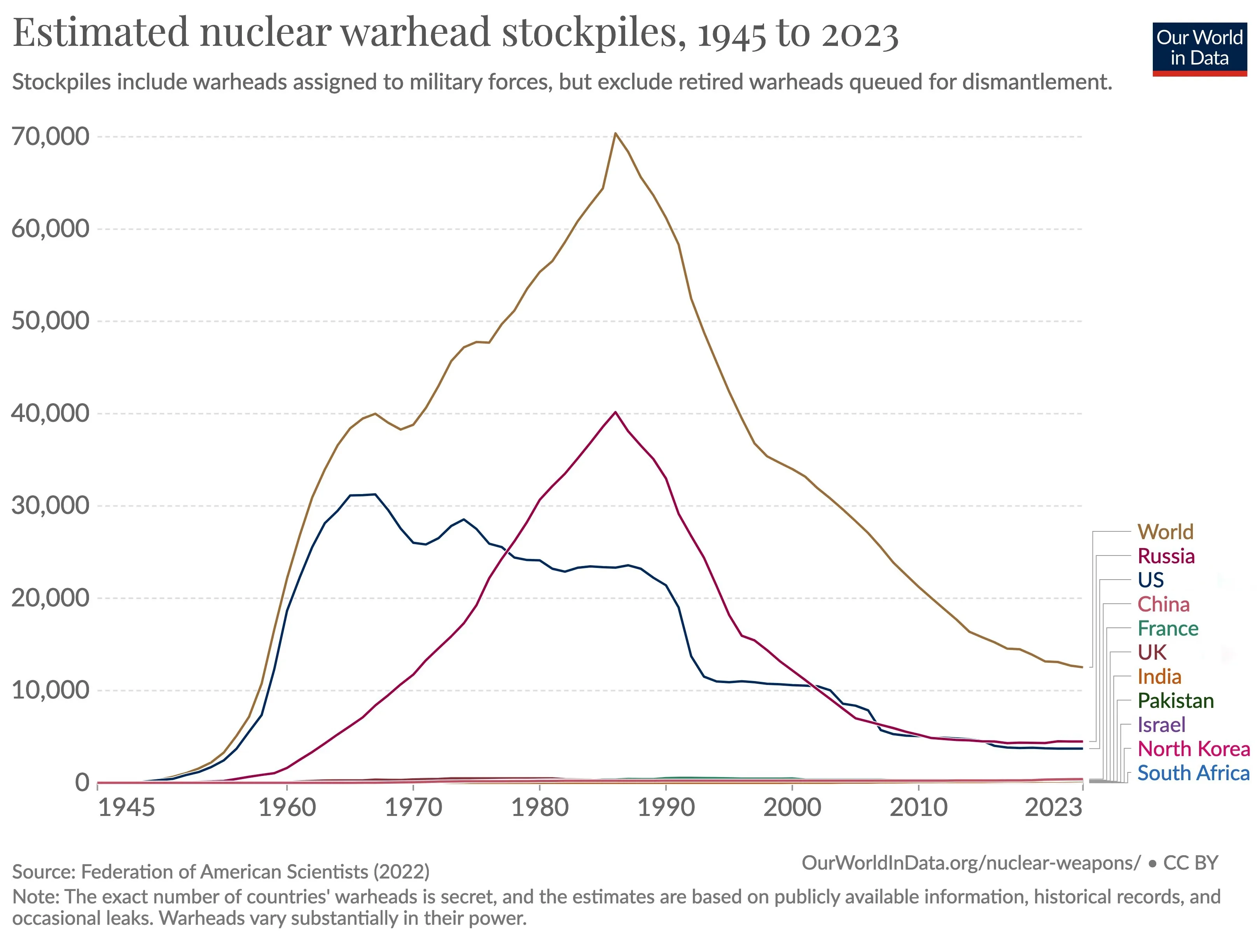
Modernization and numerical reduction can happen at the same time. A country may retire old warheads and reduce its overall inventory while replacing missiles, submarines, bombers or warheads with newer systems. Retired weapons waiting to be dismantled can also count toward a declining total, even as the military stockpile and the infrastructure supporting it are maintained or strengthened. These different categories are important because “total inventory,” “military stockpile” and “deployed warheads” do not mean the same thing. 1 (see Figure 1)
The United States is the clearest example. Its warhead stockpile has fallen since the end of the Cold War, while it has pursued modernization of nearly every major part of its strategic nuclear force. That includes ballistic missiles, submarines, bombers and warheads. In this case, replacement and upgrading have not required a larger overall stockpile. 2
Russia provides another substantial example. Open-source assessments describe a long-running effort to replace Soviet-era missiles, submarines, aircraft and associated warheads. The main pattern is replacement rather than simply adding more weapons. Because Russia does not publish complete information, some of these estimates remain uncertain, but the evidence still points to major modernization alongside the handling of retired warheads. 2
Modernization also means more than increasing the number of weapons. Newer delivery systems may improve range, accuracy, readiness, survivability or flexibility. Upgraded command systems, production facilities and warhead designs can strengthen a nuclear force without a matching rise in warhead numbers. A falling or stable stockpile therefore does not necessarily mean falling military capability. 3
The case against
The main weakness is that the claim can sound broader than the evidence allows. Several nuclear arsenals are growing, not shrinking. China is the strongest counterexample. Assessments estimate that it has roughly 500 warheads, with more in production, and is rapidly building missiles, submarines, bombers and supporting infrastructure. In China’s case, modernization is clearly linked to stockpile expansion rather than a decline. 4
The global picture is also more complicated than a simple falling trend. The Federation of American Scientists reports that the worldwide inventory has declined over time, but that reductions are slowing and many countries are increasing or maintaining their military stockpiles. SIPRI estimated about 12,121 nuclear weapons worldwide at the start of 2024 and about 12,241 in January 2025. Those totals can coexist with reductions in some countries and expansion in others.
This means a global decline cannot be treated as proof that every nuclear-armed state is reducing its own total. The claim overgeneralizes from the major powers where the pattern is best documented, particularly the United States and Russia. Evidence is also uneven because governments do not release complete, consistently defined figures. Estimates may combine operational, reserve, retired and dismantlement-bound weapons in different ways. 5
The bottom line
The evidence moderately supports a qualified version of the claim. It strongly shows that modernization can accompany a declining total inventory, especially in the United States and Russia. It also supports the broader finding that nuclear-armed states are renewing delivery systems, warheads and supporting facilities.
But the evidence does not support treating this as a universal rule. China demonstrates that modernization can instead occur alongside rapid stockpile growth, while other countries are sustaining or increasing their military holdings. The most accurate conclusion is that nuclear powers can modernize while their total inventories decline, but the relationship varies by country, time period and the definition of “stockpile.” Incomplete and inconsistent national reporting remains the biggest source of uncertainty.
Pros — Supporting Arguments
Cons — Opposing Arguments
Figures & data

All contributions are reviewed for clarity, balance, and evidence. The strongest insights are elevated into the argument graph — with credit to you.
Help improve this analysis →