NATO expansion provoked the Russia-Ukraine conflict
What's this about?
People disagree about whether NATO growing east caused the Russia-Ukraine war. The evidence says it raised tension, but it did not force Russia to start a war.
What supporters say
- In 2008, NATO said Ukraine could join one day, which worried Russia.
- Russia saw NATO moving closer as a threat to its safety and power.
- Ukraine worked more closely with NATO after 2014, even without joining it.
- NATO offered Ukraine a future path, but not NATO’s full shield from attack.
What critics say
- NATO said its moves aimed to protect its members, not threaten Russia.
- Ukraine never became a NATO member before Russia launched its full war.
- NATO growth did not make war the only choice Russia could make.
- Russia may have had other goals besides fear of NATO.
The bottom line
NATO’s growth helped create the tense setting behind Russia’s war on Ukraine. But it was not the only cause, and Russia could have chosen not to invade.
NATO’s expansion toward Eastern Europe contributed to the tensions behind Russia’s war on Ukraine, the evidence suggests. But it does not show that expansion was the sole cause of the conflict, or that Russia had no alternative to war.
The case for
The strongest argument is that NATO’s policy created a sharper security dilemma: measures the alliance described as defensive could still look threatening from Moscow. In 2008, NATO said at its Bucharest summit that Ukraine and Georgia “will become members,” even though it offered neither a timetable nor immediate membership. That pledge put Ukraine visibly on a path toward the Western alliance, while leaving it outside NATO’s protection.
For Russia, this could be seen as a loss of strategic space and a sign of political and military encirclement. NATO enlargement was a choice by Western governments, not an unavoidable feature of the post-Cold War order, and it carried diplomatic costs as well as potential benefits. A particularly fraught arrangement emerged: Ukraine was offered a future NATO path that could heighten Russian fears, but it was not given immediate protection against Russian pressure. That combination plausibly increased tensions 1.
Russian leaders repeatedly identified NATO and NATO-Ukraine cooperation as threats. This was not simply a claim invented after the invasion by outside critics of the alliance. Ukraine and NATO developed a real partnership after 2014, although Ukraine did not become a member. That record provides a factual basis for Moscow’s concern about Ukraine moving toward Western security institutions, even if it does not prove that concern was Russia’s only motive 2.
The historical record therefore supports a limited conclusion: Western policy helped create an environment in which Russia saw Ukraine’s Western orientation as a strategic danger. NATO enlargement mattered as part of the perceived-threat landscape, and a different policy might have produced less tension 3. But the evidence cannot establish with certainty that this policy determined the decision to invade in 2022.
The case against
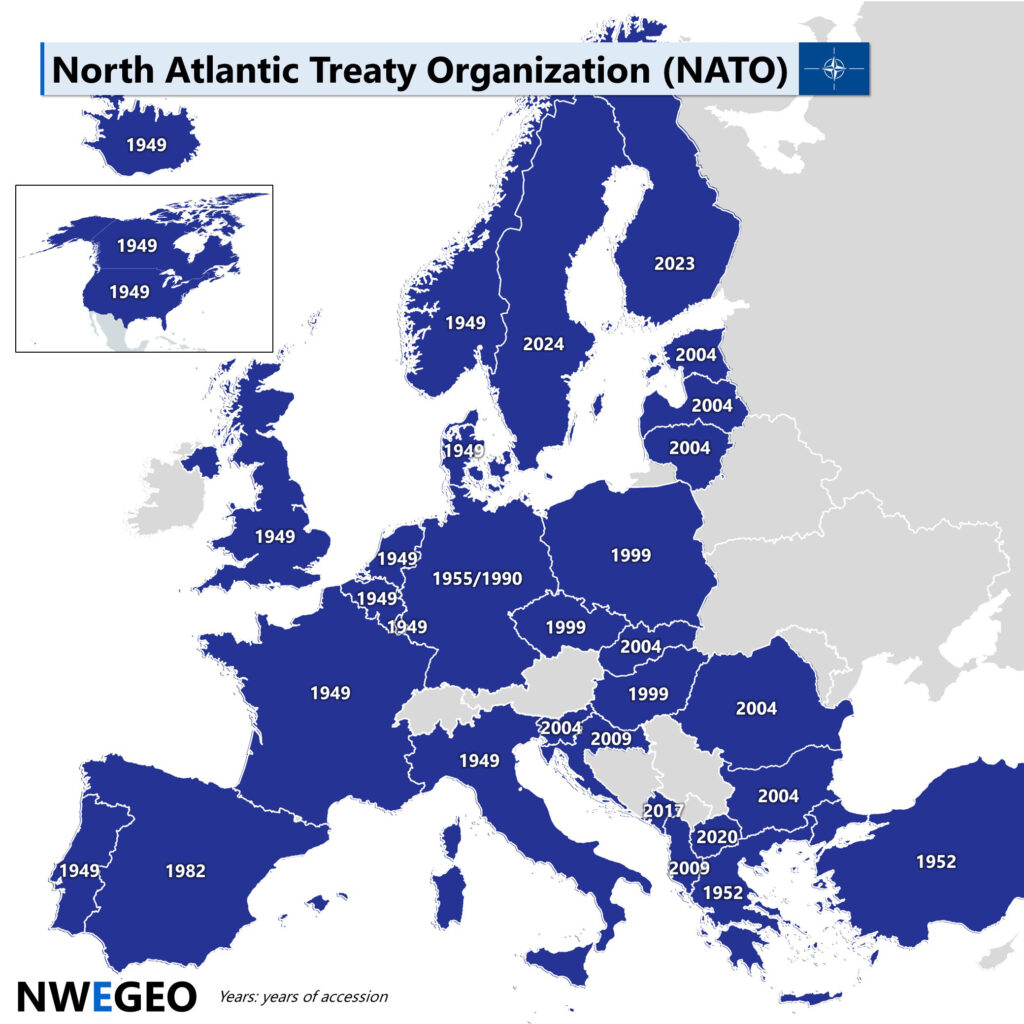
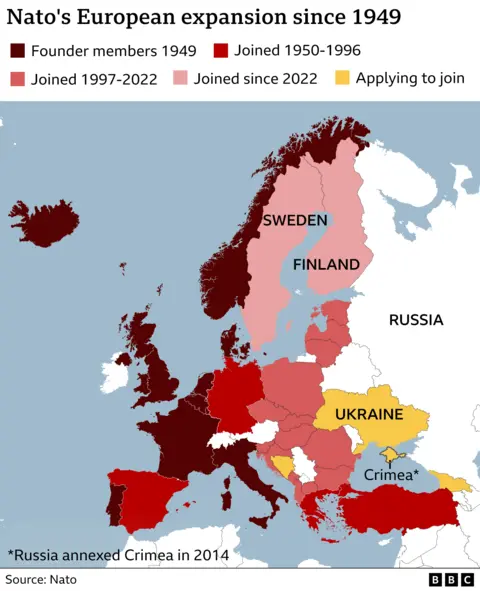
The central weakness in the claim is that Ukraine was not a NATO member when Russia seized Crimea and intervened in eastern Ukraine in 2014, or when it launched its full-scale invasion in 2022. Ukraine was not covered by Article 5, NATO’s collective-defense guarantee. A promise of possible future membership is not the same as an existing NATO military commitment, and it is inaccurate to portray Russia as confronting an already established NATO alliance in Ukraine (see Figure 1) 4.
There is also substantial evidence of motives that go beyond NATO. In a 2021 essay, Vladimir Putin described Russians and Ukrainians as one historical and cultural community, questioned aspects of Ukraine’s sovereignty, and portrayed its turn toward the West as dangerous. Those statements point to imperial and identity-based objectives, not merely a military response to alliance enlargement. They may have been used to justify policy, but they still show that Russia’s stated aims extended beyond NATO 5.
The timing of Ukrainian public opinion further complicates the argument. Support for NATO integration in Ukraine rose sharply after Russia’s aggression began in 2014. That suggests a reverse chain of events: Russian intervention helped push Ukraine toward NATO, rather than a pre-existing drive for NATO membership independently causing Russia’s intervention (see Figure 2) 6. Polling cannot settle every question of cause and effect, but it undermines a simple one-way story.
After 2014, the conflict also developed its own territorial, political and diplomatic dynamics. Disputes over the Minsk peace process, the war in Donbas, Ukrainian politics and broader European security competition all played a role. These factors cannot be reduced to the question of NATO enlargement.
The bottom line
The evidence strongly supports the view that NATO enlargement contributed to Russian threat perceptions and to the security environment surrounding the conflict. The 2008 promise of future Ukrainian membership was relevant, especially because it created expectations without giving Ukraine immediate NATO protection.
But the evidence does not support the stronger claim that NATO expansion caused the war by itself, or made a Russian invasion inevitable. Ukraine was outside NATO’s defense guarantee; Russian imperial ideas and challenges to Ukrainian sovereignty offer an independent explanation; and Russian intervention itself appears to have increased Ukrainian support for joining NATO.
The most convincing account is therefore multi-causal: NATO enlargement interacted with Russian strategy and ideology, Ukrainian choices, unresolved territorial disputes and failed diplomacy 7. Russia’s perception of provocation may have been real, but it did not remove Moscow’s agency or make war its only possible response.
Figures & data

All contributions are reviewed for clarity, balance, and evidence. The strongest insights are elevated into the argument graph — with credit to you.
Help improve this analysis →