Lobbying is legalized corruption

Updated 2026-07-29 4 supporting · 4 opposing arguments
Aldo's Synthesis high
Based on the strength of the Arguments below
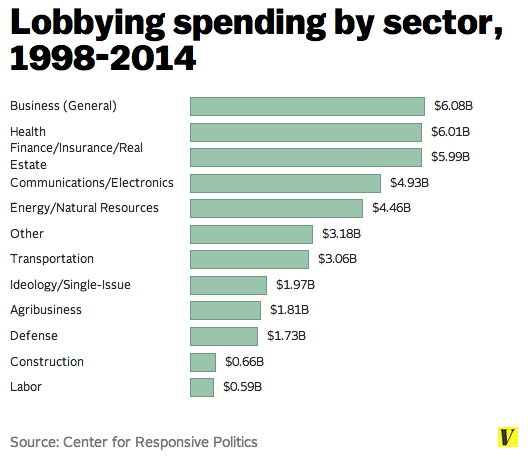
The claim that lobbying is legalized corruption asks whether lawful efforts to influence government should be judged by their formal legality or by their effects on political equality, official integrity, and the distribution of public benefits. The strongest case for the claim treats money, privileged access, personal networks, and informational assistance as functional substitutes for an illicit payment; the strongest objection maintains that petition, expertise, and unequal influence are not corruption absent an improper exchange or abuse of entrusted power. The dispute therefore turns partly on definition: a broad democratic conception emphasizes capture and unequal responsiveness, whereas a narrower conception requires evidence of quid pro quo conduct, deception, conflict of interest, or betrayal of public duty. The strongest support for the corruption analogy is that political influence appears unequally distributed and that access based on relationships has measurable commercial value. Across 1,779 U.S. policy issues from 1981–2002, economic elites and business interest groups had substantial independent associations with policy adoption, while average citizens had little or no independent association after their preferences were modeled together (see Figure 1). That observational result establishes a serious pattern of representational inequality, although it neither isolates lobbying as the cause nor proves an exchange between a lobbyist and an official. A study of lobbyists with government experience found that their revenue declined when connected politicians left office and that their issue coverage shifted with those connections, supporting the inference that clients pay in part for relationship-based access rather than expertise alone. Research on firm-government employee mobility likewise identifies personnel movement as a means of acquiring political knowledge, access, and influence, reinforcing concern that legally transferable relationships can confer private political advantages. The corruption analogy also gains force when concentrated policy benefits greatly exceed the cost of seeking them. A case study of a temporary U.S. tax provision estimated exceptionally large returns for firms lobbying for reduced taxation of repatriated foreign earnings, showing how a comparatively small political investment may accompany a much larger private payoff. The episode does not establish that lobbying caused the provision or that such returns are typical, but it illustrates the incentives for legally sanctioned rent seeking when benefits are concentrated and costs can be externalized. The broader concern is not the amount of expenditure by itself, but the possibility that concentrated resources purchase sustained access and policy attention unavailable to diffuse publics (see Figures 2 and 3). Formal legality and disclosure do not necessarily make influence visible or eliminate conflicts. A scoping review found that disclosure systems differ in timeliness, completeness, searchability, intelligibility, and usability, so formal records may not permit the public to reconstruct who sought to influence whom, on what issue, and with what resources. GAO found that most sampled federal reports contained required documentation but that some lobbyists failed one or more reporting or contribution-disclosure requirements, while statutory reporting necessarily covers only conduct within legal definitions. GAO's review of post-employment controls also describes restrictions of varying scope and limited duration, leaving some relationship-based influence legally available after public officials depart government. The strongest challenge is that lobbying comprises several legitimate and potentially useful forms of political participation, while the evidence does not justify treating all of them as purchased official betrayal. The OECD treats lobbying and influence as legitimate activities requiring safeguards against monopolized influence, covert conduct, conflicts of interest, foreign interference, and revolving-door abuse, rather than defining lobbying itself as bribery. Transparency International similarly characterizes lobbying as a legitimate democratic practice that becomes vulnerable to undue influence, unfair competition, and regulatory capture when it is opaque or inadequately safeguarded. These institutional distinctions support condemning corrupt lobbying without equating open petition, testimony, or advocacy with corruption by definition. Lobbying can also subsidize legislative capacity rather than purchase a vote. The legislative-subsidy theory holds that lobbyists often assist aligned lawmakers by supplying policy research, political intelligence, drafting work, and labor, thereby helping officials who face limits of time and staff. Such assistance can amplify groups that are already organized and may bias the informational environment, but selectivity and bias do not by themselves demonstrate that an official sold a decision. This account is principally theoretical, so it establishes a plausible non-corrupt mechanism rather than the prevalence or net social value of informational lobbying. Causal and methodological evidence also rejects a simple model in which lobbying expenditure or contact automatically controls government decisions. Four field experiments in two state legislatures found no detectable effects of the tested advocacy communications on measured legislative behavior. Those experiments provide relatively strong causal evidence against automatic persuasion, although their treatments, jurisdictions, sample sizes, and measured outcomes do not encompass access, agenda setting, implementation, or long-term influence. Reviews further identify strategic selection into lobbying, incomplete spending data, defensive activity, endogenous targeting, and unobserved policy counterfactuals as obstacles to interpreting associations between spending and favorable outcomes as causal purchases of policy. Accordingly, evidence that a group spent money, gained access, and obtained a preferred result is compatible with influence, but it is also compatible with lobbying an allied official, anticipating likely policy, providing useful information, or defending an existing position. The evidence supports a mechanism-specific judgment: some lawful lobbying resembles corruption closely, while lobbying as a whole does not form a single empirical or ethical category. Contemporary reviews distinguish information provision, access, persuasion, agenda setting, coalition building, implementation, maintenance of the status quo, and quid pro quo exchange, and they conclude that available data often cannot cleanly separate these channels. Relationship trading and revolving-door arrangements fit the analogy more closely when former public ties command private revenue, personnel movement confers privileged access, and post-employment restrictions leave lawful channels open. Open testimony and verifiable technical assistance fit it less closely because the literature recognizes information and legislative labor as distinct mechanisms that need not entail an improper exchange. Legal status, democratic legitimacy, and corruption are overlapping but non-identical inquiries. Evidence of unequal responsiveness and marketable access can establish a democratic legitimacy problem even when it does not prove bribery or abuse of office. Conversely, compliance with lobbying law does not establish equal representation or eliminate capture risks, because governance standards expressly address monopolized influence and conflicts within the sphere of otherwise legitimate activity. Regulatory responses can therefore preserve petition and expertise while targeting the conditions under which lobbying becomes capture-prone. The OECD recommends public registries, disclosure of lobbying targets and objectives, conflict-of-interest controls, cooling-off periods, enforcement, and wider stakeholder participation rather than a general prohibition. This framework makes transparency, integrity, and equality of access the relevant boundary conditions, treating corruption risk as contingent rather than inherent in every effort to influence policy. The principal gap is not a missing side of the debate but the difficulty of classifying observed influence as access, information, persuasion, agenda control, defensive activity, or an improper exchange. Much of the supportive evidence measures policy correlations, lobbyist revenue, employee mobility, disclosure quality, or returns surrounding a policy episode rather than directly observing officials trading public decisions for private benefits. Conversely, null experiments on discrete communications cannot exclude cumulative, relational, agenda-setting, implementation-stage, or status-quo influence. The unresolved conflict-of-interest classification is therefore decisive: the record identifies legally monetized relationships and incomplete safeguards, but it does not supply a uniform criterion for determining when those advantages become corruption rather than unequal yet lawful advocacy. On balance, the evidence supports with high confidence a qualified judgment: some lawful lobbying mechanisms can function like corruption by converting wealth and public relationships into privileged influence, but the categorical claim that lobbying as such is legalized corruption is too broad. The record more firmly establishes unequal representation, valuable political connections, concentrated returns, and imperfect transparency than it establishes pervasive quid pro quo exchange. The dominant uncertainty is where to place the conflict-of-interest boundary between legitimate advocacy and corruption when influence is legal, relational, indirect, and difficult to observe.

Supporting Arguments

P1Wealth can purchase unequal access and policy responsiveness
Policy outcomes in the United States have been more strongly associated with affluent citizens and organized business interests than with average citizens' preferences. Evidence that politically connected lobbyists lose revenue when their contacts leave office further suggests that access itself has market value, making legal lobbying resemble a system in which influence is distributed by resources rather than political equality.
59/100 · Data Analysis
P2Private policy gains can dwarf the cost of lobbying
The tax-repatriation case study found that firms' estimated benefits were vastly larger than their reported lobbying expenditures. Although this does not prove a corrupt exchange, concentrated returns of that magnitude create incentives to invest in political access and support the analogy to legally sanctioned rent seeking.
47/100 · Logical Inference
P3Revolving doors can monetize public relationships
Connected lobbyists' revenue responds to whether their former government contacts remain in office, indicating that personal networks have commercial value. Research on firm-government employee mobility and GAO's account of post-employment rules likewise show why legal revolving doors can generate conflicts and privileged access without an explicit bribe.
74/100 · Direct Evidence
P4Disclosure gaps allow undue influence to remain legal and obscure
OECD and transparency research show that registration and disclosure regimes often omit influence channels or produce records that are incomplete and difficult to use. GAO also continues to identify noncompliance, so legality does not guarantee that the public can see or evaluate the exchange of access, assistance, and policy benefits.
68/100 · Direct Evidence

Opposing Arguments

C1Lobbying is political petition, not inherently bribery
Major governance institutions define lobbying as a legitimate means for citizens and organizations to convey interests, while treating covert, deceptive, or improperly exchanged influence as the problem. Equating every lawful communication with corruption erases the distinction between advocacy and an official abusing entrusted power for private gain.
75/100 · Expert Opinion
C2Lobbyists can supply scarce expertise and legislative capacity
The legislative-subsidy account explains lobbying as the provision of research, drafting assistance, and political information to lawmakers who lack time and staff. That assistance may be biased toward organized groups, but useful information and labor are not equivalent to purchasing a vote.
89/100 · Logical Inference
C3Experimental evidence does not show automatic persuasion
Four field experiments in two state legislatures found no detectable effects of the tested lobbying communications on legislative behavior. Their scope is limited, but the null results contradict a simple model in which contact with a lobbyist predictably controls lawmakers.
59/100 · Direct Evidence
C4Observational correlations do not establish quid pro quo
Reviews consistently warn that groups lobby issues already likely to move, spend defensively, and choose targets strategically, while researchers rarely observe the no-lobbying counterfactual. Associations among spending, access, and favorable policy therefore cannot by themselves prove that an official was induced to betray public duties.
99/100 · Logical Inference

All contributions are reviewed for clarity, balance, and evidence. The strongest insights are elevated into the argument graph — with credit to you.

Help improve this analysis on ProConWiki →
𝕏 Share Facebook LinkedIn