Changes in U.S. climate policy have an outsized effect on global climate progress
Bottom line (updated 2026-10-23): The proof shows that U.S. policy can greatly affect world climate work, both through tech and global teamwork. But the proof does not show that the United States alone has a special, deciding role.
What's this about?
People disagree about whether U.S. climate policy can change the world's fight against a hot, harmed Earth.
What supporters say
- The United States has made many past heat-trap gases and still has great wealth and power.
- U.S. choices can build trust or harm teamwork between lands that must cut heat-trap gases.
- U.S. aid and rules can lower the cost of clean tech (tools), such as wind and sun power, across the world.
What critics say
- Past harm does not prove that U.S. rules have the most power today.
- Other big polluters, acting as a group, can have more direct power over world heat cuts.
How to read this
The number of points on each side does not show who is right; look at the proof behind each point.
The bottom line
The proof shows that U.S. policy can greatly affect world climate work, both through tech and global teamwork. But the proof does not show that the United States alone has a special, deciding role.
The claim is that changes in U.S. climate policy matter far beyond America’s borders and can significantly alter the world’s progress toward climate targets. The evidence supports that idea in a qualified way, but does not show that the United States is uniquely decisive.
The case for
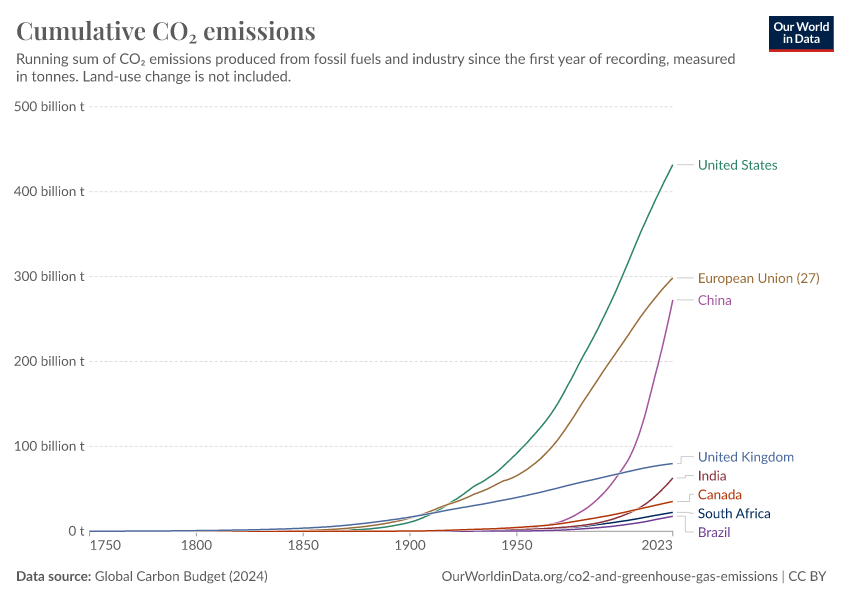
The United States has an unusually influential position because it combines large historical emissions, substantial current emissions and exceptional economic power. Peer-reviewed studies place it among the countries that have contributed most to historical global warming. Cumulative-emissions data also rank it among the largest historical fossil-fuel and industrial emitters (see Figure 1; see Figure 2). 1
Although the United States produces less than the combined emissions of other major emitters, it has an outsized role in clean-energy investment. The International Energy Agency says the country accounts for about 15% of global clean-energy investment. That gives American standards, subsidies and market decisions effects that can extend beyond its own borders.
The strongest argument is that U.S. policy can change the price and availability of clean technologies worldwide. Policies such as the Inflation Reduction Act can encourage manufacturing, investment and deployment at home, while helping technologies spread internationally. The IEA identifies these international effects, and models of the Inflation Reduction Act estimate additional global emissions cuts if supported technologies are adopted abroad (see Figure 3). 2
That does not mean the size of the effect is certain. The estimates depend on assumptions about how quickly technologies spread and whether policies remain in place. But they suggest that a U.S. policy reversal or expansion could affect global emissions by more than the emissions directly added or avoided inside the United States.
American policy also influences international cooperation and confidence. Research on the negotiations that produced the Paris Agreement credits U.S. leadership with an important role. Other peer-reviewed research finds that U.S. climate-policy announcements can affect Europe’s emissions-trading market. A separate model concludes that leaving the Paris Agreement could weaken cooperation and raise the cost of cutting emissions. 3
The case against
The main challenge is comparative. Climate stabilization requires rapid emissions cuts in every major region and sector, not just in the United States. The combined annual emissions of other major emitters are larger than America’s, meaning China, the European Union, India and others can collectively have a greater direct effect on global emissions. 4
This weakens the claim that a change in U.S. policy alone has an outsized effect on whether global targets are met. The United States is influential, but the available evidence does not show that it is clearly more influential than other major economies acting together.
Historical responsibility is also not the same as present-day leverage. Studies showing that the United States caused a large share of past warming establish responsibility for earlier emissions, but they do not by themselves show how much future warming a particular U.S. policy can prevent. Future energy demand, technology adoption and decisions by other large economies remain crucial. 5
The evidence also lacks a single comparison of the global effect of a U.S. policy change against equivalent changes in China, the European Union or India. Studies of technology spillovers and the costs of withdrawing from international agreements offer plausible estimates, but they depend on assumptions about what other countries would do. Domestic buffers matter too: states, cities and businesses may continue cutting emissions even when federal policy changes.
The bottom line
The evidence moderately supports the claim, but only in a qualified sense. U.S. climate-policy changes probably have global effects larger than their direct domestic emissions impact because America combines economic scale, technology influence, historical responsibility and diplomatic weight.
However, the evidence does not show that the United States is uniquely or decisively responsible for global climate progress. The strongest support concerns the existence of international spillovers and cooperation effects. The biggest uncertainty is their size compared with the influence of other major emitters.
Figures & data

All contributions are reviewed for clarity, balance, and evidence. The strongest insights are elevated into the argument graph — with credit to you.
Help improve this analysis →