CBDCs can improve retail payments without expanding government transaction-data access
What's this about?
People disagree about whether digital money from a central bank can make shopping payments better without giving the state more data.
What supporters say
- A CBDC could cut fees and delays where today’s payment systems use many banks and firms.
- It could help payments finish faster because money moves straight through the central bank system.
- Designers can use encryption (secret codes) to hide payment details from most network workers.
- Plans for a digital euro include more privacy for some small payments made without the internet.
What critics say
- Tests show faster payment tools can work, but they do not prove shops and buyers will pay less.
- Central banks often describe what they hope a CBDC will do, not what it has already done.
- Privacy tools can limit data, but rules and system choices still decide who can see it.
- We do not yet know if a CBDC can improve all payments without adding state access to payment data.
The bottom line
CBDCs could make some payments cheaper and faster, especially where current systems work poorly. Privacy-friendly designs can work, but evidence does not show they will always avoid more state access to payment data.
Central bank digital currencies, or CBDCs, could make some retail payments cheaper and more efficient while using designs that limit routine access to personal transaction data. But the evidence does not show that they will generally achieve both goals at once without expanding government access to payment information.
The case for
A retail CBDC has a credible case in countries where today’s payment systems are slow, fragmented or expensive. Payments can pass through several companies and institutions before they are completed, adding fees and delays. A CBDC settled in central-bank money could reduce some of those steps, while automated designs could make transfers final more quickly. Experiments by the Bank for International Settlements have shown that tokenized central-bank money can enable faster or “atomic” settlement in selected settings, though this does not by itself prove lower costs for everyday domestic purchases. Lower intermediary and settlement costs are therefore plausible, especially where existing systems have clear weaknesses. 1
Central banks are also studying CBDCs partly because they may improve payment-system efficiency. But those studies mainly show what policymakers hope to achieve and what they are designing for, rather than proving that consumers will see lower fees or faster checkouts after a CBDC is introduced.
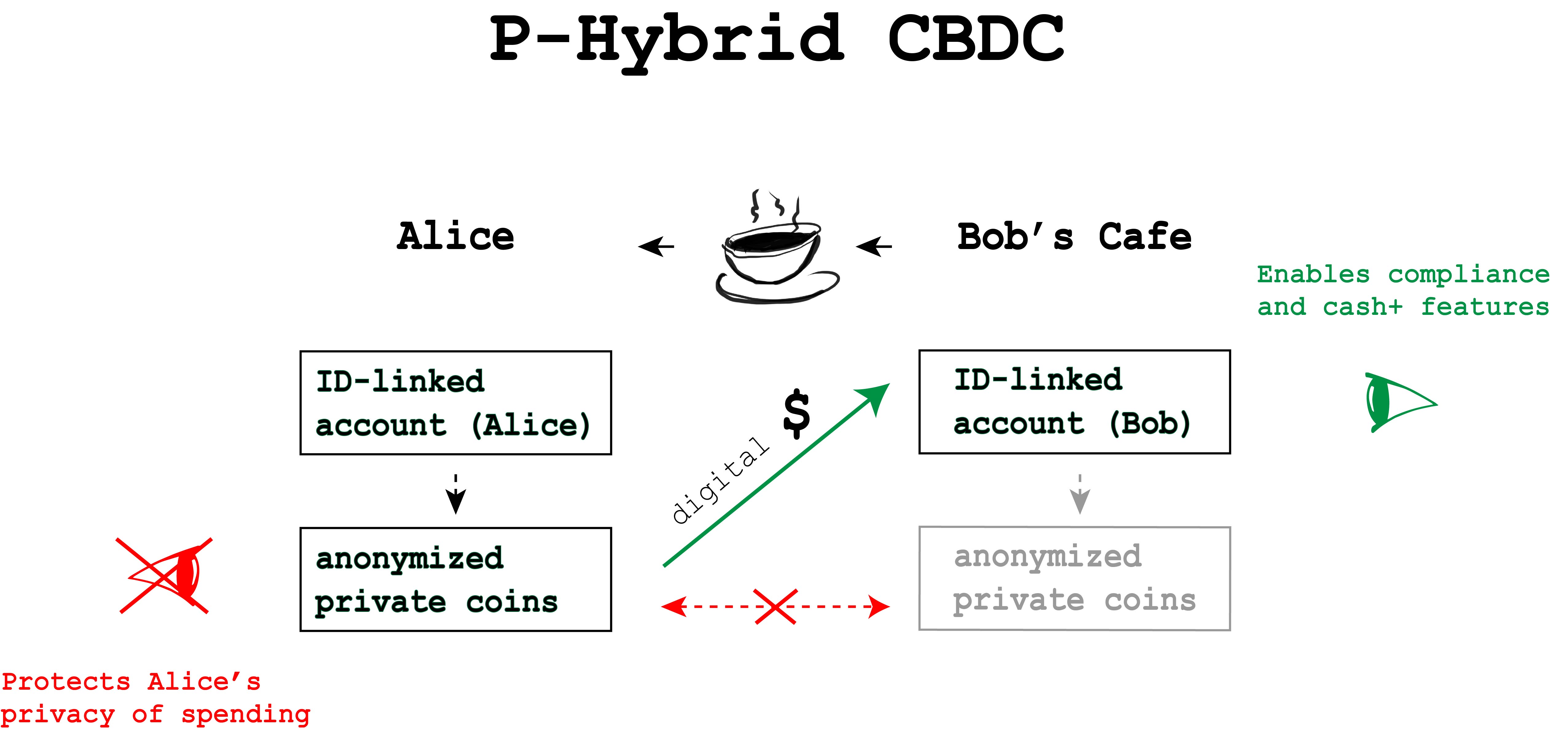
The privacy technology exists. A CBDC could use encryption, limited data collection, selective sharing of information and systems that separate payment processing from identity checks. Such measures can reduce the amount of data visible to the people running the payment network. Privacy-preserving CBDC designs are technically feasible, rather than merely theoretical (see Figure 1). 2
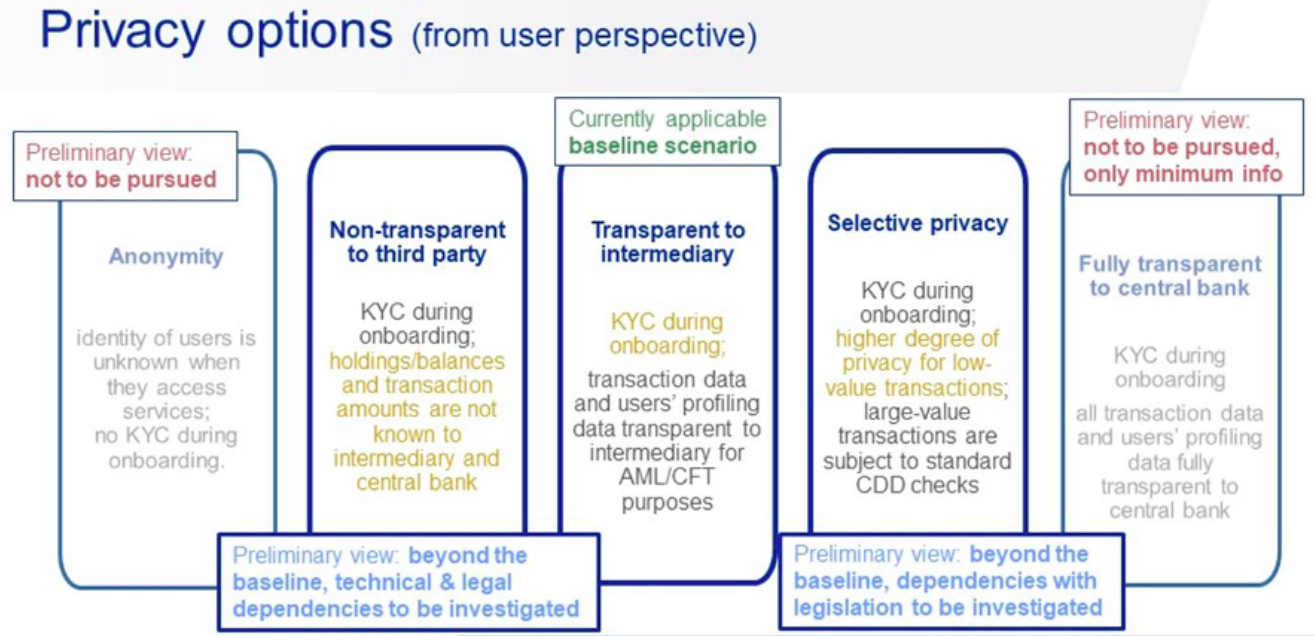
Plans for a digital euro offer one example. They have considered limiting the Eurosystem’s access to personal transaction details and offering stronger privacy for certain small offline payments. These proposals show that rules and technical choices could restrict routine access to data, even if they do not remove all access.
The case against
The biggest question is whether a CBDC would add much where digital payments already work well. In countries with cheap, widely used and interoperable instant bank-to-bank transfers, a CBDC may not be noticeably faster or less costly. The International Monetary Fund has argued that a CBDC’s value depends on the gaps in a country’s existing payment system, rather than flowing automatically from the fact that it is issued by a central bank. Existing instant-payment networks may already deliver many of the promised speed benefits. 3
Launching a CBDC could also create substantial new costs. Providers would need wallets, cybersecurity systems, identity checks, anti-money-laundering controls, customer support, fraud procedures and ways for merchants and banks to connect to the new system. Those fixed costs must be spread across enough users and transactions to make the system economical. Banking incentives, market competition, governance and public willingness to use the CBDC could all determine whether simpler settlement translates into real savings. Mass adoption may bring infrastructure and compliance costs that offset the expected gains. 4
Privacy protections have another limit: they can curb routine viewing of data, but they generally cannot prevent lawful access. Governments and regulators may still need information for anti-money-laundering and counter-terrorist-financing rules, tax enforcement, fraud cases, supervision, court orders or criminal investigations. Whether safeguards work in practice depends on how strongly laws are enforced, how institutions are governed and whether the protections endure over time. Legal privacy limits do not necessarily block government access when the law permits it. 5
The comparison also depends on what replaces what. A privacy-focused CBDC might expose less information to a central operator than some card or mobile-wallet systems. Yet it could create a more standardised channel for access than cash, or than today’s less connected private payment networks.
The bottom line
The evidence is balanced but conditional. CBDCs can plausibly improve retail payments where current systems are costly or inadequate, and they can be built to reduce routine exposure of transaction data. But there is no broad real-world evidence showing that retail CBDCs, after adoption, reliably deliver better average payment outcomes and avoid a statistically significant rise in government access to transaction data.
Most available evidence comes from proposals, surveys, experiments and legal or technical studies—not from wide post-launch comparisons. The central gap is a lack of before-and-after data on payment fees, settlement times, adoption, data collection, disclosure requests and actual government access. The claim is therefore not established as a general rule, though its two aims may be achievable in particular jurisdictions with the right payment gaps, design choices and enforceable safeguards.
Figures & data
All contributions are reviewed for clarity, balance, and evidence. The strongest insights are elevated into the argument graph — with credit to you.
Help improve this analysis →