AI systems can produce verifiable advances on novel mathematical problems rather than merely solve benchmark exercises
Too close to call
PRO 48%CON 52%
Pro 32% · Con 34% — Nuanced 34% — evidence mixed
What the evidence says Evidence quality: Pending
Graded from the quality of the cited sources · Evidence Protocol
Analysis in progress.
Figures & data
The evidence base behind this claim: 12 distinct cited sources
Every source cited on this claim, counted once at its highest evidence strength and grouped by the side it supports. Generated from this page's own evidence rows — the same records the verdict is computed from — so the chart and the score cannot disagree. Strength labels follow the scoring methodology.
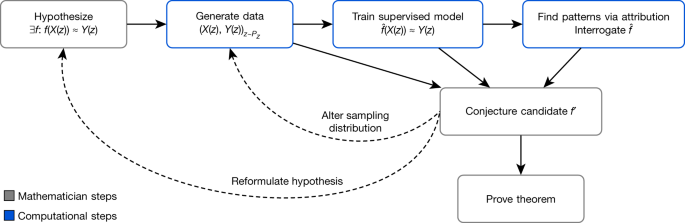
Davies et al. (2021) figure from Advancing mathematics by guiding human intuition with AI showing the machine-learning workflow that identified a previously unknown connection between knot invariants
The clearest landmark example of AI contributing to genuinely new mathematics: the model detected a non-obvious pattern, while mathematicians interpreted and proved the resulting conjecture. It directly illustrates the distinction between AI-assisted discovery and autonomous proof.
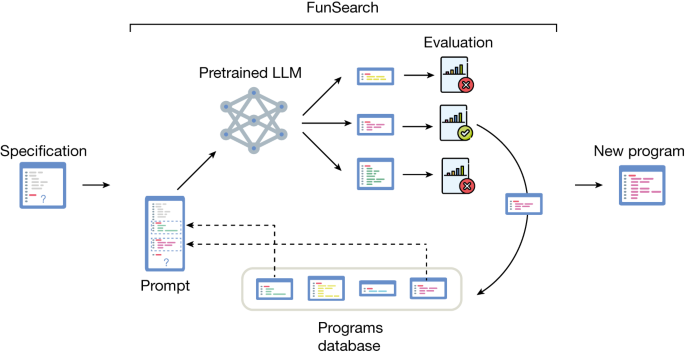
Romera-Paredes et al. (2024) FunSearch figure showing the LLM-plus-evaluator search loop and the quality of newly discovered programs for the cap-set problem and online bin packing, compared with prio
This is the strongest visual example in the evidence of an AI system producing verifiably improved mathematical constructions rather than merely answering benchmark questions. The evaluator establishes objective performance, while the human-designed representation and search setup make the limits of the claim visible.
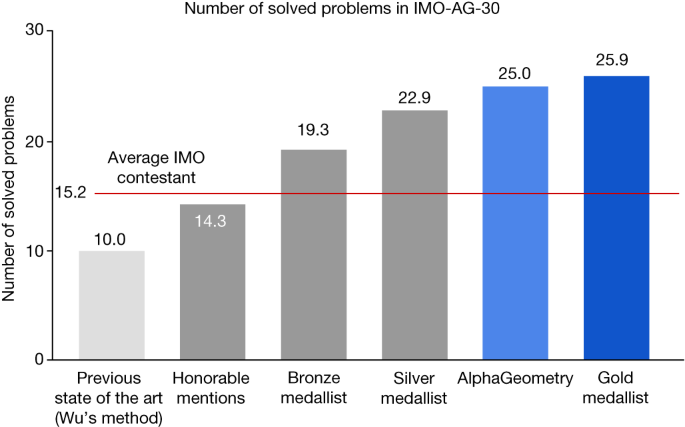
Trinh et al. (2024) AlphaGeometry performance chart comparing the number of International Mathematical Olympiad geometry problems solved by AlphaGeometry with previous automated systems and human-leve
The iconic benchmark figure for high-level machine-generated mathematical proofs: it demonstrates substantial novel proof construction and formal verification, while the curated olympiad setting helps readers distinguish contest performance from open-ended research discovery.
All contributions are reviewed for clarity, balance, and evidence. The strongest insights are elevated into the argument graph — with credit to you.
Help improve this analysis →